












 About Us
 Brand
Brand
 Career
 Contact Us



 +91-7314623098







We’ve all been in this meeting before. Staring at turnover numbers, trying to explain why hiring costs are up again, and why it’s still taking too long to fill critical roles. Instinct says something’s off, but gut-feels don’t win boardroom debates.
That’s where HR benchmarking comes in. It’s not just a spreadsheet full of ratios; it’s a reality check. Comparing your HR performance against industry data helps cut through guesswork and anchor decisions in what’s actually working elsewhere.
When paired with a solid Human Resource Management System (HRMS), it becomes more than a tracking tool. It becomes your edge. If you want a seat at the strategy table, it starts with knowing exactly where you stand—and how fast you can move.
What is HR Benchmarking?
HR benchmarking is a strategic process in which HR teams compare internal metrics, like employee satisfaction, attrition, and compensation, against industry standards or top-performing organizations.
The goal is to spot performance gaps and identify what can be improved or adapted. It helps decision-makers assess whether their current practices align with what drives results in similar companies. Traditional benchmarking models, however, often fall short in agile environments.
They rely on static comparisons that ignore how quickly business needs, workforce trends, and technology shift. Modern HR requires a more flexible, real-time approach to benchmarking that reflects the pace and complexity of today’s workplace.
Why HR Leaders Can’t Ignore Benchmarking
At a time where talent gaps evolve rapidly and expectations shift faster than policy updates, HR benchmarking gives leaders a sharper lens to evaluate and act. It replaces assumptions with clarity, pinpointing what actually moves the needle.
Here’s how it helps:
- Better Workforce Planning: HR benchmarking helps spot hiring trends early on and align workforce plans with future business needs, preventing reactive hiring and resource gaps.
- Data-Driven Decision Making: It provides real-time performance insights that allow HR leaders to back their strategies with solid data instead of relying on intuition.
- Compensation & Benefits Optimization: Benchmarking highlights how your pay structures compare with competitors’, making it easier to offer attractive, market-aligned compensation.
- Boosting Employee Engagement: Benchmarking helps identify the drivers of satisfaction and long-term retention by analyzing what top-performing teams are doing differently.
What are the Types of Human Resources Benchmarking?
To implement a successful HR benchmarking process, organisations must categorise their evaluation methods into distinct tracks. Utilising different types of HR benchmarking allows human resource teams to look at their internal data through multiple analytical lenses.
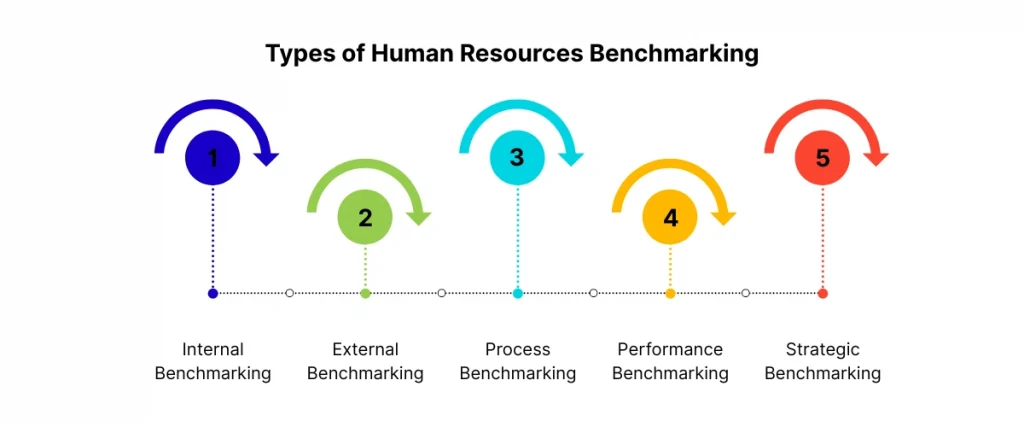
Internal Benchmarking
This process involves comparing identical metrics across different departments, branches, or regional offices within the same company. For example, an HR leader might compare the time-to-hire or employee turnover rate of a sales team in one city against a sales team in another to pinpoint localised operational issues.
External Benchmarking
External analysis expands your view outside company walls to evaluate your internal processes against your direct industry competitors or broader market averages. This method ensures your talent acquisition strategies, remote work policies, and employee care packages remain competitive within your target hiring pool.
Process Benchmarking
Process-driven tracking goes beyond pure data points to analyse how HR work actually gets executed. Teams map out, study, and compare everyday workflows, such as onboarding tracks, performance evaluation steps, or safety protocols, against top-performing organisations to eliminate administrative bottlenecks.
Performance Benchmarking
This analytical track centres strictly on quantitative outcomes and key performance indicators (KPIs). Organisations use it to track financial and volume-based metrics, such as revenue per employee, total training hours completed, or payroll processing costs, against baseline standards.
Strategic Benchmarking
The most forward-looking approach, strategic alignment, evaluates how well human resource initiatives back up long-term corporate goals. This involves looking outside your specific niche to see how world-class companies structure their leadership pipelines, implement large-scale change management, or adapt to disruptive macroeconomic shifts.
What are the Benefits of HR Benchmarking?
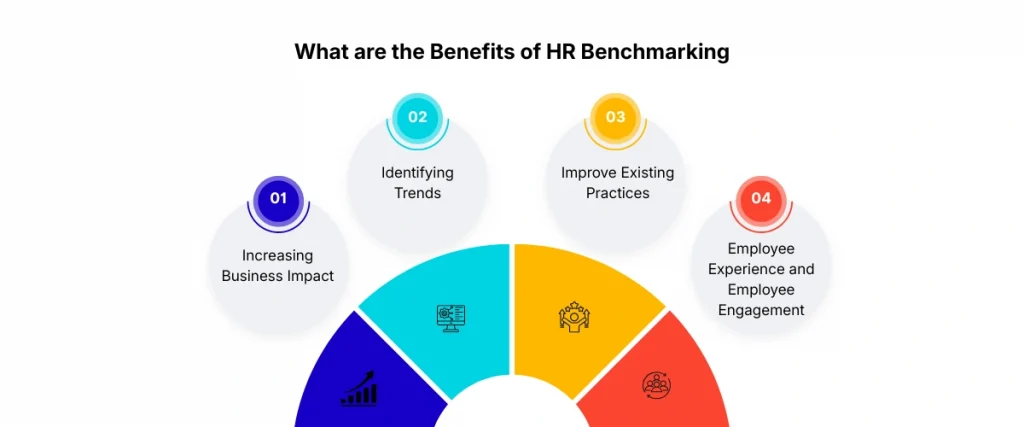
Increasing business impact
Moving past basic administrative tasks allows human resources to act as a core business driver. Proving that specific human capital initiatives directly boost organisational output turns HR into a strategic partner at the executive table.
Identifying trends
Consistently tracking historical data helps leadership spot brewing cultural and operational trends before they spiral into widespread systemic damage. It enables teams to catch early signs of rising absenteeism or shifting employee preferences in real time.
Improve existing practices
Deploying objective market data reveals exactly where internal workflows fall short. This clarity allows HR teams to systematically update outdated policies, optimise training programs, and fine-tune structural budgets with total confidence.
Employee experience and employee engagement
Comparing internal cultural sentiment against industry standards helps organisations refine their workplace experience. According to Gallup’s 2026 State of the Global Workplace Report, global employee engagement sits at a staggering low of 20%, costing the global economy an estimated $10 trillion in lost productivity. Benchmarking helps businesses buck this trend by highlighting the exact gaps in their culture that need immediate attention.
The HR Benchmarking Process: A Step-by-Step Guide
Getting real value from HR benchmarking depends on having a solid, structured process. You can’t just throw numbers around and hope something useful pops out. It starts with clarity—knowing exactly what you want to measure and why.
Here’s a step-by-step process to help you through:
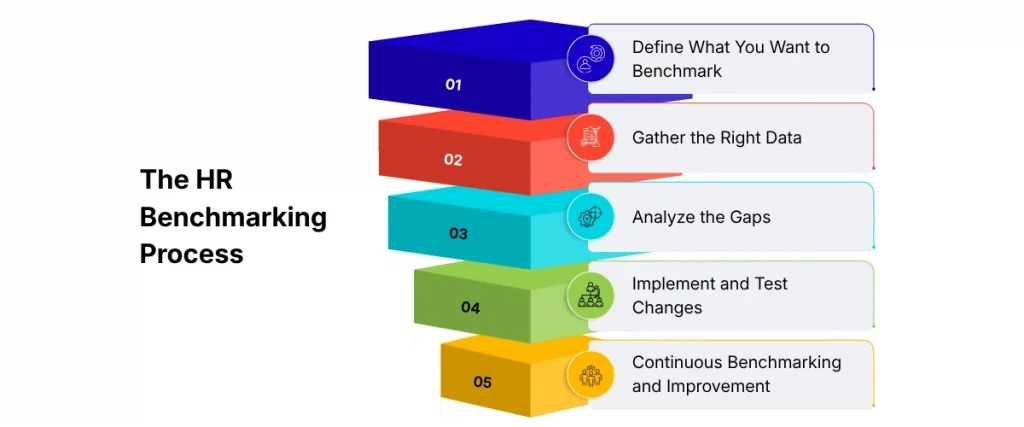
Step 1: Define What You Want to Benchmark
Before pulling data or comparing metrics, the first step is identifying which part of your HR function needs attention. Without a clear focus, benchmarking turns into noise. This step helps narrow your scope and makes the entire process more actionable.
Start by pinpointing your most pressing HR challenges.
- Are you struggling with high turnover in key roles?
- Is your talent acquisition process taking too long?
- Are your DE&I efforts stalling without measurable adoption?
All of these are valid starting points for benchmarking.
For example, if employee productivity has dropped across departments, you might benchmark performance metrics like output per employee or absenteeism rates. If diversity hiring is stagnant, compare your DE&I ratios against industry standards to see where the gaps are.
Defining what to benchmark ensures you’re not wasting time chasing irrelevant data. It directs the process and ensures comparisons produce a clear, actionable outcome.
Step 2: Gather the Right Data
Once you’ve decided what to benchmark, the next step is to collect the right data. This step matters because poor data equals poor insights.
You need a mix of internal and external sources to get a full picture of what’s happening in your company and how it compares to the market. For streamlined extraction and better comparability, a reliable Web scraper API can help you gather external benchmarking data efficiently, ensuring consistency and depth while keeping the tone informational and non-promotional.
Here’s a breakdown of where to look:
Internal Data Sources
| Source | What It Reveals | Use Case |
| Employee Surveys | Engagement, satisfaction, morale | Identify culture issues or burnout signs |
| Performance Data | Productivity levels, goal achievement | Benchmark output across departments |
| Exit Interviews | Reasons for attrition, management feedback | Spot patterns in turnover |
| Recruitment Metrics | Time to hire, cost per hire | Measure talent acquisition efficiency |
| HRIS & HRMS Tools | Centralized HR metrics and trend data | Pull clean, consistent internal benchmarks |
External Data Sources
| Source | What It Provides | Use Case |
| Industry Reports | Market averages, best practices | Compare metrics like attrition or DE&I rates |
| Salary Benchmarking Tools | Pay scale comparisons by role and region | Ensure competitive compensation |
| HR Tech Analytics Platforms | Aggregated performance and trend data | Spot where you lag vs peers |
| Professional HR Networks | Peer comparisons, qualitative benchmarks | Gather informal insights |
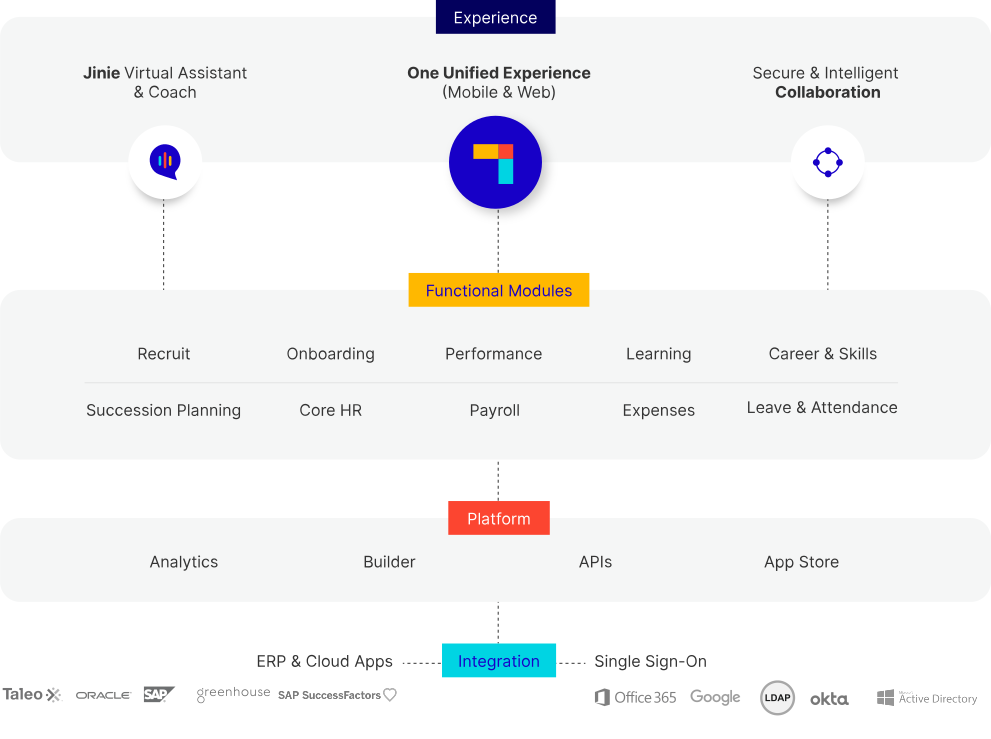
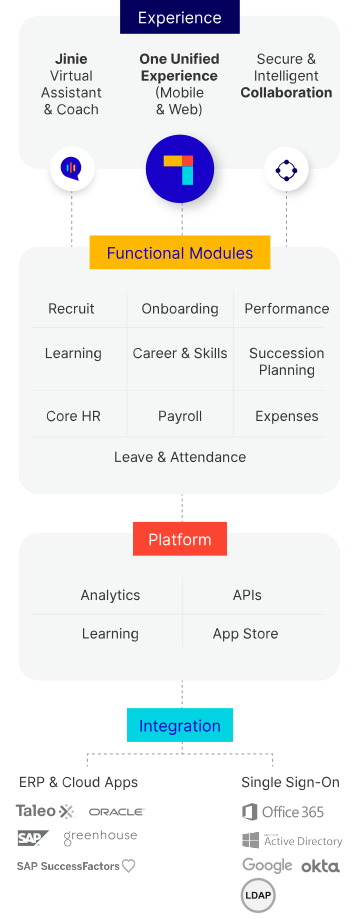
This is where PeopleStrong’s unified platform makes a difference. With built-in Analytics and seamless integrations across your HR tech stack, it ensures your data is clean, connected, and ready for real-time benchmarking. No more juggling between multiple spreadsheets.
Step 3: Analyze the Gaps
Once you’ve gathered your internal and external data, the real work begins—making sense of it. Benchmarking is only useful if it leads to action, and that starts by identifying performance gaps. Look for areas where your metrics fall short compared to industry averages or top performers. But don’t just focus on the number—ask why the gap exists.
For example, say your turnover rate is significantly higher than the industry average.
Dig deeper:
- Are exit interviews pointing to poor leadership?
- Does your compensation data show you’re underpaying compared to the market?
- Or is employee engagement low because of limited career progression or a toxic team culture?
Each of these signals point to a different solution.
Use both qualitative and quantitative data to cross-verify the root causes. A drop in engagement paired with a spike in exits is more telling than either metric alone. Look for consistent patterns across departments, periods, or roles.
Next, create a focused list of improvement areas based on the data, not assumptions. That list becomes your blueprint for targeted action—whether it’s reworking your hiring strategy, redesigning roles, or improving manager training.
Step 4: Implement and Test Changes
Benchmarking gives you the “what”—but implementation and testing tell you if it actually works in your context.
Once you’ve identified what’s not working, the next step is to fix it, without derailing what’s already in motion. Implementation doesn’t have to mean overhauling your entire HR function.
Start small. First, apply the insights from your benchmarking in a controlled, low-risk area, like piloting a new onboarding process in one department or adjusting salary bands in a specific role cluster.
Once the upgrades are in place, measure their short-term and long-term impact. For short-term results, look at immediate data shifts (e.g., a drop in time-to-hire or improvement in survey scores). For long-term effects, track trends over multiple quarters: retention rates, engagement levels, and performance outcomes.
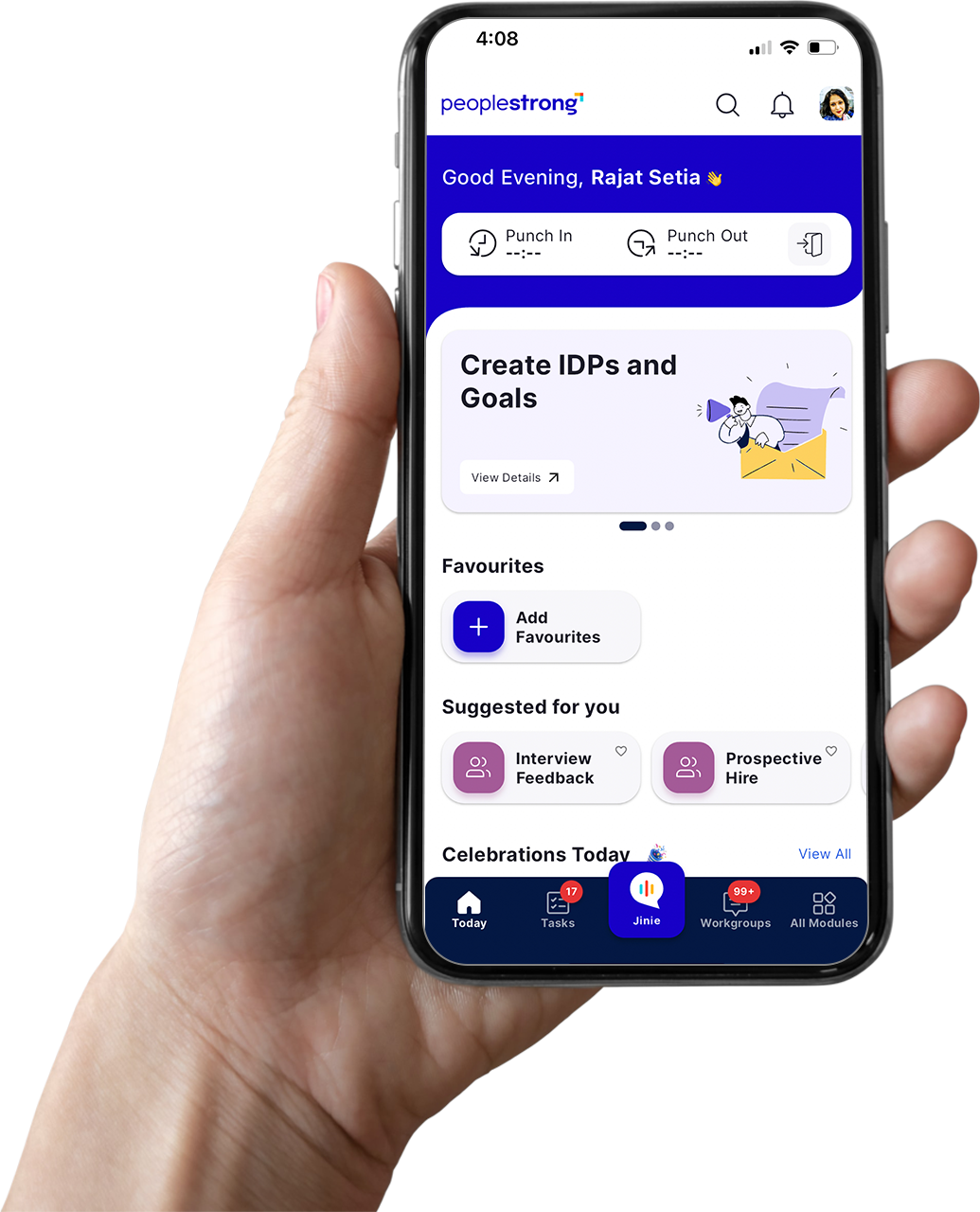
Softwares like PeopleStrong allow you to test and roll out process improvements across departments without disrupting daily operations. And with Jinie, the in-app Gen-AI bot, employees can learn new policies or workflows instantly, improving adoption rates from day one.
Step 5: Continuous Benchmarking and Improvement
Change is constant—new tools roll out, employee expectations evolve, and competitors adjust their strategies. If your benchmarking data is outdated, your decisions will be too. That’s why building a regular benchmarking cycle matters.
Depending on your company’s size and pace, this can be quarterly, biannually, or annually. Fast-growing organizations might benefit from more frequent check-ins, while more stable environments might work with twice-a-year reviews.
Set a schedule and stick to it. Define clear goals for each review cycle—like revisiting your compensation data in Q1, or tracking diversity hiring trends in Q3. Use consistent KPIs to make comparisons easier over time.
PeopleStrong’s Gen AI for HR and intelligent collaboration tools help you build a continuous improvement loop. With personalized nudges, on-demand data, and a frictionless mobile experience, your HR team is never out of sync, even between review cycles.
HR Benchmark Examples
Organisations look to specific HR benchmark examples to ground their performance metrics in real-world contexts:
Engagement Benchmarks
- Metric: Employee Net Promoter Score (eNPS) or annual satisfaction ratings.
- Context: Comparing your team’s psychological safety and connection scores against regional competitors to maintain a healthy, high-performing corporate culture.
Retention Benchmarks
- Metric: Voluntary and involuntary annual turnover percentages.
- Context: Evaluating how well you keep top talent. Recent data from Mercer highlights that average voluntary turnover moderated to 13.0% globally, giving companies a vital target to measure their attrition against.
Cost Benchmarks
- Metric: Cost-per-hire and total HR administrative spend per employee.
- Context: Tracking your hiring budgets against industry standards to ensure recruiting pipelines remain lean, optimised, and financially sustainable.
Compensation Benchmarks
- Metric: Median salary bands, equity distribution, and health benefit packages.
- Context: Monitoring local pay premiums. For instance, the SHRM-Keka India HR Pay Pulse Report documented a 24% increase in median HR salaries over a five-year period, underscoring the rising premium placed on strategic people management.
DE&I Benchmarks
- Metric: Gender pay equity ratios and diversity representation across leadership tiers.
- Context: Measuring internal inclusion milestones against global corporate averages. Research from McKinsey shows that organisations scoring in the top-quartile for diversity are 39% more likely to financially outperform their less diverse peers.
Best Practices for Effective HR Benchmarking
Doing HR benchmarking isn’t hard. Doing it right is.
Many HR teams collect data, run comparisons, and still end up with vague insights that don’t change anything. The difference lies in the approach.
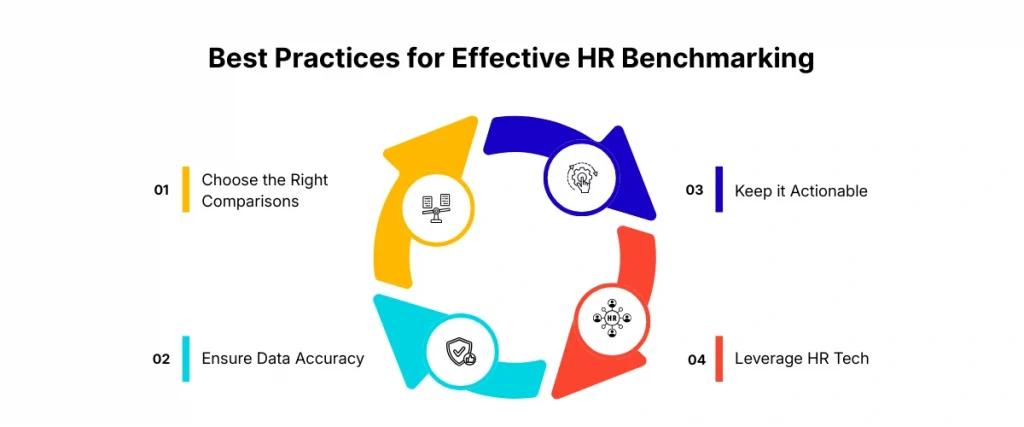
Here are some key practices to make your benchmarking efforts actually useful:
1. Choose the Right Comparisons
Benchmarking only works when you’re measuring against the right peer group. Avoid comparing your 200-employee tech startup to a 10,000-strong legacy enterprise in a different industry.
Use relevant filters—company size, geography, industry, or growth stage—to make the data meaningful. For example, if you’re in early-stage growth, benchmark against similar high-growth firms, not long-established giants with different priorities.
2. Ensure Data Accuracy
Your insights are only as good as your inputs. Inaccurate, outdated, or poorly categorized data skews everything. Before comparing metrics, check the source.
- Are your HRIS systems up to date?
- Are you comparing apples to apples (e.g., voluntary vs. total attrition)?
If the data’s messy, the conclusions will be too.
3. Keep it Actionable
Benchmarking shouldn’t be a report you file and forget. Focus on extracting insights that tie directly to decisions—raising offer packages, shifting recruitment strategy, or redesigning performance reviews. Every benchmarking effort should answer: “What do we do next?”
4. Leverage HR Tech
Trying to compare spreadsheets from different quarters and companies manually is a slow grind. Use tools that simplify the process. Platforms like PeopleStrong help you champion AI-driven analytics, real-time dashboards, and industry benchmarking built into their HRMS.
These tools automatically identify gaps and flag areas that need attention. They remove the guesswork. Instead of hunting for data, you focus on interpreting and acting on it.
How Technology and AI Are Transforming HR Benchmarking
AI-Powered Analytics
Artificial intelligence instantly processes millions of unstructured data points, turning messy feedback loops into clear, actionable cultural insights. It automatically categorises complex sentiment data, allowing HR teams to see the exact themes driving organisational trends.
Real-Time Benchmarking
The old approach of waiting for lagging annual reports is fading fast. Modern digital infrastructure gives leadership access to real-time data feeds, making it easy to compare internal metrics against live market changes as they unfold.
Predictive Workforce Insights
Advanced machine learning models look at current benchmarks to forecast future talent developments. By flagging subtle patterns in team feedback and operational output, these tools warn leadership about potential retention risks months before an employee hands in their resignation.
Automated HR Reporting
Automated HR software solutions eliminate manual spreadsheet work by compiling and formatting regular performance reviews on its own. This operational shift gives HR professionals the breathing room to focus on high-level talent development and strategic culture building.
Get Started with HR Benchmarking Today
Not sure where to begin? You’re not alone. Many HR teams sit on tons of data but lack the tools to turn it into something useful. That’s where PeopleStrong’s HR Tech 4.0 comes in. It simplifies benchmarking with built-in analytics, real-time dashboards, and industry comparisons—all in one platform. With multiple views for CHROs, directors, managers & employees built-in across the ecosystem, decision-making has never been easier.
Whether you’re tracking attrition, compensation, or engagement, the system gives you clear, actionable insights without the manual hassle.
Ready to make better HR decisions backed by real data?
Request a demo today and unlock smarter workforce insights with PeopleStrong.
Frequently Asked Questions
Can benchmarking justify HR budgets?
Yes. Presenting hard, objective data that connects HR spending to reduced turnover and higher workforce productivity makes it easy to prove the financial return on investment (ROI) of people programs to executive leadership.
Which Type of Benchmarking is Better?
No single method fits every situation. Internal benchmarking is ideal for fixing localised team friction, while external and performance tracking are vital for ensuring your business stays competitive and financially optimised within the broader market.
Where does the benchmark data come from?
Data is gathered from trusted third-party industry studies, national labor statistics, secure corporate registries, vendor platforms, and collaborative professional associations like SHRM or McKinsey.
Why is HR benchmarking important for organisations?
It replaces executive guesswork with reliable, data-driven facts. Tracking your performance objectively helps your business manage labor budgets, fix hidden cultural problems, and build competitive workplaces that attract elite industry talent.
What are the key metrics used in HR benchmarking?
The most critical metrics track voluntary turnover percentages, time-to-hire speeds, cost-per-hire averages, employee net promoter scores (eNPS), revenue per full-time employee (FTE), and training investment per worker.
How do you conduct an HR benchmarking process?
Start by choosing your primary focus metrics, then pick your target internal or external comparison groups. Gather your data securely, analyze the performance gaps, build a practical corporate action plan, and track your ongoing progress regularly.
Can HR benchmarking improve employee retention?
It absolutely can. Consistently evaluating your internal workplace practices against external standards reveals where your compensation, management support, or flexibility programs fall behind. Fixing those specific gaps stops top talent from jumping ship to a competitor.