











 About Us
 Brand
Brand
 Career
 Contact Us



 +91-7314623098







The HR function has moved a long way from being a purely administrative department. In 2026, HR teams are expected to shape culture, retain talent in a tight and competitive job market, and use data to make decisions that used to be based on gut feeling. Getting there consistently comes down to following proven HR best practices, the kind of human resource practices that have been tested across organisations of every size and refined into repeatable habits. This guide walks through why these practices matter, breaks down five of the most important ones to prioritise, and lays out a practical roadmap for putting them into action.
What Are HR Best Practices?
Gartner research reveals a critical insight: 86% of HR leaders recognize that career paths within their organizations remain ambiguous for many employees. This underscores the imperative of adopting HR best practices that span from recruitment and onboarding to advanced techniques for employee engagement, retention, and continuous learning and development.
While specific HR best practices inevitably vary by company and sector, a consistent thread remains: enhancing employee experience in harmony with overarching organizational goals.
These best practices are powerful catalysts, directly improving employee satisfaction, retention rates, performance, and growth. As a core component of “performance ABC” they strategically drive attitudes, behaviors, and capability.
Companies that neglect robust HR management best practices face a stark risk: losing their most talented employees, with those who remain potentially experiencing diminished motivation. Ultimately, such organizational inertia can trigger a competitive downward spiral.
The impact of HR best practices
Good HR practices don’t just make life easier for the HR team; they show up directly in business outcomes. Organisations with strong hiring, onboarding, and communication practices tend to see lower attrition, faster time-to-productivity for new hires, and higher engagement scores across the board. Employees who feel fairly compensated and genuinely heard are less likely to disengage or leave, which reduces the cost and disruption of constant rehiring. On the flip side, weak or inconsistent HR practices tend to compound over time; a rushed hiring process leads to early attrition, a lack of onboarding structure slows down ramp-up, and poor communication erodes trust long before it shows up in exit interviews. The five practices below round out a complete picture of what good HR practices look like when they’re implemented well.
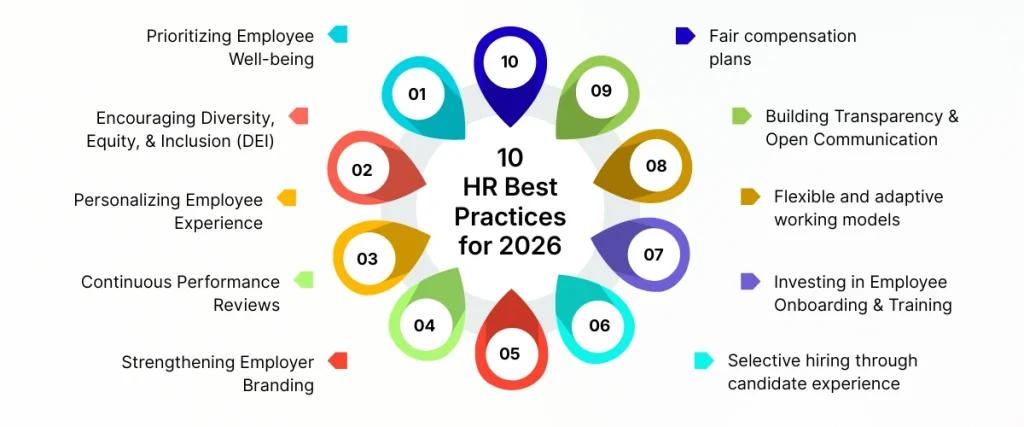
10 HR Best Practices for 2026
Here are the five best practices in HR that forward-looking professionals are putting into practice this year:
1. Prioritizing Employee Well-being
In 2025, employee well-being has evolved far beyond traditional perks like gym memberships and yoga days. It’s now a strategic imperative for HR departments, representing a comprehensive support system that addresses physical and mental health holistically.
Modern wellness programs must go beyond surface-level benefits. They should include robust mental health support services, professional counseling, stress management resources, and flexible policies like hybrid work options. These approaches are critical for addressing emerging workplace challenges such as burnout and job-related stress.
Integrating comprehensive well-being practices into HR strategies isn’t just compassionate—it’s a competitive advantage. Companies that create a culture of genuine support and value are more likely to increase employee loyalty, engagement, and productivity. When employees feel truly supported, they’re motivated to deliver superior performance.
By 2025, HR departments that prioritize holistic well-being will distinguish themselves. They’ll transform employee support from a checkbox exercise to a strategic cornerstone of organizational success.
2. Encouraging Diversity, Equity, & Inclusion (DEI)
Diversity, Equity, and Inclusion (DEI) represents a system where every individual, regardless of background or identity, receives equal treatment and opportunities for growth—without favoritism.
Forward-looking enterprises recognize DEI as more than a trend; it’s a core driver of organizational success that HR departments must actively promote across all operational areas.
The strategic advantage of this HR best practice is clear: a diverse workforce generates unique perspectives, drives innovation, enhances decision-making, and strengthens company culture. This approach creates an environment where every individual feels genuinely valued, irrespective of background, race, gender, sexual orientation, or disability status.
To implement effective DEI strategies, HR departments should focus on:
- Inclusive Hiring Practices: Mitigate recruitment bias by evaluating candidates solely on skills and experience, challenging unconscious preferences.
- Training and Education: Conduct regular DEI sessions exploring unconscious bias, systemic inequality, and empathy, ensuring employees understand and support inclusive practices.
By collaborating with employee associations and voluntary groups, organizations can develop robust DEI policies. The result? More innovative workplaces that attract top talent while enhancing internal and external reputation and loyalty.
3. Personalizing Employee Experience
Employee experience personalization emerges as a critical HR best practice for 2025, focusing on tailored experiences that align with individual preferences. Leveraging new technology, HR departments can customize the entire employee journey from onboarding through continuous development.
Gone are the days of one-size-fits-all approaches. Modern employers recognize that each employee harbors unique motivations and challenges, demanding personalized strategies.
Personalization can manifest through:
- Onboarding adapted to individual learning styles
- Career development paths aligned with specific skills and aspirations
- Targeted training programs addressing individual needs
AI-driven platforms and data analytics now enable HR professionals to gain deep insights into individual preferences and behaviors. These technologies empower the creation of distinctive, personalized employee experiences that enhance engagement and professional growth.
For example:
- New hires may receive tailored onboarding schedules that fit their preferred learning pace.
- An employee who wants to improve specific skills could be given a targeted training plan.
Naturally, taking steps to develop personalized approaches makes employees feel valued. The company’s retention rates will improve, and the staff will make greater efforts to meet goals.
4. Continuous Performance Reviews
In the past, annual performance reviews were the norm. However, many organizations nowadays have come to understand the issues with this system. HR departments are moving towards a continuous feedback system of performance reviews for effective insights into employees.
This approach ensures that employees receive feedback on time. It allows them to improve throughout a given period and not wait to find out how they are performing when it may be too late to change.
Continuous performance reviews allow HR departments to access regular and timely data on employee performance and identify areas for improvement.
Here are some tips for continuous performance reviews.
- Regular Discussions: Department heads should conduct monthly or quarterly check-ins to:
- Discuss employee progressSet future goalsProvide constructive feedbackEnable proactive performance improvement before challenges escalate
- Gain comprehensive performance perspectivesIdentify improvement areas more effectivelyCreate a holistic evaluation framework
- Dynamic goal modificationResponsive responsibility realignmentTimely objective achievement
5. Strengthening Employer Branding
Employer branding has become a strategic imperative for modern HR departments. A compelling employer brand doesn’t just attract top talent—it cultivates a thriving workplace culture that sustains long-term success in today’s competitive landscape.
Building a powerful employer brand requires deliberate action: celebrating employee achievements, demonstrating core values like fairness, and creating clear pathways for professional growth. The goal is to foster an environment where employees become natural brand ambassadors, proudly sharing their experiences.
When employees feel genuinely valued and engaged, they become powerful advocates for your organization. This authentic advocacy strengthens your reputation both internally and externally, creating a self-reinforcing cycle that attracts and retains exceptional talent committed to building their careers with your company.
6. Selective hiring through candidate experience
Selective hiring isn’t just about raising the bar for who gets hired; it’s about how well the hiring process itself reflects the organisation’s standards. A rushed, disorganised, or unresponsive candidate experience signals a lot about what it might be like to actually work somewhere, and top candidates increasingly factor this into their decision. Being selective means clearly defining what success looks like for a role before opening it up, structuring interviews so every candidate is assessed against the same criteria, and closing the loop with every applicant, not just the ones who get an offer. Organisations that invest in this tend to see stronger long-term retention, since candidates who accept an offer already have realistic expectations of the role and the culture.
7. Investing in Employee Onboarding & Training
The first few months of employment set the tone for how long someone stays and how quickly they become productive. A strong onboarding programme goes beyond paperwork and laptop setup; it includes structured role-specific training, clear 30-60-90 day goals, regular check-ins with a manager or buddy, and enough context about the company’s mission and culture that new hires feel like they belong rather than just showing up. Training shouldn’t stop after onboarding either; continuous learning and reskilling opportunities matter more in 2026 than ever, given how quickly job requirements are shifting alongside new tools and technologies. Companies that treat onboarding and training as ongoing investments, rather than one-time events, consistently see faster ramp-up times and lower early attrition.
8. Flexible and adaptive working models
Flexibility has moved from a competitive perk to a baseline expectation in many industries. This doesn’t mean every organisation needs to go fully remote; it means giving employees meaningful choice in how, when, and sometimes where they work, whether that’s hybrid schedules, flexible hours around core collaboration windows, or results-based performance measurement rather than strict time-tracking. Adaptive working models also mean being willing to revisit policies as circumstances change, rather than locking in a single approach indefinitely. Organisations that get this right tend to see broader talent pools, since they aren’t limited to candidates within commuting distance, along with higher retention among employees balancing work with caregiving or other responsibilities.
9. Building Transparency & Open Communication
Employees consistently rank honest, two-way communication as one of the biggest factors in how much they trust their leadership. This means being upfront about company performance, changes in strategy, and the reasoning behind decisions that affect people’s day-to-day work, not just sharing good news and staying quiet during difficult periods. Open communication also means creating real channels for employees to raise concerns or ask questions and actually seeing those channels used, whether through regular town halls, anonymous feedback tools, or accessible leadership office hours. Where communication is inconsistent or filtered too heavily, rumour and uncertainty tend to fill the gap, which erodes trust far more than difficult news delivered honestly.
10. Fair compensation plans
Compensation remains one of the most direct signals of how much an organisation values its people, and fairness here goes beyond simply paying competitively. It means having a clearly defined, consistent structure for how pay is determined across similar roles and experience levels, conducting regular market benchmarking so pay doesn’t quietly fall behind, and being transparent about how raises, bonuses, and promotions are decided. Pay equity, ensuring people doing comparable work are compensated comparably regardless of gender, background, or other non-performance factors, has also become a growing area of scrutiny, both from employees and regulators. Organisations that get compensation right reduce one of the most common and preventable reasons people leave for a competitor.
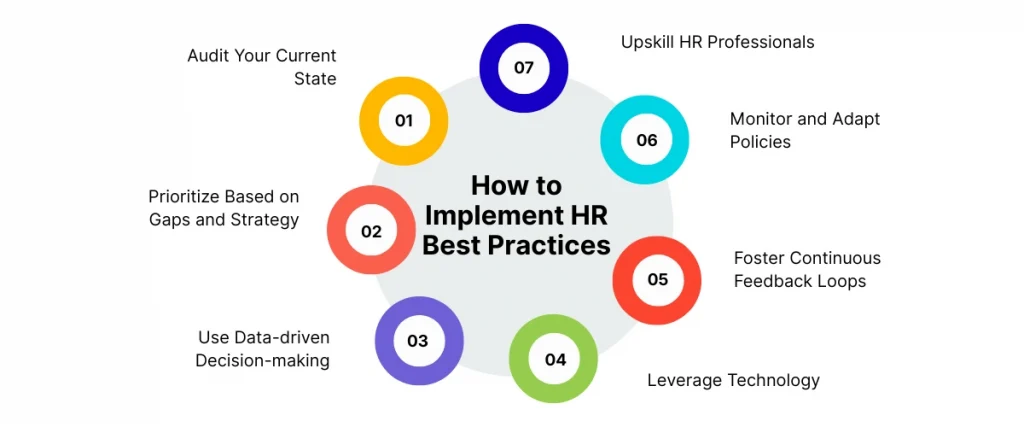
How to implement HR best practices
Knowing what good practices look like is only half the challenge; the harder part is rolling them out in a way that actually sticks. Here’s a practical sequence for implementation.
Audit your current state
Before changing anything, get an honest picture of where things stand today. This means reviewing current policies, gathering feedback from employees and managers, and looking at hard data like attrition rates, time-to-hire, and engagement survey results. An audit reveals which practices are already working reasonably well and which ones are quietly costing the organisation in ways that haven’t been fully measured yet.
Prioritize based on gaps and strategy
Not every gap needs fixing at once, and trying to overhaul everything simultaneously usually leads to half-finished initiatives. Once the audit is complete, rank the gaps by both severity and alignment with broader business priorities, if retention in a specific department is bleeding talent, that likely deserves attention before a lower-urgency policy update elsewhere.
Use data-driven decision-making
Every major HR decision, from compensation adjustments to onboarding redesigns, should be grounded in actual data rather than assumptions. This means tracking metrics like attrition by department, time-to-productivity for new hires, engagement scores over time, and the outcomes of past initiatives, so that future decisions build on evidence rather than guesswork.
Leverage technology
Modern HRMS platforms make it realistic to track, automate, and analyse the practices above at scale, from applicant tracking and onboarding workflows to compensation benchmarking and pulse-survey tools. Technology doesn’t replace good judgment, but it removes a huge amount of manual effort and inconsistency, freeing HR teams to focus on the parts of the job that genuinely require human judgment.
Foster continuous feedback loops
Best practices shouldn’t be rolled out once and left untouched. Building regular feedback mechanisms, pulse surveys, skip-level meetings, exit interview analysis, and open forums, ensures HR stays aware of how policies are actually landing with employees, rather than assuming a policy is working just because it was implemented.
Monitor and adapt policies
Business needs, workforce expectations, and even labour regulations shift over time, and HR practices need to shift with them. Setting a regular cadence, quarterly or annually, to formally review policies against current data and employee feedback keeps practices from becoming outdated or misaligned with what the organisation actually needs.
Upskill HR professionals
HR teams can’t implement modern best practices with outdated skill sets. Investing in training for HR professionals themselves, in data analysis, new HR technology, employment law updates, and evolving people-management approaches, ensures the team driving these changes is equipped to execute them well, rather than relying on practices that were current a decade ago.
How Can Data Help to Shape HR Practices in 2025?
A major shift in the way HR departments can implement best practices properly is by the efficient use of data through performance management software. A notable example is the use of Artificial Intelligence (AI). The most progressive companies nowadays use AI methods with a high degree of success.
By analyzing such AI-driven data along with the right tech implementation, HR departments can gain deep insights into employee performance and find ways of improvement. They can identify problems well in time and make better decisions. Here are some ways to do this.
- Optimizing Recruitment: AI-powered tools can screen resumes, check candidate fitness, and calculate success based on previous hiring data. The result is more efficient recruitment and a better match between candidates and roles. The recruitment process becomes speedier and more accurate.

- Personalized Employee Experiences: Data can assist HR in creating custom experiences for employees. They can spot preferences, skill gaps, and aspirations. Learning and development programs, for example, can be created to meet individual needs.
- Workforce Planning & Skill Gap Analysis: With predictive analytics, HR can understand the company’s skill gaps and forecast future needs. This data-driven approach enables them to plan for tomorrow and be ready for potential challenges.
- Employee Health Monitoring: Comprehensive data can help the HR department monitor employee well-being. Methods and surveys can be designed to track metrics of stress levels, absenteeism, and engagement. Professionals can intervene and offer solutions to combat burnout before it interferes with health and productivity.

In Summary
In the last few years, the HR environment has been changing rapidly. It is no longer only about recruitment and staffing. Companies need to adopt proper HR best practices in 2025 if they want to remain competitive and attract and retain the best talent for their needs.
These best practices include:
- An emphasis on workplace well-being throughout the company
- Welcoming diversity and inclusion in the workplace
- Creating personalized employee experiences
- A system of continuous performance reviews
- Strengthening employer branding
Such steps help the HR department to create a workplace where employees grow and thrive.
With proper use of data and technology, HR departments can take these practices to the next level. They can optimize recruitment, enhance engagement, and shape a workforce for tomorrow.
For organizations aiming to implement HR best practices effectively, PeopleStrong provides a comprehensive suite of solutions designed to make HR smarter, more efficient, and focused on employees. We empower your HR teams to streamline workflows and build a talent workforce that’s ready for the future.
Get in touch with us today to discover more!

Frequently Asked Questions
What are some general best practices that HR teams should follow in 2026?
Beyond the ten covered in this guide, HR teams in 2026 should prioritise data-informed decision-making, mental health and well-being support, pay transparency, skills-based hiring and development, and adaptive policies that can evolve alongside changing regulations and workforce expectations. The common thread across all of these is treating HR as a strategic function rather than a purely administrative one.
Why is employee well-being an important issue in 2026?
Burnout, financial stress, and blurred work-life boundaries remain widespread concerns, and organisations that ignore well-being tend to see it show up as absenteeism, disengagement, and attrition. Investing in well-being, through flexible schedules, mental health resources, and manageable workloads, has become closely tied to retention and productivity, making it a business priority rather than just a wellness initiative.
Why should HR departments consider continuous performance reviews?
Unlike the older system of only annual reviews, continuous performance reviews mean regular and timely feedback. Necessary adjustments to personal goals and development can be made before it is too late. With regular feedback, employees can adjust their ways of working, so that they meet expectations.
How can data and analytics improve HR practices nowadays?
By using AI-powered tools to crunch workforce data, HR can spot trends, customize learning, and predict talent needs. They can take these steps to address issues before they arise and escalate.
What are HR practices important?
HR practices are important because they directly shape whether an organisation can attract, retain, and get the best out of its people. Weak practices lead to higher turnover, disengaged employees, and inconsistent decision-making, while strong human resources best practices create a more predictable, trust-based environment where people are motivated to stay and perform well.
What is best practice approach?
A best practice approach means adopting methods and processes that have been tested and proven to produce consistently good outcomes across organisations, rather than relying on ad-hoc or reactive decision-making. In an HR context, this means using established, evidence-backed approaches to hiring, onboarding, compensation, and communication instead of reinventing the wheel for every situation.
How do you know if your best practices are actually working?
The clearest signal comes from tracking measurable outcomes over time, attrition rates, time-to-hire, employee engagement scores, internal promotion rates, and feedback from exit interviews. If these metrics are improving or holding steady in a positive direction after a practice is implemented, it’s a strong sign the practice is working; if they stagnate or worsen, it’s worth revisiting the approach.
What are the Benefits of Implementing HR Best Practices?
Organisations that consistently apply strong HR practices tend to see lower attrition, faster and smoother onboarding, higher employee engagement, stronger employer branding that makes future hiring easier, and better alignment between people decisions and overall business strategy. Over time, this also translates into cost savings, since preventing turnover and disengagement is consistently cheaper than dealing with their downstream effects.