











 About Us
 Brand
Brand
 Career
 Contact Us



 +91-7314623098



Over the past few months, we have been travelling across India, meeting HR leaders who are in the middle of their AI journeys. Some are just starting out. Others are two or three pilots in, trying to figure out why things have not moved the way they expected.
While the use of conversational AI models is common, purpose-built tools are still struggling to get going. The HR teams have invested time and effort in identifying vendors and pilots and in building internal buy-in; most projects slow down during implementation. The most quoted bottleneck is often their HR Tech stack.
The AI Ground Report 2026, built from a survey of 500+ HR leaders across India, reflects this.
What the Data Tells Us About Who Is Actually Winning on AI
The report mapped organisations across two dimensions: how actively they adopt AI and the quality of the HR technology stack supporting it. The quadrant below shows this mapping.
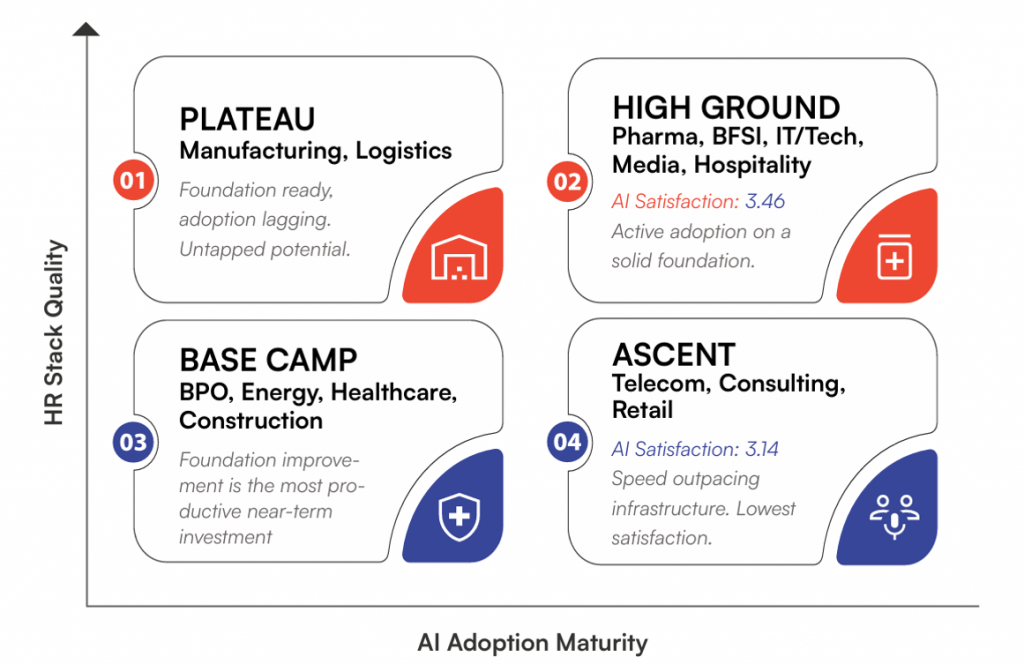
The High Ground organisations sit in the top right: high adoption paired with high stack quality. Their average stack quality score is 3.57 out of five. 53% are fully confident in their HR technology strategy. Their average AI satisfaction score is 3.46.
Directly across from them sit the Ascent organisations. These are among the most active AI adopters in the entire study, running more concurrent initiatives than most, investing seriously, and moving fast. Their stack quality sits closer to 3.03. Only 18% express full confidence in their HR technology strategy. Their average AI satisfaction score is 3.14.
The stack determines the outcomes
The Ascent group is not a cautionary tale about organisations doing AI poorly. They are doing a great deal of it. The numbers reveal that activity without a foundation produces a satisfaction ceiling. The cost of deploying AI on a stack that was not ready to support it shows up directly in the outcomes.
The extensibility data makes this concrete. Organisations with easy-to-extend HR stacks are six times more likely to have AI live at scale. Among High Ground organisations, that agility is built in. Among Ascent organisations, the pace of adoption is outpacing what the architecture can reliably deliver.

Why the Foundation Work Cannot Be Skipped
When we ask HR leaders who are satisfied with their AI outcomes what they did differently, the theme of consolidation comes up consistently. Fewer, better-integrated platforms. Data that did not need to be manually stitched together for every new initiative.
Only 7% of organisations have yet to make name consolidation a top priority. By the piloting stage, that figure is 32%. Among already-live organisations, 31% say they would have consolidated first if starting over. The further along the journey, the more emphatic the answer.
We have seen organisations pause their AI roadmap, clean up their HR stack and their data layer, and then return to AI, moving significantly faster than before. But this process takes time and further investment. From the outside, it looks like they lost six months. From the inside, the programme finally has a foundation worth building on.
The Organisations Getting This Right Are Playing a Longer Game
AI success takes time and a lot of unglamorous work to sort out the technology and data layers first. This builds the foundation required for faster progress, not just on AI. Organisations have been on the hunt for tools to incorporate intelligence into daily workflows.
For HR leaders still working through their first or second pilot, the research offers a clear direction. The step back is not a delay. For the organisations that have adopted it, it has consistently proven to be the fastest route to lasting outcomes. Organisations willing to endure this necessary pain will be rewarded in the long run.
The AI Ground Report 2026 provides the insights you need, distilled from a survey of 500+ leading organisations in India. The report looks at the AI adoption landscape, what the successful organisations are doing, and where they are focusing their investments.
📥 Download the full report to read more : The AI Ground Report 2026