











 About Us
 Brand
Brand
 Career
 Contact Us



 +91-7314623098






A strong employee experience increases engagement, productivity, and retention. Employees who feel valued contribute more, stay longer, and strengthen the company’s success. Many businesses overlook how daily interactions, workplace culture, and leadership support shape an employee’s motivation and performance.
Every stage of the employee journey—from hiring to career growth and beyond—affects how people feel about their work. Strong communication, opportunities for development, and recognition programs create a workplace where employees want to stay and succeed. Companies that focus on these areas see fewer resignations, higher output, and a stronger employer brand.
Organizations that invest in improving employee experience build a workforce that drives long-term success. Engaged employees perform better, share ideas, and create a positive work culture. A weak experience leads to disengagement, high turnover, and lost productivity. Structuring an employee experience framework helps businesses shape an environment where employees thrive.
What is Employee Experience?
Employee experience describes how employees feel about various organizational factors such as leadership, trust, respect, communication, camaraderie among coworkers, meaningful contributions, opportunities for growth and development, tools and resources, work processes, and recognition appreciation.
According to an article published by the Society of Human Resource Management (SHRM), employee experience involves a total redesign of outdated workplace practices. It focuses on putting employees at the centre.
Like customer experience, where brands ensure that their customers are happy since “happy customers make loyal customers,” we can apply this concept to the workplace. I make this comparison because, according to Gallup, “employees are consumers of the workplace.” Therefore, happy employees make loyal employees.
Why Employee Experience Matters
In today’s hyper-competitive, rapidly changing global talent marketplace, organisations cannot continue relying exclusively on conventional systems of remuneration to lure and retain the best talent worldwide. High-level talent will always prioritise an environment where there is psychological security, professional clarity, and state-of-the-art technological support.
A failure to consciously create such an environment leads to a disjointed organisational structure. The moment organisations fail to consider the employee experience in their organisational processes, they create an environment of disengagement, poor performance, and even high attrition levels.
Benefits of employee experience
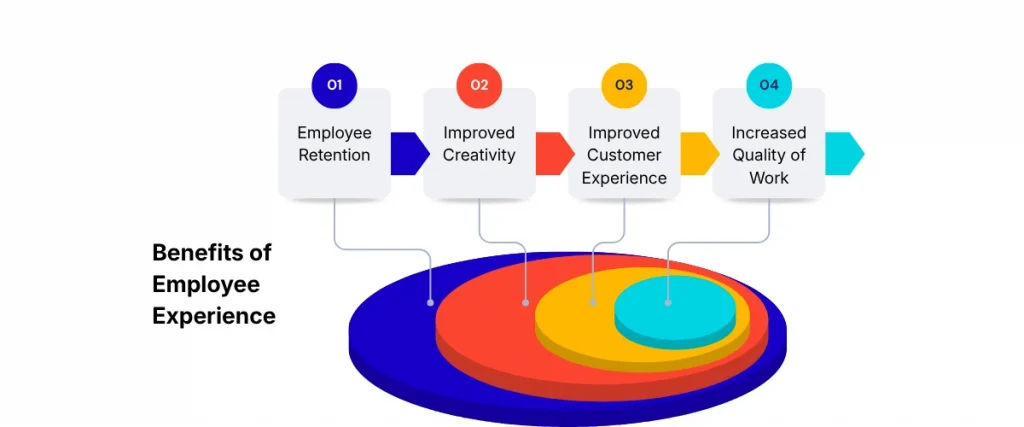
Employee retention
Discipline in the workplace is an unshakeable foundation of organisational culture. Employees who are consistently valued and supported will find it difficult to search for other opportunities in the labour market because of the voluntary attrition rate.
Improved creativity
Once an employee is not constrained by micromanagement or other frictions, they can make use of their mental capacity for creativity. With a favourable working environment, employees will have the liberty to speak about their creative ideas and challenge the conventional methods.
Improved customer experience
External customer experience is usually a reflection of your internal culture. The frontline employees who are valued, empowered and engaged would definitely pass that on to customers through the way that they relate with customers.
Increased quality of work
High calibre “employee journeys” build intrinsic motivation. When employees can see a clear connection between daily tasks and the company’s long-term mission, they stop treating everything as a simple checklist, and start taking personal responsibility for the results.
The stages of employee experience
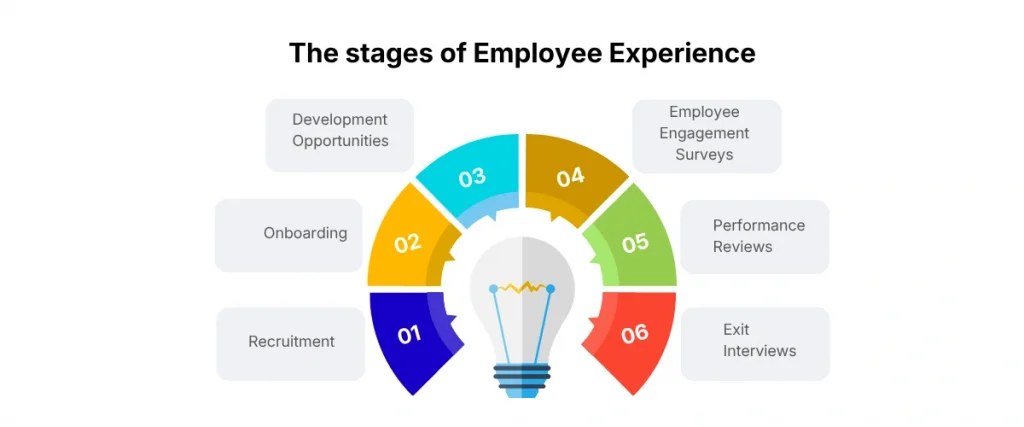
Recruitment
The journey kicks off long before day one. This initial phase includes every early touchpoint, from the clarity of your job descriptions and the ease of your application portal to the transparency, professionalism, and warmth shown by your talent acquisition team during interviews.
Onboarding
A great onboarding phase moves far beyond handling basic IT setup and signing tax paperwork. It is a highly intentional orientation process designed to introduce a new hire to internal team cultures, clarify immediate performance goals, and provide the exact training resources needed to succeed.
Development opportunities
Talented professionals will inevitably look elsewhere the moment they feel their career growth has flattened. This stage focuses on establishing highly transparent internal promotion pathways, funding external skill certifications, and offering robust mentorship programs.
Employee engagement surveys
Continuous feedback loops keep an organisation’s culture aligned. Regularly deploying anonymous, targeted pulse surveys gives leadership the direct, unfiltered data needed to spot emerging operational bottlenecks or department-level frustrations before they escalate.
Performance reviews
Modern performance evaluations must shift away from anxious, top-down annual rankings and transition into predictable, two-way career conversations. These discussions should celebrate recent wins, constructively address skills gaps, and map out concrete objectives for the upcoming quarter.
Exit interviews
The employee journey doesn’t end when a resignation letter is handed in. Conducting thorough, respectful exit interviews provides organisations with highly candid, invaluable insights into systemic management issues or cultural blind spots that need to be addressed.
What are the key components of employee experience?
Physical experience
This component encompasses the tangible, material reality of an employee’s daily work environment. It includes structural office layouts, ergonomics, quiet focused zones, ambient lighting, and the overall physical comfort of the workspace or the home-office stipends provided to remote teams.
Digital experience
This represents the collection of software systems, hardware setups, internal portals, and digital communication applications an employee relies on to execute their duties. A seamless, frictionless digital environment removes daily administrative frustration and boosts core operational output.
Cultural experience
The cultural pillar defines the unwritten rules, behaviors, and social dynamics of a workplace. It is shaped directly by leadership transparency, peer-to-peer appreciation habits, structural commitment to diversity, and the level of trust managers place in their remote or hybrid teams.
Understanding the Employee Experience Framework
Shaping a strong employee experience framework requires a structured approach that aligns workplace culture, leadership, and business goals. A workplace where employees feel heard, supported, and valued fosters higher engagement and long-term retention. Organizations that focus on experience see stronger team collaboration, increased motivation, and better overall performance.
Key Elements Of An Effective Employee Experience Framework
A well-structured framework consists of several elements that directly influence how employees engage with their work, colleagues, and leadership. Focusing on these areas creates a workplace where people feel motivated to contribute and grow.
- Workplace Culture – Employees thrive in an environment that values respect, inclusivity, and recognition. A positive culture fosters collaboration, trust, and long-term commitment, while a toxic or disengaged environment leads to high turnover and dissatisfaction.
- Leadership and Management – Employees look to leadership for direction, motivation, and support. A strong employee experience depends on managers who provide clear expectations, regular feedback, and guidance. When leaders foster a culture of communication and recognition, employees feel more engaged and valued.
- Growth Opportunities – Career progression plays a major role in retaining top talent. Employees who receive ongoing learning opportunities, mentorship, and upskilling resources see a clear path for growth within the organization. Without these opportunities, employees often seek better prospects elsewhere.
- Work-Life Balance – A company that values well-being acknowledges that employees perform better when they have flexibility. Supporting hybrid or remote work, offering mental health resources, and respecting personal time create a healthier, more sustainable work environment.
- Technology and Tools – The digital employee experience impacts productivity, collaboration, and overall engagement. Efficient digital tools streamline workflows, reduce unnecessary administrative tasks, and help employees stay connected. When outdated or inefficient systems create bottlenecks, frustration and disengagement increase.
Aligning Employee Experience with Company Culture and Goals
An experience that reflects the company’s values and mission strengthens employee commitment. Employees should feel that their work contributes to a larger purpose. Organizations that clearly communicate expectations, provide structured career paths, and recognize achievements build a culture where employees see long-term potential.
Leadership’s Role in Shaping a Great Employee Experience
Executives and managers set the tone for engagement and workplace culture. Employees who feel supported by leadership are more likely to stay committed and contribute at a high level. Open communication, clear feedback, and encouragement create an environment where people perform at their best.
Most Effective Strategies to Enhance Employee Experience
A well-structured employee experience framework does more than improve engagement—it strengthens workforce resilience, aligns employee efforts with business objectives, and enhances operational efficiency. Organizations that take a systematic approach to experience design see higher discretionary effort, stronger collaboration, and measurable gains in productivity.
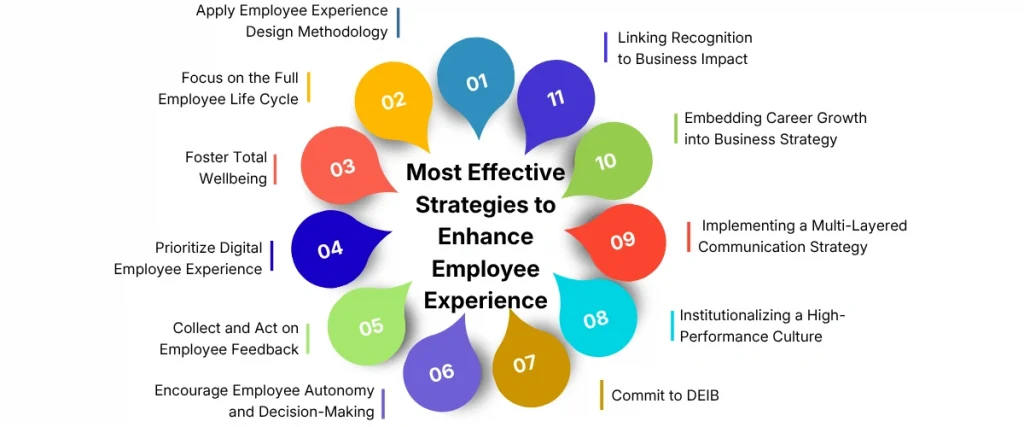
1. Apply Employee Experience Design Methodology
Treat your workforce journey like a premium customer product. Utilise user-persona research, empathy maps, and journey mapping to design internal processes that are intuitive, accessible, and completely free from bureaucratic friction.
2. Focus on the Full Employee Life Cycle
Avoid the common trap of front-loading all your cultural efforts into recruitment and onboarding. Ensure that mid-tenure professionals receive the exact same level of leadership attention, targeted skill development, and customised milestone recognition as brand-new hires.
3. Foster Total Wellbeing
Move past superficial health perks and address structural wellness. This means implementing sustainable workload boundaries to combat chronic burnout, providing comprehensive mental health resources, and offering financial planning workshops to support your teams holistically.
4. Prioritise Digital Employee Experience
Invest heavily in modern, collaborative HR technologies that simplify administrative tasks. Centralising your payroll, asset tracking, leave management, and peer recognition into a single, mobile-first ecosystem dramatically reduces daily digital fatigue.
5. Collect and Act on Employee Feedback
The fastest way to destroy workplace trust is to collect workforce feedback and then do absolutely nothing with it. Share your survey insights transparently with your organisation, and explicitly detail the exact structural changes you are making based on their input.
6. Encourage Employee Autonomy and Decision-Making
Dismantle rigid micromanagement frameworks by giving your people true ownership over how, when, and where they complete their projects. Focusing entirely on actual performance outcomes rather than active screen hours builds a deep culture of mutual trust.
7. Commit to DEIB
Build a workplace where Diversity, Equity, Inclusion, and Belonging are woven directly into operational systems. This requires maintaining completely transparent promotion tracks, eliminating gender pay gaps, and establishing active employee resource groups.
8. Institutionalizing a High-Performance Culture
Culture is reinforced through structural incentives, behavioral expectations, and decision-making frameworks. Engagement is not the result of individual initiatives but a function of how well the organization integrates accountability, transparency, and purpose into daily operations.
Performance management systems must align behaviors with business priorities, ensuring employees understand their role in long-term success. A culture built on trust, autonomy, and clearly defined expectations drives sustained engagement and commitment.
9. Implementing a Multi-Layered Communication Strategy
Information flow within an organization must be precise, adaptive, and responsive. A digital employee experience that enables real-time feedback, targeted communication, and sentiment analysis reduces misalignment and strengthens engagement. Static communication models—reliant on periodic updates—fail to address evolving workforce expectations.
Data-driven insights should guide messaging strategies, ensuring clarity and consistency across all levels. Platforms that support asynchronous updates, AI-driven knowledge sharing, and real-time interaction create a more connected workforce.
10. Embedding Career Growth into Business Strategy
Development programs that exist in isolation from business priorities fail to deliver long-term impact. Workforce planning must integrate career progression, ensuring that employees develop the skills needed to meet evolving market demands.
AI-driven learning paths, targeted mentorship programs, and internal mobility strategies retain high-value talent while reducing dependency on external hiring. Structured career mapping enhances engagement by providing visibility into growth opportunities while aligning individual capabilities with organizational objectives.
11. Linking Recognition to Business Impact
Recognition is most effective when it reinforces behaviors that drive measurable outcomes. Programs designed around employee experience examples, such as performance-based awards, milestone-based bonuses, and peer-driven recognition create stronger alignment with strategic goals.
Generic appreciation efforts offer limited impact—recognition must be structured to incentivize innovation, operational efficiency, and revenue growth. Data-backed insights ensure that recognition frameworks remain equitable and directly tied to value creation.
12. Redesigning Work to Optimize Productivity and Well-Being
Sustaining high performance requires an approach that goes beyond traditional work-life balance initiatives. Flexibility must be built into workload distribution, meeting structures, and process optimization to ensure employees operate efficiently.
AI-driven task automation, streamlined workflows, and incentive-based pay systems that reward outcomes over effort improve retention and productivity while reducing unnecessary burnout. A well-calibrated work design eliminates inefficiencies and ensures employees can focus on high-value contributions. Another powerful way to enhance employee fulfilment and connection is by encouraging volunteer opportunities with nonprofits or cause-based organisations. This strategy has been shown to boost morale and instil a greater sense of purpose in the workplace.
Employee Experience Management: Best Practices
A consistent employee experience management approach ensures that strategies remain responsive, measurable, and aligned with evolving workforce needs. Ad hoc initiatives rarely produce sustainable outcomes. Long-term impact requires structured systems that integrate employee feedback, behavioral data, and operational performance into a continuous improvement loop.
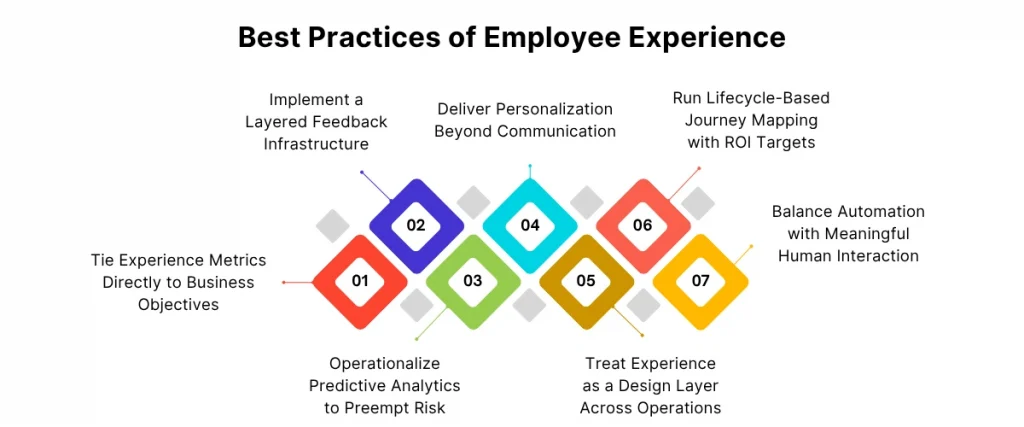
1. Tie Experience Metrics Directly to Business Objectives
Employee experience can’t operate in isolation. It must be tracked alongside critical business KPIs such as customer satisfaction, productivity ratios, and revenue per employee. This alignment ensures that experience initiatives are evaluated based on their contribution to business performance—not perception alone.
For instance, a rise in engagement scores should correspond with improved output, reduced error rates, or shorter project delivery timelines.
2. Implement a Layered Feedback Infrastructure
Annual engagement surveys no longer capture the pace of workforce sentiment. Organizations need a layered approach that includes real-time pulse surveys, lifecycle feedback (onboarding, role transitions, exits), and open-ended qualitative insights.
Behavioral signals—such as login activity, meeting load, and learning participation—should be analyzed in parallel to expose hidden trends. Tools like PeopleStrong help unify this feedback ecosystem across touchpoints, ensuring insights translate into timely action.
3. Operationalize Predictive Analytics to Preempt Risk
Experience management matures when analytics move from descriptive to predictive. Early detection of disengagement, flight risk, or burnout—based on patterns in communication, productivity, or feedback—enables proactive intervention.
AI-led tools can surface micro-signals, such as changes in collaboration habits or training drop-offs, weeks before they become attrition drivers. This allows experience teams to course-correct before issues affect team dynamics or business continuity.
4. Deliver Personalization Beyond Communication
Personalization often stops at messaging—but the highest-performing organizations extend it across learning, recognition, career mobility, and rewards.
For example, incentive structures can be dynamically adapted based on role, performance level, and team structure using platforms like PeopleStrong. Similarly, learning paths can be calibrated to match growth aspirations, tenure, and project history—making the entire employee journey context-aware rather than standardized.
5. Treat Experience as a Design Layer Across Operations
Rather than building standalone experience initiatives, the most effective organizations embed experience as a design principle in how work is structured.
That means reconsidering how meetings are run, how goals are set, how decisions are communicated, and how transitions are handled. Experience isn’t a separate project—it should be built into every process, system, and policy decision to ensure consistency across the employee lifecycle.
6. Run Lifecycle-Based Journey Mapping with ROI Targets
Mapping employee journeys—across hiring, onboarding, promotions, and exits—must go beyond emotional checkpoints. Effective journey mapping identifies experience gaps that result in financial or operational inefficiencies.
For instance, delayed onboarding leads to longer ramp-up times, which affects customer delivery metrics. Assigning ROI metrics to each stage ensures journey mapping is not just a branding tool but a business efficiency strategy.
7. Balance Automation with Meaningful Human Interaction
AI and workflow automation can handle repetitive communication, scheduling, and reporting—but certain experience drivers require human presence. Career conversations, recognition moments, and performance feedback are better delivered face-to-face or via live digital interactions.
The goal is to create bandwidth through automation without hollowing out the touchpoints that build trust, psychological safety, and emotional connection.
Measuring and Continuously Enhancing Employee Experience
Experience strategies require active monitoring. Without measurement, organizations risk misallocating resources or reinforcing ineffective practices. Sustained improvements depend on tracking the right metrics, maintaining open feedback loops, and adapting to shifting workforce expectations.
A static approach erodes relevance over time, while continuous iteration keeps the experience aligned with evolving priorities.
1. Track Experience-Centric KPIs Alongside Business Metrics
Traditional metrics like engagement scores and eNPS offer directional insight, but they need to be tied to operational outcomes to carry weight at the executive level.
Metrics such as internal mobility rates, time-to-productivity, absenteeism trends, and voluntary attrition costs create a clearer link between experience and business performance. When these KPIs are viewed together, organizations gain a more complete picture of how employee experience influences profitability, agility, and retention.
2. Leverage Exit and Stay Interviews for Actionable Insights
Exit interviews often expose long-standing issues that remained unaddressed during an employee’s tenure. Stay interviews, when conducted with top performers and high-potential talent, uncover what is currently working and what risks might be on the horizon.
Combining these two perspectives allows organizations to identify systemic patterns and close feedback gaps that standard surveys may overlook. Over time, this approach contributes to a more stable and experience-conscious talent strategy.
3. Use Behavioral Analytics to Detect Silent Attrition Risks
Not all disengagement shows up in survey responses. Behavioral signals—like reduced collaboration, longer response times, drop-offs in learning activity, or avoidance of voluntary stretch projects—often precede formal attrition.
Platforms with built-in analytics, such as PeopleStrong, can process these subtle cues and flag risks early. This enables proactive intervention before productivity dips or resignation notices appear.
4. Implement Pulse Survey Cadences Based on Employee Milestones
Fixed quarterly or annual surveys often miss the context around how employee sentiment shifts at critical stages. Triggering pulse surveys after specific events—such as onboarding completion, team changes, promotion cycles, or major project closures—provides more relevant and timely data.
This milestone-driven approach captures emotional shifts as they occur, helping organizations adjust quickly and improve the experience during high-impact moments.
5. Segment Feedback by Function, Tenure, and Performance Bands
Aggregated data masks nuanced trends. Segmenting feedback by function, seniority, location, or performance tier exposes unique experience challenges within each cohort. For example, new hires in sales may experience friction during onboarding that isn’t present in other departments.
Similarly, tenured employees may report stagnation in development while newer hires prioritize learning access. Segment-specific insights make it easier to deploy targeted improvements rather than blanket interventions.
6. Tie Experience Improvements to Workforce Cost Optimization
Experience design is often seen as a soft initiative unless it’s tied to measurable outcomes. Linking experience initiatives—such as streamlining onboarding or automating routine manager check-ins—to financial improvements builds more substantial internal sponsorship.
Demonstrating how these changes reduce time-to-productivity, cut support ticket volume, or decrease error rates frames experience as a business efficiency lever rather than a morale booster.
Challenges of employee experience
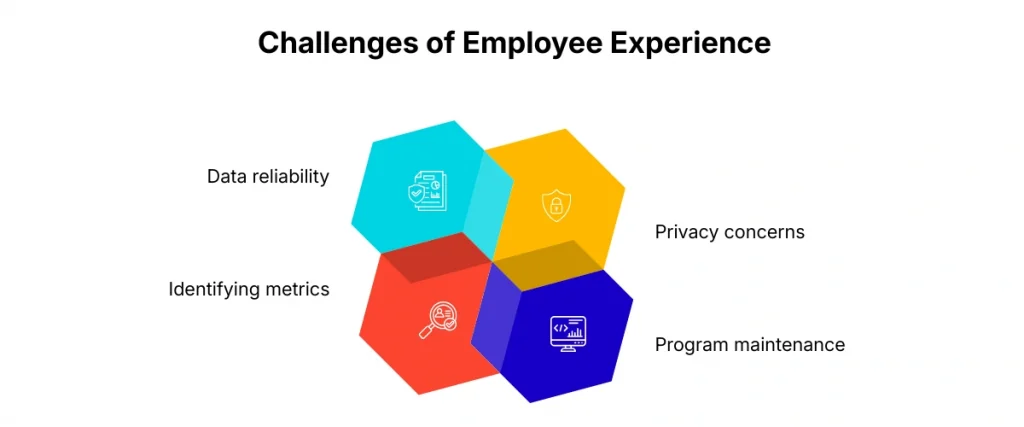
Data reliability
Gathering an accurate picture of company culture is incredibly difficult if employees feel uncomfortable sharing their true opinions. If your workforce suspects their feedback isn’t completely confidential, they will simply input empty, positive answers that skew your data.
Identifying metrics
Because human sentiment is inherently subjective, defining a clean set of actionable key performance indicators presents a continuous challenge. Organisations often get bogged down tracking superficial vanity metrics rather than focusing on hard indicators like internal mobility and regrettable churn.
Privacy concerns
As companies adopt advanced behavioral analytics and digital tracking tools to monitor employee strain, they must navigate sensitive data privacy boundaries. Maintaining absolute transparency regarding what data is collected and how it is secured is vital for retaining employee trust.
Program maintenance
Building an extensive workplace culture strategy requires sustained, long-term investments of both time and budget. Initiatives frequently lose momentum if executive leaders treat experience management as a passing trend rather than an enduring business priority.
Make Employee Experience Measurable, Personal, and Scalable—With PeopleStrong
Designing a meaningful employee experience requires more than goodwill and internal surveys—it demands a system that brings structure, clarity, and agility to every moment that matters. This is where PeopleStrong becomes more than just an HR tech vendor. It becomes a strategic partner in building a workforce that’s engaged and prepared for what’s next.
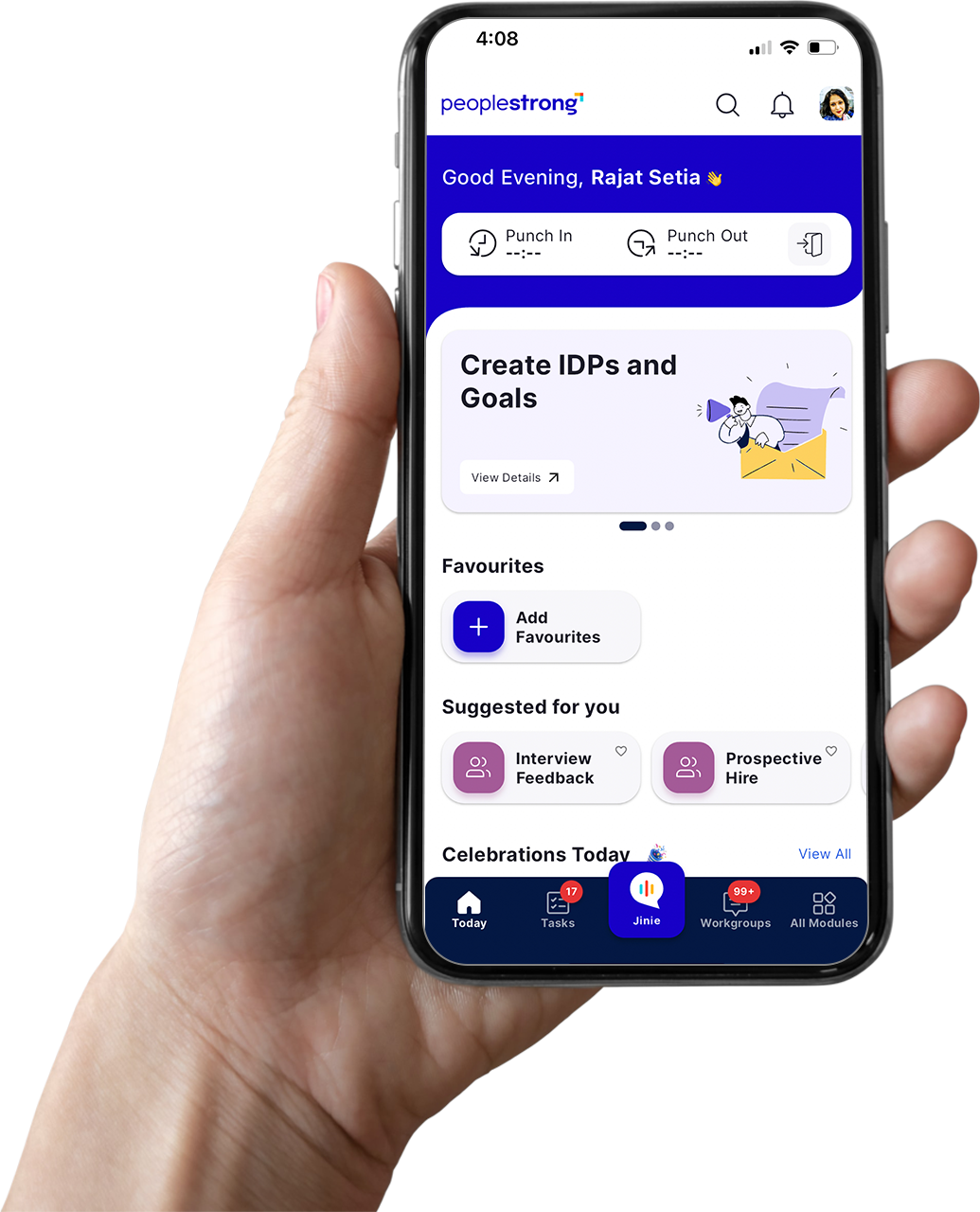
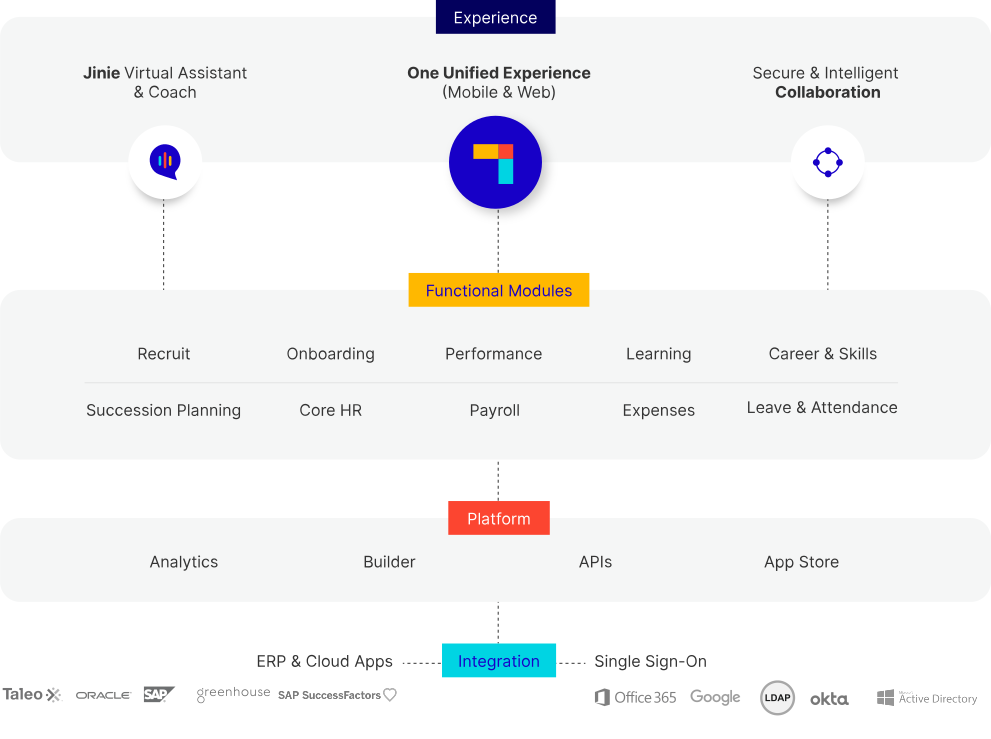
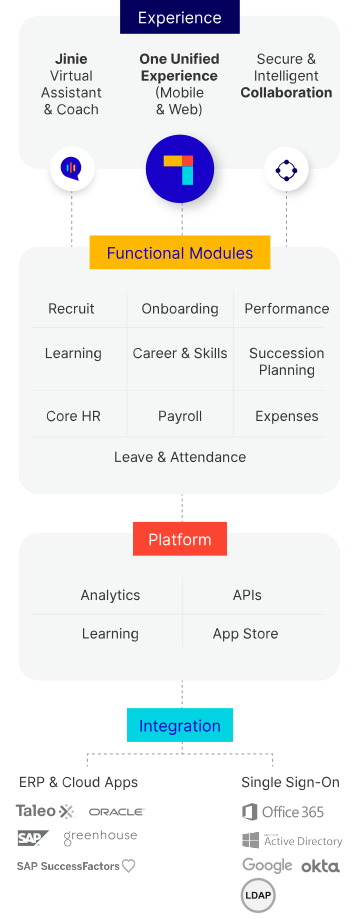
PeopleStrong’s platform is designed to support experience at scale, aligning technology with the way modern employees work, learn, and grow. With AI-powered tools built into every layer—from recruitment and onboarding to performance and payroll—their system transforms fragmented HR processes into seamless journeys.
The result?
Employees experience less administrative friction and more focus on what truly matters: purpose, growth, and recognition.
- Their mobile-first experience meets employees where they are, enabling real-time access to learning, feedback, and collaboration tools.
- With AI-led talent management, every employee receives a personalized growth path, from career development to succession planning.
- Their payroll and workforce solutions ensure accuracy and contribute directly to employee trust—a cornerstone of long-term engagement.
- The platform’s intelligent feedback and analytics capabilities turn insights into actions, so organizations don’t just listen—they respond in real-time.
By embedding PeopleStrong into the broader employee experience framework, organizations replace reactive HR efforts with proactive experience design. It’s no longer about fixing disengagement after it happens. It’s about shaping every interaction—before, during, and after it occurs.
For companies looking to create consistency across diverse teams and geographies, PeopleStrong doesn’t just enable scale—it protects experience quality as you grow.
Conclusion
A strong employee experience fuels retention, productivity, and long-term business success. It’s shaped through intentional design—rooted in feedback, aligned with company goals, and supported by the right technology.
Organizations that build structured frameworks, personalize career growth, and invest in seamless digital tools consistently outperform those that rely on surface-level engagement efforts. Experience management is not a one-time initiative—it’s a continuous cycle of listening, measuring, and adapting.
Solutions like PeopleStrong make it possible to scale this effort without adding complexity, giving teams the insights and tools they need to act with precision. As expectations evolve, companies that treat employee experience as a core business priority—not just an HR responsibility—are better equipped to attract talent, reduce attrition, and strengthen organizational resilience across every level.

FAQs
Why do businesses need to invest in employee experience?
Investing in the workforce journey is a critical commercial strategy. High-turnover environments drain company profitability through constant headhunter costs, onboarding delays, and lost institutional knowledge. Building a supportive culture stabilises operational performance, protects client relationships, and boosts your long-term bottom line.
What employee experience factors are most critical?
While individual priorities vary across tenures, the most consistent drivers of workplace happiness include highly transparent career advancement opportunities, competitive and equitable compensation, empathetic management styles, genuine recognition for extra effort, and sustainable boundaries that prevent chronic burnout.
How can organisations build a great employee experience?
Organisations build exceptional environments by treating their workforce journey as a core design project. This means mapping out critical career milestones, gathering continuous anonymous feedback, training managers to act as supportive career coaches rather than strict taskmasters, and investing in integrated software platforms that simplify daily work.
What Are the Employee Life Cycle Stages?
The professional journey moves through six primary operational phases. It begins with the initial recruitment and interview touchpoints, transitions into structural onboarding, and progresses through ongoing skill development, continuous engagement tracking, regular performance evaluations, and structured exit interviews.
How Can You Improve the Employee Experience?
Real improvements require moving past superficial fixes and addressing systemic workflows. Organisations can enhance their culture by expanding workplace flexibility, opening transparent cross-functional communication lines, delivering timely peer recognition, and using data analytics to proactively fix department-level management issues.
What is an employee experience platform (EXP)?
An employee experience platform is an integrated software system designed to centralise and personalise the workforce journey. Unlike old, siloed transactional HR tools, an EXP brings communication networks, skill development modules, pulse surveys, benefits management, and self-service administration into one cohesive digital space.
How does digital employee experience impact engagement?
A strong digital employee experience removes friction from daily workflows, enabling employees to communicate, collaborate, and access resources without delays. Employees feel more supported and productive when digital tools are intuitive and integrated. This directly influences engagement by reducing frustration, improving response times, and supporting a more agile working method.
How can AI help in employee experience management?
AI supports employee experience management by analyzing sentiment, predicting attrition risks, and personalizing engagement. It identifies patterns that traditional tools miss, helping organizations adapt more quickly to changing needs. AI can also streamline onboarding, automate routine communication, and recommend personalized development paths—enhancing the overall experience at scale.