












 About Us
 Brand
Brand
 Career
 Contact Us



 +91-7314623098






We cannot read every individual’s mind, but there is a means of knowing whether your employees are truly engaged and flourishing in your workplace.
Employee engagement surveys are only one of the methods you can use to move beyond sheer guesswork and know what your employees really feel about your organization. As per a 2025 Report, 56% of organizations report having achieved a positive ROI from investments in employee engagement programs.
They can help you understand:
- Are they motivated, productive, and happy?
- How engaged do they feel with the company culture, team members, and work?
- Are they likely to stay with your organization for the long term?
However, employee engagement is not as simple as asking your staff to complete a questionnaire. To achieve real change, organizations need to ask the right questions, guarantee anonymity, process results properly, and, most importantly, follow through on the feedback received.
In this guide, we’ll take you through eight steps to running successful employee engagement surveys, from setting your objectives to taking action based on facts. By the end, you’ll have a blueprint to build effective surveys that drive employee satisfaction and create a supportive workforce.

Suggested Read:
Guide to Evergreen Employee Engagement in Your Company
What is an Employee Engagement Survey?
An employee engagement survey is a detailed questionnaire that is designed to measure employees’ commitment, motivation, and overall connection to their workplace. These surveys focus on how employees feel about their roles, leadership, work environment, and company culture.
The aim is to collect honest views through the combination of multiple-choice, Likert scale, and open questions, as well as one-to-one discussions, to collect quantitative and qualitative information.
Collecting such feedback helps measure levels of engagement, identify areas of concern, and enhance morale and productivity.
Why Are Employee Engagement Surveys Important?
An employee engagement survey is one of the most reliable diagnostic tools a business can use to measure the health of its workplace culture. Rather than assuming leadership knows how teams feel, a structured survey turns abstract concepts like morale, alignment, and job satisfaction into clear, trackable data points.
Regularly deploying these assessments helps HR leaders catch brewing systemic problems, like team-level burnout or creeping management friction, long before they lead to a wave of voluntary resignations. It moves an organisation from a reactive stance of putting out structural fires to a proactive style of culture management.
Benefits of Employee Engagement Surveys
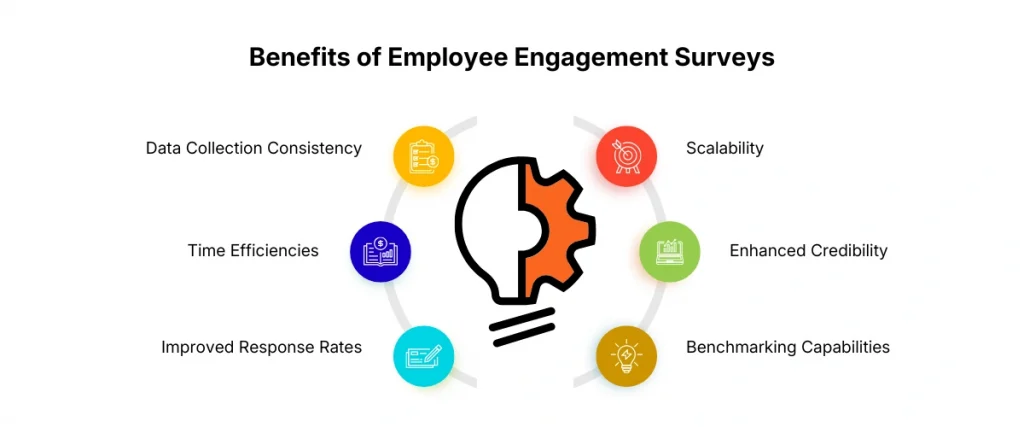
Data collection consistency
Using a standardised evaluation method ensures you gather your culture metrics uniformly across every department. This structured approach allows you to reliably compare historical data and see if changes you made in the past are actually paying off over time.
Time efficiencies
Modern survey software eliminates the need for messy, manual feedback loops like endless group interviews or paper suggestion boxes. HR teams can launch an organisation-wide check-in instantly, gathering massive amounts of workplace data within days.
Improved response rates
Providing employees with a centralised, user-friendly digital portal makes sharing feedback a breeze. When taking part requires minimal effort, team participation rates naturally climb, leaving you with a much more accurate picture of company culture.
Benchmarking capabilities
Standardising your scores allows you to measure your internal metrics against broader industry standards. Knowing exactly how your cultural health ranks against your direct market competitors lets you see if your workplace practices are keeping pace.
Enhanced credibility
When an organisation uses structured, scientific evaluation methods rather than relying on upper-management intuition, employees view the process as fair and objective. This transparency builds deep cultural trust between frontline workers and executive leaders.
Scalability
Whether your business employs fifty people in a single office or tens of thousands of professionals scattered globally across remote teams, digital surveys scale instantly without adding administrative overhead or stretching your HR budget.
What makes a good employee engagement survey?
Clear objectives
Never launch an evaluation just to check an HR box. A highly effective survey focuses on specific, timely goals, such as evaluating a newly rolled-out remote policy, diagnosing a recent drop in retention, or mapping out future training demands.
Clear, concise questions
The phrasing of your employee engagement survey questions determines the accuracy of your results. Avoiding dense corporate jargon, double-barreled prompts, and biased language makes it easy for employees to give quick, honest, and accurate answers.
A mixed-methods approach
Relying solely on multiple-choice rating scales gives you a rigid, two-dimensional view of your culture. Combining closed-ended metrics with open-ended text fields lets you track high-level trends while gathering the real human stories behind the numbers.
Testing and refinement
Before sending a new questionnaire to your entire global workforce, test it with a small, diverse focus group of internal employees. This pilot run helps catch confusing phrasing, technical bugs, or formatting issues that could mess with your final data collection.
Why Should You Conduct Employee Engagement Surveys?
In most organizations, the management and human resources teams think everything is fine because they pay attention to performance management and not team engagement.
This implies that if there is disengagement or discontent among employees, it continues to fester until it is too late to make things right.

Based on Gallup’s 2023 State of the Global Workplace on training! If your training budget isn’t this generous, tracking and controlling employee turnover can help you prevent this cost from going off the charts. With every employee onboarding, you have to incur significant training costs which can only be controlled by retaining old employees.
Based on Gallup’s 2023 State of the Global Workplace findings, $8.9 trillion is lost in the global economy due to low engagement. 62% of employees in the survey reported not feeling engaged at the organization, with 15% feeling actively disengaged.
By conducting employee engagement surveys regularly, organizations can get direct inputs from the employees, helping them measure employee satisfaction, motivation, and commitment, which are key drivers of productivity and retention.
Conducting these surveys enables you to:
- Identify Strengths and Weaknesses: Determine areas where your organization is strong and where it is weak.
- Improve Retention: Gain direct feedback from your employees and tackle the root causes of employee turnover to eliminate them in the first place.
- Boost Productivity: Know what drives employees and streamline workflows accordingly based on feedback.
- Enhance Company Culture: Create a constructive and inclusive culture where every employee feels heard and encouraged.
By adapting based on employee feedback, you build trust and show your team that their views matter. This makes them feel a sense of belonging and facilitates change in the organization for the better.
8 Steps to Conduct Effective Employee Surveys
To maximize your employee engagement surveys, the most important thing is to have the right strategy and pose the right questions. Here are eight steps to help you conduct employee engagement surveys effectively:
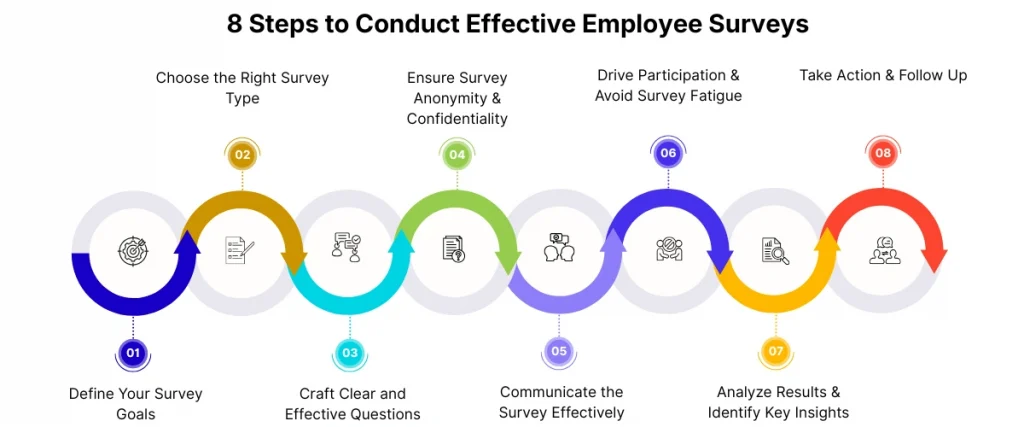
Step 1: Define Your Survey Goals
A survey without well-established goals can lead to irrelevant data, misinterpretation, and wasted effort.
So, the initial step is to know why you are carrying out the survey and what you wish to know. What particular ends do you want to meet? What data do you seek to discover? Bring your survey objectives into direct alignment with your higher business and HR goals.
Also, ensure that your goals are measurable and actionable. For example, instead of broad objectives like “improve morale,” aim for specific targets with clear OKRs such as “increase employee satisfaction scores by 10% in the next quarter” or “reduce employee turnover by 5% in the coming year.”
Clearly defined goals will guide your question design, analysis, and subsequent action planning, leading to a more focused and impactful survey process.
Step 2: Choose the Right Survey Type
Choose the right survey type. There are different employee engagement surveys, each designed to serve distinct purposes, and the choice depends on your organization’s specific needs and goals.
Some of the employee engagement survey types include:
- Annual Surveys: These surveys give an in-depth look at the engagement of employees, providing a holistic view of the workforce’s sentiment. They are often carried out on an annual basis and touch on a wide range of subjects.
- Pulse Surveys: Quick, regular, and brief surveys that give real-time feedback about employee sentiment and morale. These are best for tracking current trends and responding to new issues.
- Lifecycle Surveys: These surveys are conducted at specific points in the employee lifecycle, such as onboarding, performance reviews, or exit interviews. They give useful feedback at key moments and assist in determining areas for improvement in the employee experience.
- Ad-hoc or Always-on Surveys: These may be additional always-on surveys that are available to employees at any time or specially created surveys, e.g., DEI (Diversity, Equity, and Inclusion) or work-life balance feedback.
Choosing the right survey type ensures that you gather the most relevant and actionable data for your organization.
Step 3: Craft Clear and Effective Questions
The success of an employee engagement survey depends largely on the questions you ask. Poorly worded or ambiguous questions can lead to confusing data, while well-structured questions provide actionable insights.
To help create an impactful employee engagement survey:
- Keep Questions Clear and Concise: Employees should understand the question without overthinking. Avoid jargon and complex phrasing.
- Be Specific and Actionable: Instead of asking, “Do you feel valued?” ask, “Do you feel recognized for your contributions by your manager?”
- Use a Mix of Question Types: Different formats help capture diverse perspectives. These can include Likert Scale Questions (e.g., On a scale of 1-5, how satisfied are you with your work-life balance?), Multiple-choice questions (e.g., Which benefits do you value the most?) or Open-Ended Questions (e.g., What’s one thing we could do to improve your work experience?)
- Avoid leading or overly complex questions: A question like “How great is our company culture?” assumes a positive view. Instead, ask “How would you describe our company culture?”
Step 4: Ensure Survey Anonymity & Confidentiality
A major worry among employees participating in an engagement survey is whether their responses remain anonymous.
If employees feel that their feedback could be recorded, they may withhold honest opinions or provide overly cautious responses. To get genuine and useful insights, organizations must prioritize confidentiality.
Follow these best practices:
- Use Third-Party Survey Tools: Check out platforms like Culture Amp, SurveyMonkey, or PeopleStrong that offers built-in anonymity features and HR dashboards ensuring that individual responses remain private.
- Limit Identifiable Questions: Avoid questions that could pinpoint individuals, such as “What is your exact job title?” or “Which department do you work in?” (unless the department has a large number of employees)
- Aggregate Results, Not Individual Responses: Share team-wide trends rather than specific answers. This ensures that survey responses cannot be traced back to individual employees.
- Communicate Clearly About Anonymity Reassure employees when taking anonymous feedback that no managers or HR personnel will have access to raw data. This reassures them to provide real answers.
Step 5: Communicate the Survey Effectively
Even the best-designed employee engagement survey won’t be effective if employees aren’t aware of it or don’t understand its purpose. Clear and strategic communication is essential to drive participation and ensure that employees take the survey seriously.
So use a multi-channel strategy to engage all employees, such as email, internal meetings, and modern intranet software. You can follow the 3x3x3 communication model: communicate three times before, during, and after the survey. Having a consistent approach ensures that employees are kept informed and involved throughout.
Additionally, set clear expectations to help gather more feedback by telling:
- Who should participate? (All employees, a specific department, etc.)
- How long will it take? (5-10 minutes for greater engagement)
- When will the survey close? (Provide a strict deadline with reminders)
- What happens next? (Describe when results will be published and how changes will happen.)
This reinforces that the survey is a chance for employees to help make positive change and that their opinions are important.
Step 6: Drive Participation & Avoid Survey Fatigue
A common challenge with employee engagement surveys is low participation rates and survey fatigue, when employees feel overwhelmed by too many or overly long surveys. To get the most honest and useful feedback, it’s essential to increase participation while ensuring that employees don’t feel burdened.
To boost participation:
- Establish a Realistic Target for Participation: Strive for a 70-80% response rate for data accuracy. Announce this goal to employees to motivate collective participation.
- Keep Surveys Short & Relevant: Ensure that your surveys last no longer than 10-15 minutes, and do not include any unnecessary or repeated questions.
- Incentivize Response Without Making Them Feel Forced: To engage more participants, you might have Raffles or Giveaways giving the respondents an opportunity to win a little prize for answering the survey. Also, give some minor perks like complimentary coffee, snacks, or a longer break.
- Harness Leadership & Peer Pressure: Make top leaders and managers personally endorse participation in surveys.
Step 7: Analyze Results & Identify Key Insights
Collecting survey responses is just the beginning. To improve employee engagement, organizations must analyze the data effectively, identify trends, and uncover actionable insights.
To get the best from your employee engagement surveys:
- Use data visualization tools to highlight trends and patterns in the feedback. Look for correlations between different questions and identify areas where employee sentiment is particularly high or low.
- Pay close attention to patterns in feedback across different employee groups, such as departments, tenure, or demographics.
- Prioritize issues based on their frequency and potential impact on the organization.
- Focus on identifying actionable insights that can be translated into concrete strategies for improvement.
Remember, the goal is not just to collect data but to use it to drive meaningful change.
Step 8: Take Action & Follow Up
Gathering and comparing employee input only has value if it creates change. The last and most important part of having a successful employee engagement survey is to follow through on taking action and informing employees. Employees will disengage and distrust surveys if this isn’t done.
Share findings honestly and openly with employees, emphasizing both the positives and improvement areas.
You can even establish a definitive timeline for making changes from the survey comments and monitor progress on a regular basis. Report back to employees, illustrating that their comments matter and are followed through on.
This follow-through is key to establishing trust and momentum. By demonstrating to employees that their voice counts, you reinforce a culture of ongoing improvement and involvement.
Tips to Write Employee Engagement Survey Questions
Solicit more
Design your questions to uncover actionable details about the entire workplace journey. Don’t just ask if employees like their jobs, ask about their relationships with leadership, the tools they use, their career progression paths, and their daily work-life balance.
Keep the Questions Simple
Write your questions cleanly so they require zero overthinking. Simple prompts like “I have the resources I need to do my job effectively” yield far more accurate and reliable data than complex, multi-clause academic paragraphs.
Open-Ended Questions Vs Close-Ended Questions
Balance your data types to build a highly actionable employee engagement scorecard. Close-ended questions (like 1-to-5 scales) are perfect for generating clean statistical trends, while open-ended text boxes give employees the freedom to explain the “why” behind their ratings.
Take Your Survey for a Spin
Run through your completed questionnaire on multiple devices, including smartphones and tablets. Ensuring your survey loads fast and feels intuitive on mobile layouts prevents drop-offs from busy on-the-go or field employees.
Employee engagement survey best practices
Keep questions to the point
Respect your team’s limited time by trimming out repetitive or filler questions. Keeping your questionnaires brief prevents survey fatigue, ensuring your employees stay focused and provide high-quality answers from start to finish.
Keep questions open ended
While scale-based metrics are vital for tracking corporate trends, make sure to include open text boxes at the end of major sections. Giving employees room to type out their thoughts unfiltered often brings critical, hidden issues to the surface.
Conduct surveys regularly
Ditch the old tradition of the massive, stressful annual review. Adopting a modern pulse cadence, such as short quarterly or monthly check-ins, helps leadership track real-time shifts in team morale throughout the business year.
Keep surveys anonymous
To ensure your data is accurate and trustworthy, you must guarantee total privacy. Using secure, third-party software to protect individual identities gives employees the psychological safety they need to share their real opinions without fear of backlash.
Give employees space to work on surveys
Do not expect teams to squeeze surveys into their personal time or frantic lunch breaks. Explicitly instruct managers to block out fifteen minutes of dedicated company time during the workweek for everyone to complete the check-in stress-free.
Follow up on feedback
The fastest way to ruin employee trust is to gather feedback and then do absolutely nothing with it. Share your findings transparently with the company and outline the exact cultural and operational updates leadership plans to make based on the data.
The best employee engagement survey questions to ask
General satisfaction
- How satisfied are you with your current role?
- How likely are you to recommend our company as a place to work?
- On a scale of 1-10, how would you rate your overall job satisfaction?
Work environment
- Do you think you have the necessary tools and resources to do your job well?
- On a scale of 1-10, how would you rate the physical work environment (office space, equipment, etc.)?
- Do you feel the organization prioritizes work-life balance?
Career development
- Do think the company can offer you a clear career progression framework?
- On a scale of 1-10, how satisfied are you with the professional development opportunities the organization offers?
- Do you think your current role fully utilizes your skills?
Leadership and management
- How would you rate the effectiveness of communication from senior leadership?
- Do you feel your immediate supervisor supports your professional growth?
- How confident are you in the leadership of the organization?
Company culture and values
- To what extent do you feel the company’s values align with your personal values?
- Do you feel the organization prioritizes Diversity, Inclusion, Equity, and Belonging?
- How well do you think the company lives up to its stated mission and values?
Recognition and rewards
- Do you feel your team and the organization recognize and reward your contributions?
- How satisfied are you with your compensation and benefits package?
- Do you believe there are fair opportunities for advancement within the company?
Teamwork and collaboration
- On a scale of 1-10, how would you rate the level of cooperation within your team?
- Do you feel comfortable sharing your ideas and opinions with your colleagues?
- How effective is the communication between different departments or teams in the organization?
Job role and responsibilities
- Do you have a clear understanding of your job responsibilities and expectations?
- Do you find your workload manageable and appropriate?
- On a scale of 1-10, how challenging do you find your current role?
Company processes and procedures
- Do you find the company’s decision-making processes efficient?
- Do you think the organization’s policies and procedures support your ability to do your job effectively?
- On a scale of 1-10, how would you rate the effectiveness of the company’s internal communications?
Future outlook
- On a scale of 1-10, how confident are you about the organization’s future success?
- Do you see yourself still working for this company in two years’ time?
- Are you optimistic about your own future within the organization?
Open-ended questions
- What do you like most about working here?
- If you could change one thing about the organization, what would it be and why?
- What additional support or resources would help you perform your job more effectively?
How to Analyze Employee Engagement Survey Results
Reviewing your survey data requires looking past company-wide averages, as high overall scores frequently mask serious localised problems. Break your data down by specific business functions, office locations, performance tiers, and management levels to discover why one specific team is thriving while another faces extreme attrition.
Next, prioritise your cultural focus areas by cross-referencing low-scoring categories against your voluntary turnover metrics. If an analytical deep dive reveals a direct link between falling manager feedback scores and high resignation rates in your engineering arm, that department is where you need to deploy immediate management coaching.
Employee engagement survey example and free template
To build an impactful internal questionnaire, review these practical employee engagement survey examples covering core culture pillars:
- Organisational Alignment: “I understand how my daily responsibilities contribute directly to our long-term company goals.”
- Management Support: “My direct supervisor gives me actionable feedback and actively supports my professional growth.”
- Tools and Environment: “I have seamless access to the software, training, and equipment required to execute my role excellently.”
To help you launch your feedback loop instantly, copy and customise our proven, fillable employee engagement survey template:
Markdown
# Corporate Engagement Pulse Check
Please rate the following statements on a scale of 1 (Strongly Disagree) to 5 (Strongly Agree):
1. I feel proud to tell people outside this organisation where I work. [1] [2] [3] [4] [5]
2. I believe my current workload is sustainable and allows for a healthy work-life balance. [1] [2] [3] [4] [5]
3. I am confident that extra effort is recognised and fairly rewarded here. [1] [2] [3] [4] [5]
4. I see clear, viable long-term career progression tracks for myself within this company. [1] [2] [3] [4] [5]
Open-Ended Feedback:
What is the single biggest operational roadblock slowing your team down right now?
Common Employee Engagement Survey Mistakes to Avoid
The biggest mistake an HR team can make is over-promising and under-delivering. Launching a massive feedback drive that creates expectations of cultural change, and then staying silent for months without sharing results, breeds quiet corporate cynicism.
Another common pitfall is falling victim to survey bloat. Packing an assessment with over fifty complex questions causes deep cognitive fatigue, resulting in rushed, low-quality responses toward the end of the form. Additionally, avoid choosing defensive or leading phrasing that subtly pushes employees to give positive scores, as this ruins your data integrity.
Conclusion
Employee engagement surveys are a strategic imperative for organizations that want to develop a successful and productive workforce. With a structured platform for employees to voice their opinions and concerns, these surveys offer invaluable insights that can drive meaningful change.
To maximize the benefits of your engagement surveys, having the right HR technology partner is key. A platform like PeopleStrong can help you streamline survey creation, analyze feedback with AI-powered insights, and take data-driven actions that foster real change.
Want to take employee engagement in your organization to the next level? Start by implementing a well-structured survey and take the first step toward a more connected and engaged workforce.
FAQs
What questions should I ask in engagement surveys?
Your questionnaire should touch on a mix of workplace factors. Focus on role clarity, alignment with company vision, supervisor relationships, access to tools, psychological safety, and growth opportunities.
How to Choose the Right employee engagement survey vendor?
Look for a partner that guarantees complete data security, offers real-time analytical dashboards, handles mobile-responsive layouts smoothly, and provides automatic text analysis to sort through open-ended comments easily.
How AI can help with employee engagement surveys?
Artificial intelligence speeds up data processing by automatically analyzing thousands of open-ended comments. It groups unstructured text into clear sentiment themes, instantly highlighting hidden burnout trends and localised team issues.
Why measure employee engagement?
Tracking engagement gives leadership concrete, objective numbers on organisational health. It removes guesswork, allowing you to optimise labor costs, improve employee retention, and build cultures that naturally attract top-tier talent.
Are employee engagement surveys anonymous?
Most modern organisations use secure, third-party HR software platforms to host their surveys. This structure completely hides individual employee identities, which encourages teams to share highly candid, honest feedback.
How can I drive better employee participation in surveys?
Boost response rates by keeping questionnaires short and simple, getting your management layer to champion the check-in, giving teams dedicated work time to finish it, and consistently showing that leadership takes action on the findings.
Affordable employee engagement survey tools for high-growth HR teams
Fast-scaling businesses can use agile software platforms like PeopleStrong to run their feedback loops. These tools automate pulse distributions, handle mobile access cleanly, and provide real-time cultural analytics without straining your budget.
What should you do after running an employee engagement survey?
The immediate next step is publishing a transparent summary of the high-level results for the whole company. Follow that up by hosting collaborative team workshops to build practical action plans that fix the main issues highlighted by your people.
How many questions should an employee engagement survey have?
For standard, regular pulse checks, limit your questionnaire to ten or fifteen highly focused prompts. For deep annual reviews, keep the total count under thirty items to prevent survey fatigue and keep response quality high.
How often should you conduct employee engagement surveys?
It varies based on your company’s objectives and the nature of the survey that is being conducted. For instance, annual engagement surveys are carried out once a year in order to give a general overview, and pulse surveys typically take place every quarter or monthly to monitor progress in real time. A combination of both gives ongoing feedback and improvement.
What types of questions should be included in an engagement survey?
Employee engagement surveys should ideally touch upon multiple aspects, such as job satisfaction, company culture, effectiveness of leadership, career growth, and work-life balance. For this, you can use a mix of Likert scale questions, multiple-choice, and open-ended answers, which guarantees comprehensive and actionable feedback.
Should employee engagement surveys be anonymous?
Yes, anonymity encourages employees to provide honest, candid feedback without fear of repercussions. Using a confidential survey platform ensures privacy and builds trust in the process.
How can you increase employee participation in surveys?
To boost participation in employee engagement surveys:
- Communicate the purpose of the survey clearly.
- Keep it short and relevant (avoid survey fatigue).
- Provide incentives like small rewards or public recognition.
- Show employees how feedback leads to action so they feel their input matters.
What are the best tools for conducting employee engagement surveys?
There are many tools available to collect employee feedback and generate analytics from these responses. However, we recommend using HR platforms like PeopleStrong, which help companies create custom surveys, analyze responses in real time, and use AI-powered insights to understand what employees truly feel. This turns feedback into meaningful improvements, making it easier for your leadership team to boost engagement and build a better workplace.
How can you measure the impact of employee engagement surveys?
Employee engagement can be monitored through actionable metrics such as survey response rates, engagement movements, retention ratios, and other KPIs.