












 About Us
 Brand
Brand
 Career
 Contact Us



 +91-7314623098







Getting an organization to work efficiently is not just about hiring the right people or having the right tools. There’s a magic ingredient that often sets the best organizations apart – Employee Enagement.
Employee engagement is a difficult beast to tame, and gives the leadership sleepless nights. A disengaged workforce can lead to a toxic environment where the employees turnover is high, and organization fail to hit their goals.
According to Gallup’s State of the Global Workplace 2024 Report, workplace engagement dropped by 21% last year, leading to an estimated loss of $438 billion to the global economy. While there are several reasons for this drop, one of the biggest factors is that most organizations never track this metric or consider it part of their organization’s Objectives and Key Results (OKRs).
To make sure that you are not making the same mistake, here are 10 crucial employee engagement metrics that you should be aware of.
What Are Employee Engagement Metrics?
Metrics to measure employee engagement refer to numbers that show how dedicated, driven, and content your employees feel in their jobs.
These figures dig deeper than surface observations, giving solid insights into employees’ emotional and mental bonds with their jobs, coworkers, and the company overall.
Unlike basic performance measures, engagement metrics zero in on the individuals behind the output. They help HR leaders and teams grasp what boosts worker morale, what might be holding it back, and how it affects the company’s success.
These employee engagement metrics, from turnover rates and satisfaction scores to feedback loops and collaboration data, lay the groundwork to create a more engaged workforce.
By keeping tabs on these engagement metrics, businesses can move from fixing problems after they happen to planning ahead, building a tougher and more invested workforce for the long haul.
Why Employee Engagement Metrics Matters?
When companies are already tracking several Key Performance Indicators (KPIs), does adding one more metric actually make sense? The answer will both surprise you and make you rethink your approach to organizational success.
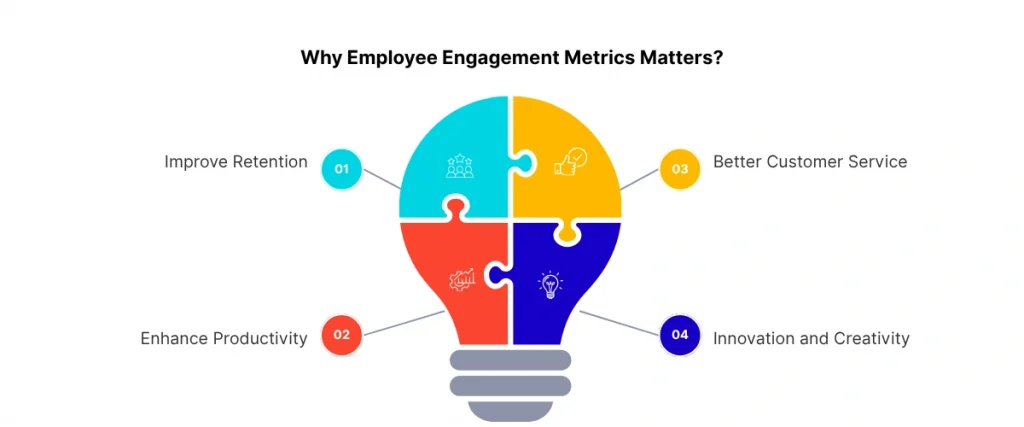
Employees who feel engaged with the workplace have been shown to improve productivity and foster a healthier team culture. It has also been proven to:
Improve Retention
Let’s be honest: When good workers leave, it costs a lot—not just in hiring new people but also in lost work and the mess it makes. Engaged employees who care about their jobs are 87% less likely to leave.
Enhance Productivity
When employees are engaged at work, they usually do a better job. They don’t just do the basics; they try harder and aim to do their best. This increased effort often shows up in how much work gets done and how well projects are completed.
As per Gallup research, $9.6 trillion in productivity can be added to the economy if the global workforce is fully engaged. Teams that enjoy their work tend to collaborate well and are generally more productive. It’s simple and effective.
Better Customer Service
Employee engagement doesn’t just impact productivity and workplace culture; it has also been shown to improve customer retention and ratings. Companies with a higher level of engagement often showcase a 24% higher Net Promoter Score, and also report a 20% increase in sales.
Engaged teams often deliver exceptional customer experiences, especially when supported by agile backend systems like Virtual Call Center Software, ensuring seamless service delivery and stronger engagement loops.
Innovation and Creativity
A workplace where employees feel valued and connected creates a safe space for new ideas to thrive. When employees are engaged, they feel safe voicing their opinions, suggesting improvements, and thinking outside the box.
They’re even more likely to take risks and be okay with failure, helping cultivate a culture of innovation and creativity.
Why should you measure employee engagement metrics?
If managers rely only on their intuition to evaluate the work culture, they remain totally oblivious to the hidden frustrations of their employees. Across the globe, such an oversight translates into huge losses, considering that the disengaged and hostile workplace culture costs approximately $10 trillion in lost productivity each year.
Employee engagement measurement provides you with indisputable numbers that indicate the team morale. Making employee engagement tracking a priority enables organisations to create an employee engagement scorecard that clearly shows what departments are doing well and which require intervention by the management.
Top 10 Employee Engagement Metrics to Track
To truly create an engaged workforce, HR leaders need to rely on more than just gut feelings; they need to have real data to back their intuitions. Here are 10 actionable employee engagement metrics that can help you improve team morale, boost productivity, and help foster a more engaged workforce:
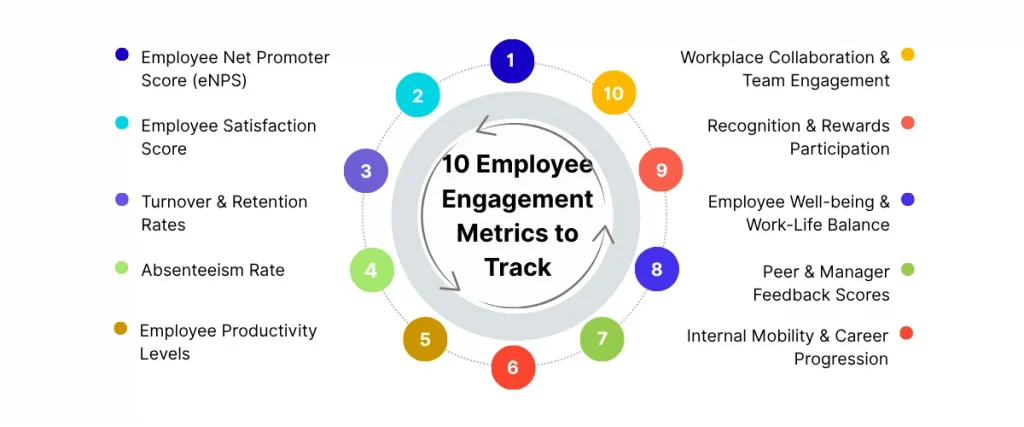
1. Employee Net Promoter Score (eNPS)
You must have already heard about Net Promoter Score (NPS), which tells you how satisfied your customers are with your services or products. Employee Net Promoter Score (eNPS) works in a similar fashion, only it gets direct feedback from your team.
To measure eNPS, you can ask one simple question to your employees: “On a scale of 0 to 10, how likely are you to recommend our company as a workplace to a friend or colleague?” Based on their responses, employees are categorized into three groups:
- Promoters (9-10): These are your enthusiastic and loyal employees who are likely to speak positively about your organization.
- Passives (7-8): Although they are not particularly excited to aggressively suggest your business, these workers are usually content.
- Detractors (0-6): These are employees who are likely dissatisfied and could potentially spread negative feedback.
eNPS is calculated as % of Promoters – % of Detractors. Passives aren’t factored into the score but can often provide valuable context.
Thus, a higher score indicates stronger employee engagement and loyalty, while a negative or low score can be a cause for worry.
2. Employee Satisfaction Score
Another crucial employee engagement metric is the Employee Satisfaction Score. While eNPS focuses on advocacy, the Employee Satisfaction Score focuses on your employees’ overall happiness and fulfillment in their current roles and the work environment.
To understand Employee Satisfaction Score, organizations usually use anonymous employee surveys with pointed questions about the various aspects of their job role, including:
- Work-life balance,
- Relationships with colleagues
- Management support
- Company culture
- Growth and development opportunities
- Overall satisfaction with the company
These questions use rating scales, such as 1 (Strongly Disagree) to 10 (Strongly Agree) or a similar Likert scale. You can calculate an average satisfaction score across the organization or for specific teams.
By analyzing each area of the responses, HR can understand where they are lacking. They can use this data to:
- Address dissatisfaction themes that show up repeatedly
- Train managers to be more empathetic and supportive
- Monitor teams for burnout and rebalance assignments as needed
- Provide upskilling and promotion opportunities that help employees grow

Suggested Read:
10 Strategies to Boost Employee Satisfaction & Happiness
3. Turnover & Retention Rates
Turnover rate or retention rate are used to understand how many employees stay with you organization in a defined time period. High turnover may indicate issues like disengagement or poor management, while strong retention rate suggests a healthy culture.
To calculate Turnover Rate, use the formula:
- Turnover Rate = (Employees who left ÷ Average total employees) × 100
For example, 10 departures out of 100 employees in a year mean a turnover rate of 10%.
To improve turnover rates, you can:
- Strengthen onboarding by helping new employees feel included and valued
- Encourage internal movement and promote role changes to prevent exits.
- Conduct exit interviews to identify why people leave and notice patterns.
- Invest in culture to create an environment where employees feel connected and appreciated
Suggested Read:
Employee Retention Guide: Strategies, Best Practices & Metrics
4. Absenteeism Rate
The absenteeism rate tracks the number of days an employee is unexpectedly absent from the workplace. If this number is unusually high, it can signal several red flags, such as low engagement, high burnout, or job dissatisfaction.
The absenteeism rate is calculated as:
- Absenteeism Rate = (Total number of unplanned absence days ÷ Total number of workdays for all employees) × 100.
To help keep this score low:
- Promote wellness programs by offering mental health days or active support to deal with work-related stress and issues
- Address burnout by using quick surveys to assess and respond to stress levels
- Offer flexibility to your employees, like hybrid work options to lower absences
- Boost the morale of your employees using awards and recognition to encourage a culture of ownership
Suggested Read:
Guide to Calculate and Reduce Employee Absenteeism Effectively
5. Employee Productivity Levels
Another metric to gauge engagement is Employee Productivity Levels. Engaged employees typically demonstrate higher productivity, meet deadlines, and exceed expectations by being more innovative and thinking out of the box.
Thus, you can capture productivity levels based on several factors like:
- Output volume: Count completed projects, closed tasks, or sales made
- Quality of work: Assess accuracy, attention to detail, and client satisfaction
- Time efficiency: Check if deadlines are met and how quickly tasks are completed
- Performance reviews: Use manager evaluations based on KPIs and OKRs
To keep track of your team’s performance, you can use Productivity Tracking Tools or PeopleStrong’s Talent Management module. It uses AI-powered insights to track goals and fetch real-time performance analytics to help you understand exactly how productive your teams are.
6. Internal Mobility & Career Progression
Another measure of employee engagement is internal mobility and career progression among existing team members. If you notice that most of your team members are getting promoted or changing roles, this indicates high internal mobility. It showcases that your Learning and Development programs are giving solid ROI.
To measure internal mobility and progression, look at:
- Promotion rate: Check the percentage of employees promoted over a certain time
- Lateral move rate: Track how many employees switch departments or roles
- Average time to promotion: Determine how quickly employees advance
- Training program participation: Measure the number of employees taking part in skill improvement courses.

Pro Tip: A Gartner study finds that most employees lack the motivation to upskill and participate in skilling initiatives, and only 16% know what makes up their organization’s Employee Value Proposition. Make sure to link your L&D programs with immediate impact, like a change in job role or a probable promotion, to encourage existing team members to upskill in their careers.
7. Peer & Manager Feedback Scores
Another approach to understanding employee engagement is to analyze their feelings about their co-workers and leadership. Peer and Manager Feedback is the cornerstone of an engaged workforce, as it helps employees feel more valued, understood, and supported.
To measure peer and manager feedback scores, you can initiate:
- 360-degree feedback surveys: Collect opinions from peers, reports, and supervisors
- Manager ratings scores: Evaluate leaders on communication, support, and fairness
- Team effectiveness surveys: Assess teamwork, problem-solving, and mutual support
8. Employee Well-being & Work-Life Balance
In any modern organization, employee well-being is no longer a perk – it’s a necessity for a sustainable and engaged workforce. This metric focuses on tracking employees’ stress levels, mental health, and overall sense of balance between their professional and personal lives.
To understand if your organization is truly prioritizing employee well-being and work-life balance, you can conduct:
- Employee well-being surveys: Ask employees if they often feel stressed, overworked, or mentally tired
- Use wellness resources: Check how many employees use mental health programs, wellness apps, or employee assistance programs (EAPs)
- Burnout Indicators: Monitor overtime hours, complaints, and reported stress cases
9. Recognition & Rewards Participation
Feeling appreciated is a fundamental human need, and in the workplace, recognition, and rewards play a significant role in boosting employee engagement. This metric tracks how often employees are recognized for their contributions and participation in formal or informal rewards programs.
To measure the success of your Recognition and Rewards program, make sure to:
- Look at the % of employees who are actively engaged on recognition platforms like Bonusly, Kudos, or other internal tools
- Frequency of recognitions given per month or quarter
- Employee satisfaction with regard to recognition programs and awards
- Peer-to-peer recognition volume to understand how often team members appreciate each other publicly
10. Workplace Collaboration & Team Engagement
Lastly, let’s examine a metric that examines the general dynamics within teams and the effectiveness of employee collaboration.
Teamwork and collaboration at work can be gauged using employee surveys about team dynamics, communication effectiveness, and the degree of trust and support within teams.
HR teams can also gain insights from team project feedback and participation rates, using it to understand team engagement and collaboration.Teams with higher levels of engagement are typically more cohesive, communicative, and successful at reaching common objectives. However, if this score is low, HR teams can work on:
- Promoting open communication to allow every team member to voice their opinion
- Facilitating interactions between diverse teams, to ensure that cross-functional teams can work together seamlessly on projects
- Offer chances for team-building exercises using off-site events or group sessions
- Make sure that roles and responsibilities are clearly defined within teams to avoid any confusion or internal politics
- Establish a culture that celebrates and values teamwork
What are the 3 aspects of measuring employee engagement?
Surveys
The digital pulse checks and annual surveys serve as the structural foundation for your data gathering efforts, making employee feelings quantifiable.
Employee Feedback
The open-ended questions from the surveys, suggestions boxes, and exit interviews serve as the necessary human element behind the numbers, providing the “why” of the data.
Key Performance Indicators (KPIs)
Linking your cultural information to specific operational KPIs such as retention, internal mobility, and performance will give you a balanced set of employee engagement KPIs which will connect the health of your workplace with business success.
Best Practices for Measuring Employee Engagement
Monitoring employee engagement involves more than just gathering data; it also entails acting upon the insights that are gleaned. HR directors must take a methodical and deliberate approach to accomplish this.
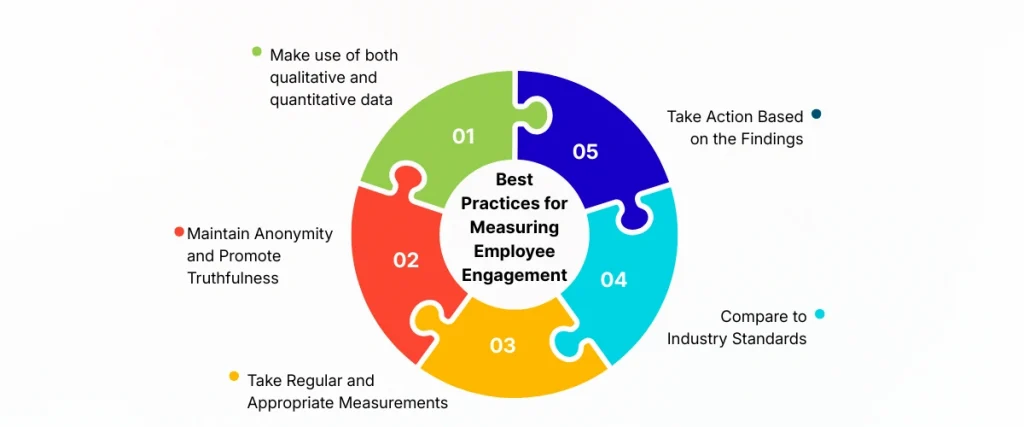
The following guidelines should be adhered to when assessing employee engagement:
1. Make use of both qualitative and quantitative data
Open-ended answers and qualitative feedback provide context and depth, while quantitative metrics and scores aid in identifying trends. Always include comment boxes in surveys that gather ratings to find out the “why” behind the score.
2. Maintain Anonymity and Promote Truthfulness
For engagement surveys to collect honest answers, they must be anonymous. When workers feel protected from criticism or reprisal, they are more inclined to provide candid feedback. Emphasize that each response is unique.
3. Take Regular and Appropriate Measurements
Don’t wait too long between engagement check-ins, but also don’t over survey. It usually works best to combine an annual in-depth engagement survey with quarterly pulse surveys.
4. Compare to Industry Standards
Use industry benchmarks to find out how your company compares to its peers. This aids in establishing reasonable objectives and monitoring advancement over time.
5. Take Action Based on the Findings
Feeling ignored is the biggest source of employee disengagement. Present findings to your teams and, using their input, develop precise action plans.
How PeopleStrong helps measure employee engagement metrics
PeopleStrong simplifies workplace data collection by moving away from messy, manual spreadsheets and replacing them with an integrated, automated platform. The platform lets HR teams deploy intelligent pulse surveys, track real-time eNPS trends, and build automated dashboards that highlight burnout risks and management issues before they impact retention. By centralising your feedback loops and operational metrics, PeopleStrong helps leadership turn raw workforce data into clear, actionable cultural improvements.
Wrapping Up
Monitoring employee engagement indicators is crucial to creating a supportive and effective work environment.
By monitoring these important metrics closely, HR leaders can learn a lot about how workers feel about their leadership, career opportunities, and work environment. Understanding engagement levels can result in a more inventive workforce, increased productivity, better customer service, and better retention.
Are you prepared to advance your approach to employee engagement? With PeopleStrong’s HR solutions, you can gain real-time insights into engagement trends, implement targeted interventions, and continuously improve your workplace culture.
Request a demo today and explore real-time engagement insights!
Frequently Asked Questions
Can employee engagement metrics predict turnover?
Yes. A steady drop in a team’s eNPS, an increase in negative manager feedback scores, or a sudden spike in unplanned absenteeism are some of the clearest early indicators that employees are burning out and likely looking for outside opportunities.
Why should you measure employee engagement metrics in Hybrid work?
When teams work remotely, you lose the casual, day-to-day office interactions that make it easy to spot frustration or isolation. Data shows that hybrid employees are actually 24% more engaged than fully on-site or fully remote workers when supported correctly; structured digital tracking ensures they stay connected to the company culture.
What to do after measuring the employee engagement metrics?
The immediate next step is sharing a transparent summary of the data with your team. Follow that up by setting up collaborative focus groups to build clear, practical action plans that address the top issues your people highlighted.
How do I measure employee engagement in my organisation?
Start by choosing a few core metrics, like eNPS and voluntary turnover. Use a secure, anonymous survey tool to establish your baseline scores and set up a predictable schedule for regular pulse checks.
Which tools can help automate the tracking of employee engagement metrics?
Comprehensive HR tech suites like PeopleStrong automate the entire process, from scheduling pulse checks to generating real-time dashboards and building your company’s engagement scorecard.
What are the key engagement metrics for tech companies?
Tech companies should pay close attention to internal mobility, peer-to-peer recognition participation, and specific well-being scores to keep a close eye on developer burnout in high-pressure environments.
Can we measure employee engagement without surveys?
While surveys are vital for direct feedback, you can gather a lot of data by tracking behavioural indicators like internal promotion rates, participation in optional company events, and absenteeism trends.
How to select the right employee engagement KPIs
Focus on a small, highly relevant set of metrics that connect directly to your current business goals. If your company is struggling with retention, make voluntary turnover and upward manager scores your primary KPIs.