












 About Us
 Brand
 Career
 Contact Us



 +91-7314623098


Quick overview:
Automated payroll software speeds up multi-entity processing across business operations. It helps to maintain enterprise-grade compliance with local statutory regulations and changing regional tax laws. It also centralises HRMS and ERP data into a single platform to deliver real-time labour cost visibility.
Key takeaways
- Payroll software automates gross-to-net processing to reduce cumulative financial leaks across pay cycles.
- Real-time local tax tables enable full compliance of multi-region APAC business operations with evolving labour legislation requirements.
- Direct API integration loops across HRMS, biometrics, and ERP ledgers reduce multi-entity payroll processing time.
- Unified payroll dashboards provide instant insight into the Total Cost of Workforce for improved financial budgeting.
- Mobile self-service portals provide access to payslips and tax documents.
Payroll errors are costly. A 2026 EY analysis puts the cost of fixing one payroll error at $339, and errors appear in 1 of 5 payrolls. For an enterprise paying thousands of people every month, those errors add up quickly.
However, payroll software benefits extend far beyond fixing mistakes. Forrester’s Total Economic Impact study reveals that enterprise organisations transitioning from fragmented payroll setups to automated global payroll engines achieve up to $6.4 million in compliance cost savings and realise a 75% reduction in manual payroll processing effort.
This blog walks you through the top 10 benefits of payroll software for businesses looking to automate operations and reduce costly errors.
Why Payroll Systems Need a Rethink in 2026
Large enterprises now pay people across multiple entities, regions, and employment types. Each location brings its own tax, social security, and labour rules. Those rules change often. Spreadsheets and disconnected tools struggle to keep up.
The benefits of payroll system automation become clear whenever rules change. A configured platform updates calculations once and applies them to every employee. The ten benefits below show what that looks like in practice.
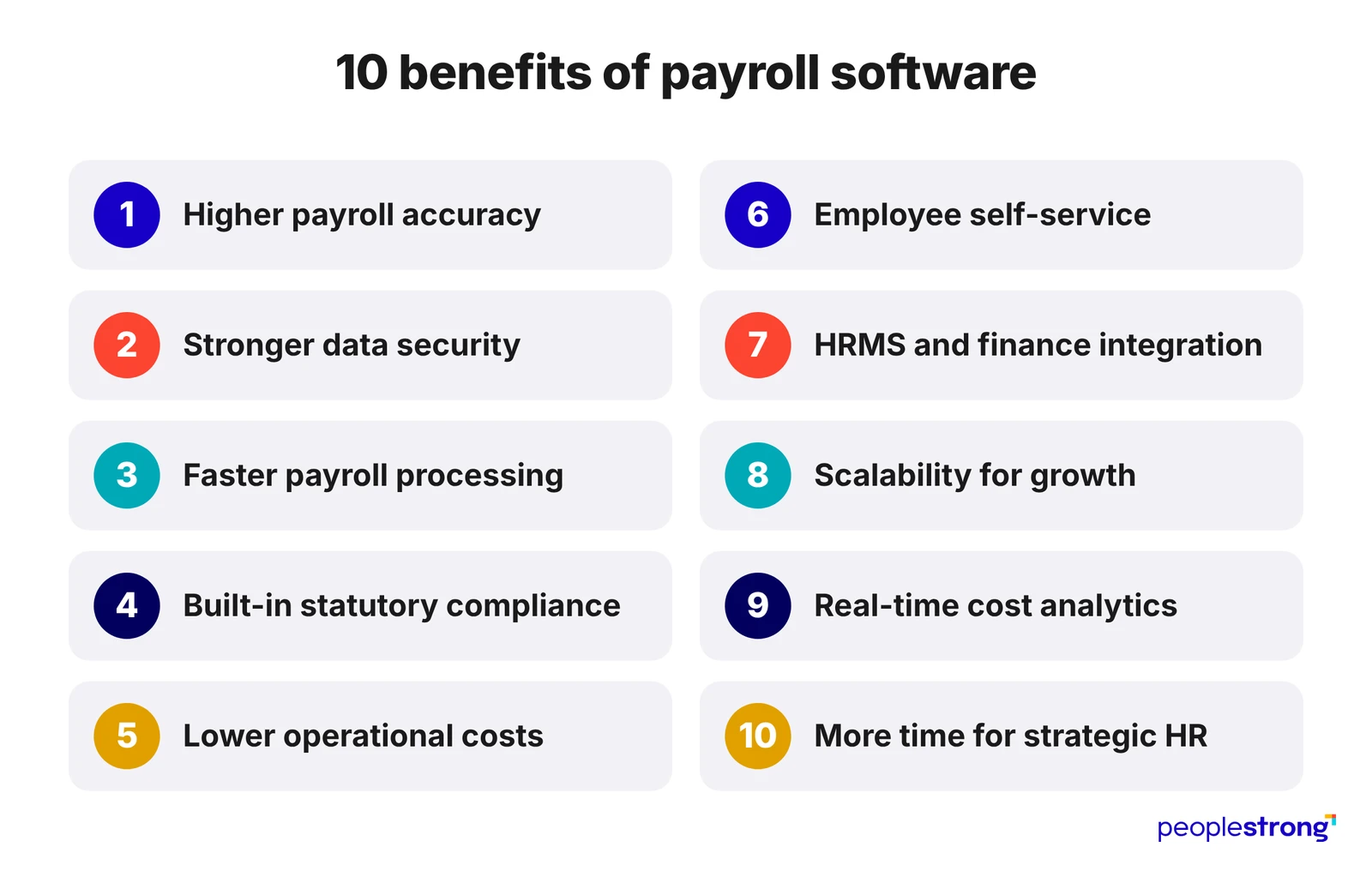
Top 10 Benefits of Using Payroll Software
Here is how modern payroll systems deliver value across enterprise operations:
1. Higher Payroll Accuracy
Manual payroll invites errors. Missed overtime and duplicate entries creep in when teams juggle spreadsheets. Software applies the same maths to every record in every cycle.
The first advantage of payroll system automation is that it removes manual handoffs. Most errors enter when attendance, leave and compensation data are re-keyed between files. A good platform validates every input against set rules before generating a single payslip.
Amara Raja Group shows how much this matters. The Indian multinational has over 15,000 employees and ran payroll on spreadsheets with no data validation. After moving to PeopleStrong, it cut processing time from 32 hours to 2 hours and reached 100% payroll data accuracy. Payroll team productivity rose by 91%.
2. Stronger Data Security
Payroll contains all critical organisational information in one location, including salary payments and tax identification numbers. So sending files by email increases the risk of data exposure.
Enterprise payroll platforms guard sensitive information through –
- Role-based access
- Encryption
- Complete audit logs
PeopleStrong’s payroll services are ISO 27001 certified and SOC 1, SOC 2, and SOC 3 assessed. Every change leaves a trail, and auditors get clear answers quickly.
3. Faster Payroll Processing
Payroll cycles consume days. Data collection, validation, approvals, and disbursal queue up. Automation runs these steps in parallel and flags exceptions early.
Southeast Asian carrier AirAsia unified its payroll on PeopleStrong and reports 35% faster processing. Shorter cycles give finance earlier visibility into cash outflow. HR gets time back for work that needs human judgement.
4. Built-In Statutory Compliance
Tax slabs and wage rules vary by country and state. Each change triggers recalculation and fresh filings.
Among the benefits of using payroll software, compliance sits near the top. Payroll software maintains statutory rules centrally. Audit-ready reports reduce penalty exposure. This means your team applies a rule change once, and it reaches every payslip.
5. Lower Operational Costs
Rework is a hidden cost centre. A commissioned 2026 EY analysis finds that time, presence, and expense errors cost organisations $289,722 per 1,000 employees. Fewer mistakes mean fewer correction cycles and escalations.
Payroll system automation reduces manual touchpoints. Teams spend less time on data entry and query handling. These savings compound across thousands of payslips every year.
6. Better Employee Experience Through Self-Service
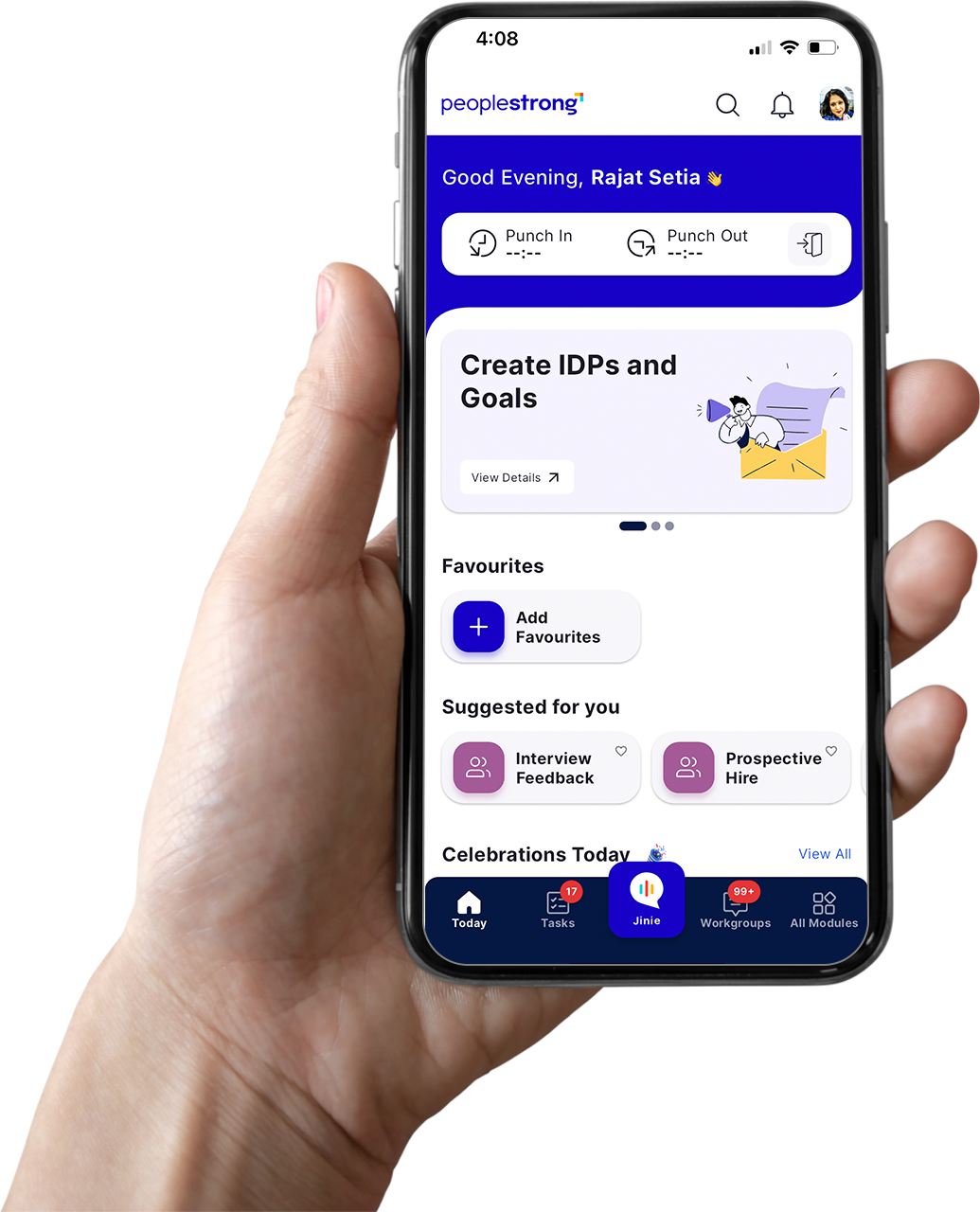
Delayed expense claims and unclear tax deduction breakdowns burden HR helpdesks with repetitive inquiry tickets while eroding employee trust. Mobile-first Employee Self-Service (ESS) portals grant staff direct access to –
- View digital payslips
- Check tax declarations
- Download annual withholding forms
- Log expense claims
Providing workforce transparency dramatically cuts internal support tickets and improves workplace satisfaction across regional offices.
An IT company case saved 15% of staff time by resolving queries faster. Clear payslips mean fewer HR tickets.
7. Seamless HRMS and Finance Integration
Payroll depends on attendance, leave, joiners, exits, and compensation data. When these live in separate tools, someone re-keys the data. That is where errors enter.
However, integrated payroll software pulls inputs straight from the HRMS and pushes journals to the ERP. One source of truth feeds every downstream process. As a result, manual payroll processing effort drops by up to 75%, while data accuracy across finance and HR ledgers reaches up to 100%.
8. Scalability for Growth and Mergers
Growth stresses payroll first. Pay structures change faster than teams can hire. A scalable platform absorbs the load without extra headcount.
A leading financial services company scaled payroll from 14,000 to 30,000 employees with PeopleStrong. It handled a complex merger without delay and reached 100% payroll automation. This is one of the benefits of using payroll software that CFOs value most during M&A.
9. Real-Time Analytics and Workforce Cost Visibility
Payroll data is a strategic asset that shows cost by –
- Department
- Overtime trends
- Attrition patterns
- Pay equity gaps
Dashboards turn these signals into decisions. Deloitte’s 2026 Global Human Capital Trends report surveyed more than 9,000 leaders across 89 countries. Seven in ten named speed and agility as their core competitive strategy. Speed depends on timely data. Payroll analytics let executives view hiring and budgeting costs in real time.
10. More Time for Strategic HR Work
This may be the most underrated benefit of payroll software. It changes HR’s role in the boardroom.
Every hour spent fixing payslips is an hour away from talent strategy. Automation removes repetitive checks and reconciliation. HR business partners can then focus on workforce planning and employee experience.
ROI Analysis: Manual vs. Automated Enterprise Payroll
Here is a quick snapshot of the financial impact of shifting from legacy processes to an automated payroll platform:
| Operational Metric | Legacy / Manual Processing | Enterprise Automated Payroll | Business Impact |
|---|---|---|---|
| Processing Time | 4 to 5 business days per cycle | Under 2 hours to complete run | >90% reduction in processing overhead |
| Effort Reduction | Heavy manual tracking | Automated data calculation | Up to 75% efficiency gain (Forrester) |
| Compliance Risk | Manual tracking of local statutory rules | Real-time statutory updates, auto-filing | Avoids audit penalties |
| Data Security | Shared spreadsheets, local file storage | Role-based encryption | Protection against data breaches |
| Cost of Compliance | High risk of late-filing fines & errors | Automated audit trails and rules engine | Up to $6.4M in compliance cost savings (Forrester) |
Make Payroll a Strategic Advantage
Payroll software benefits focus on regulatory compliance and operational scalability across APAC. As regional employment tax rules grow more complex, manual processes carry high risk. Payroll software automates local tax rules and regional labor laws to protect your bottom line.
Wondering where to start? Explore PeopleStrong’s payroll services to see how your team can run payroll accurately and easily. We serve over 500 enterprises across Asia Pacific and handle multi-country payroll complexity.
Schedule a product walkthrough to future-proof your payroll strategy!
Frequently asked questions
What is the biggest advantage of payroll system automation?
The main advantage is consistent accuracy, even as your company grows. Automated systems eliminate human error during calculations, which keeps employees happy and stops you from wasting money on constant pay corrections. Automatic tax and legal updates are a close second.
How does payroll software support multi-country compliance?
Good software built for international teams builds regional tax laws, labour codes, and reporting requirements directly into the system. Instead of tracking changing regulations manually in every location, you update the rules in one central hub. The platform then generates clear, audit-ready reports tailored to each country’s tax authority.
Is payroll software secure enough for enterprise data?
Yes, payroll software is secure enough for enterprise data when you pick a reliable payroll software provider. Reputed vendors employ bank-level security methods. These include end-to-end encryption and role-based access. Such platforms also showcase valid security certifications like ISO 27001 or SOC 2.