











 About Us
 Brand
 Career
 Contact Us



 +91-7314623098




Enterprise HR processes do not operate independently. A new hire may move through recruitment, document verification, onboarding, payroll setup, and mandatory training before completing their first week.
Each step relies on accurate information and timely action from several teams. If these processes are managed through disconnected systems, it will lead to an inconsistent employee experience.
The value of an HRMS therefore depends on how reliably the modules exchange information and support the full employee lifecycle.
This guide explains the principal HRMS modules, what each one manages, and the requirements enterprises should assess when choosing them.
Key takeaways
- HRMS modules are functional components that each manage one HR process while sharing employee data.
- Enterprises need modules across core operations, hiring, talent management, employee services and workforce intelligence.
- Most enterprises start with core HR, payroll, attendance, leave and employee self-service.
- Evaluate each module on record integrity, controls, integrations and fit with real policies.
- The strongest HRMS connects modules through consistent data, clear ownership and reliable workflows.
HRMS Modules at a Glance
What are HRMS modules?
HRMS modules are the functional components of a human resource management system. Each module manages a specific HR process while sharing employee data with other parts of the system.
Essential enterprise HRMS modules include:
- Core operations: Core HR, payroll, attendance, leave and benefits
- Hiring: Recruitment and onboarding
- Talent management: Performance, learning, compensation and succession planning
- Employee services: Self-service, HR support and offboarding
- Workforce intelligence: People analytics and workforce planning
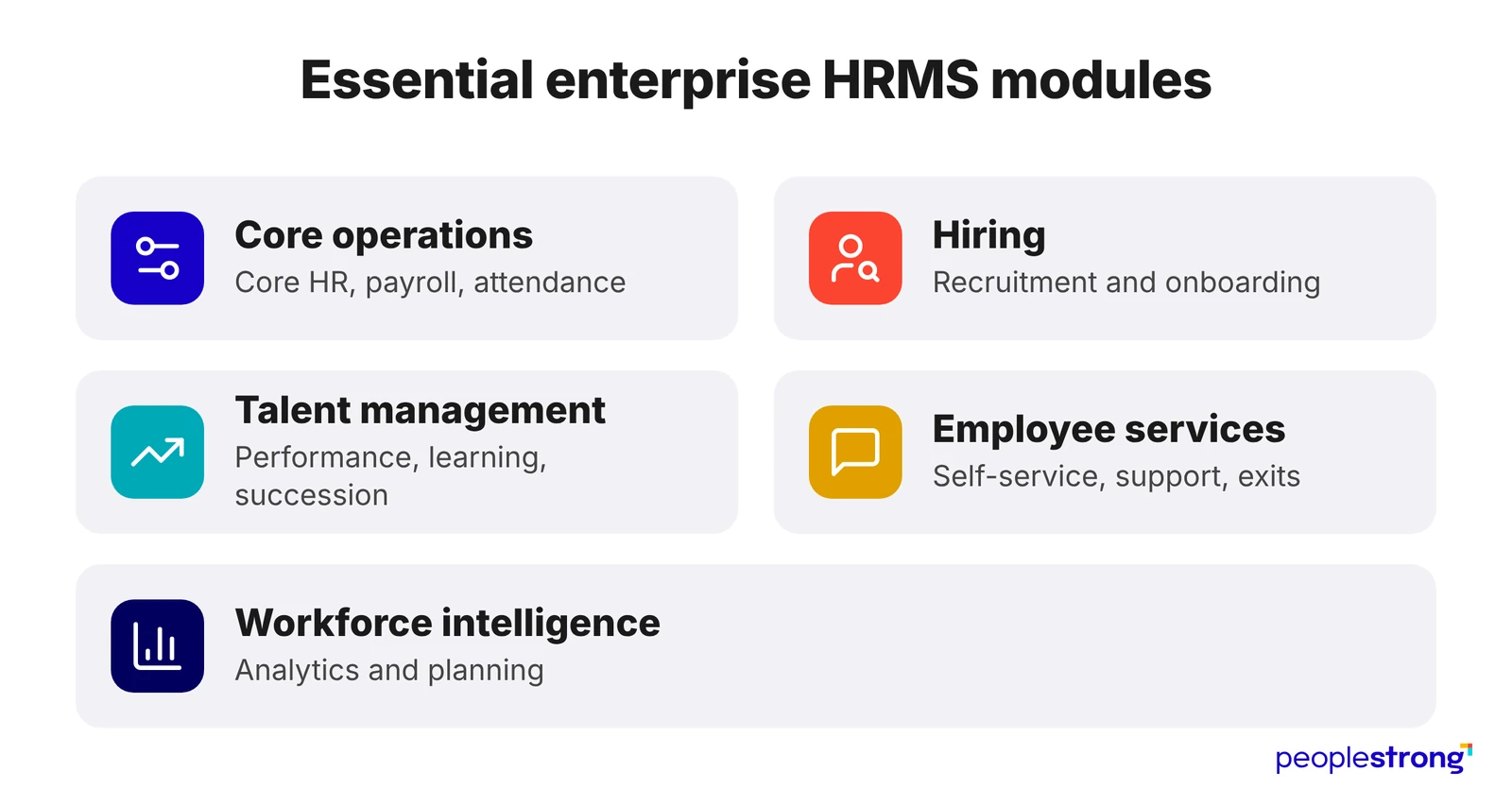
Enterprises should choose modules based on their workforce structure, compliance requirements, and operational priorities. The strongest HRMS connects these modules through consistent data, clear ownership and reliable workflows.
What Are HRMS Modules?
HRMS modules are the functional components of a human resource management system.
Each module manages a specific area of HR, such as payroll, recruitment, attendance, learning or performance management.
Together, these modules support the processes through which an organisation hires, manages, develops, pays and eventually separates employees.
HRMS Modules List for Enterprise Operations in 2026
| HRMS Module | Primary responsibility |
|---|---|
| Core HR | Employee and organisational records |
| Payroll | Earnings, deductions and payments |
| Attendance and leave | Work, absence and schedules |
| Recruitment | Vacancies, candidates and offers |
| Onboarding | New-hire preparation |
| Performance | Goals, feedback and reviews |
| Learning | Training, skills and certifications |
| Compensation and benefits | Rewards, eligibility and enrolment |
| Career and succession | Mobility and leadership continuity |
| Employee services | Self-service and HR support |
| People analytics | Workforce reports and plans |
| Exit management | Separation and clearance |
1. Core HR and Employee Records
Core HR maintains employee identities, employment histories, organisational structures and documents across entities and locations.
What to evaluate:
- Record integrity: Does the system retain dated employment changes and a complete audit history?
- Structure and security: Can it support multiple entities and assignments while restricting access by role, field and employee group?
Explore how PeopleStrong’s core HR software supports employee records and lifecycle administration.
2. Payroll Management
Payroll calculates earnings, deductions, arrears and payments using approved employment, attendance and leave data.
What to evaluate:
- Accuracy and control: Can payroll teams validate each run, trace calculations and separate preparation from approval?
- Corrections and coverage: Does the system handle reversals, off-cycle payments and country-specific requirements with a complete audit trail?
- Integration: Can approved data move reliably between payroll, core HR, attendance and finance?
Explore how PeopleStrong’s payroll software supports controlled payroll processing and compliance.
3. Attendance, Leave and Scheduling
These modules connect scheduled work with attendance and approved absence across different shifts, calendars and policies.
What to evaluate:
- Can the system apply the correct schedules, leave policies and payable-time rules to each employee group?
- Does it identify exceptions and track corrections before payroll closes?
4. Recruitment and Applicant Tracking
Recruitment manages vacancies, applications, assessments, interviews and offers, including delays in approvals and decisions.
What to evaluate:
- Can teams identify approval delays and compare candidate progression across roles and locations?
- Does verified candidate information move into onboarding, with accepted offers reported separately from confirmed joiners?
5. Onboarding
Onboarding coordinates documents, policy acknowledgements, equipment, access and induction across HR, managers, IT and facilities.
What to evaluate:
- Does every task have an accountable owner, deadline and visible status?
- Can the system distinguish document submission from verification and show whether the employee is ready before the joining date?
6. Performance Management
Performance modules maintain goals, feedback and reviews when roles or reporting relationships change.
What to evaluate:
- Do goals, evidence, and review histories remain when reporting relationships change?
- Can the module support different assessment criteria while retaining rating and moderation records?
Gartner reported that only 39% of employees considered their manager effective at providing developmental feedback.
7. Learning and Skills Development
Learning modules assign programmes, record completion and connect role requirements with employee skills.
What to evaluate:
- Can training be assigned based on an employee’s role, location, and skill requirements?
- Does the system retain course versions, completion evidence and certification expiry dates?
In April 2026, McKinsey reported that 75% of US workers expected AI to change their roles within five years, but only 45% had recently completed an upskilling programme.
Explore how PeopleStrong’s learning platform supports recurring requirements as roles change.
8. Compensation and Benefits
Compensation planning supports salary increases, incentives and reward budgets. Benefits administration manages eligibility, enrolment and coverage changes.
What to evaluate:
- Can managers compare proposed awards with budgets while HR reviews exceptions and approval history?
- Do approved compensation and benefit changes reach payroll without including proposals still under discussion?
9. Career and Succession Planning
Career and succession tools connect employee opportunities with critical roles, potential successors and development requirements.
What to evaluate:
- Does the module distinguish current performance from readiness for another role?
- Can HR identify critical positions without credible, available and willing successors?
10. Employee Self-Service and HR Support
Employee services provide document access, permitted updates, requests and tracked HR support.
What to evaluate:
- Can employees view request status and identify the team responsible for the next action?
- Does the system protect sensitive cases and escalate requests that exceed response targets?
11. People Analytics and Workforce Planning
Analytics reports on the workforce, while planning models future roles, capacity and cost.
What to evaluate:
- Are workforce metrics based on consistent definitions and traceable source records?
- Can users keep approved workforce plans separate from hypothetical scenarios?
12. Exit and Clearance Management
Exit management coordinates notice periods, handovers, clearance, final settlement and access removal.
What to evaluate:
- Can teams track outstanding actions by responsible department and reconcile settlement inputs with payroll?
- Does the system confirm that access has been removed from connected applications?
How to choose the right HRMS modules
A useful selection process should answer six questions:
- Does the module support the organisation’s real policies?
- Can it share dependable data?
- Are security controls sufficiently detailed?
- Can administrators configure it without constant vendor support?
- Does it produce evidence in addition to activity?
- Will employees and managers use it?
AI features deserve the same scrutiny. McKinsey reported operational AI in 28% of HR processes in 2026, with another 37% still in pilot stages. The research also found that adoption was concentrated in administrative areas such as time and absence, process optimisation and employee data management.
The bottom line: Go for a connected HRMS
There is no universal HRMS modules list that suits every enterprise.
A manufacturer with shift-based employees, a professional-services firm and a multinational retailer will place different demands on payroll, scheduling, recruitment and learning.
The right choice begins with business processes and data responsibilities.
Module names help organise the evaluation, but the real questions concern coverage, controls and connections.
When those elements are sound, the HRMS gives employees, managers and HR teams one dependable way to complete work across the employment lifecycle.
Explore PeopleStrong to see how core HR, payroll and talent management can work together.
Frequently asked questions
Does an enterprise need every HRMS module?
An enterprise does not need every HRMS module from the initial implementation. The best approach is to prioritise modules that address immediate operational needs, regulatory requirements and process dependencies. Enterprises can add additional capabilities later if the HRMS supports phased implementation without extensive restructuring.
Which HRMS modules should an enterprise implement first?
Most enterprises should begin with core HR, payroll, time and attendance, leave management, and employee self-service. These HRMS modules establish dependable employee records and support essential workforce operations. Recruitment, onboarding, performance, learning, and analytics can then be prioritised based on business needs.
Are HRMS modules priced separately?
HRMS vendors may price modules individually, bundle them into packages or include them in an enterprise agreement. Buyers should confirm module access, employee limits, implementation fees, integrations, support charges and future expansion costs in the written proposal. Product demonstrations may include features that are absent from the quoted subscription.
Can HRMS modules from different providers work together?
HRMS modules from different providers can work together through application programming interfaces, pre-built connectors or scheduled data transfers. Successful integration requires consistent employee identifiers, clear data ownership, an agreed update frequency and a process for resolving failed transfers. Buyers should also confirm whether information moves in one direction or both.
Is employee self-service a separate HRMS module?
Employee self-service may be included within the core HR module or offered as a separate module, depending on the vendor. Its capabilities can range from viewing payslips and personal records to updating information, requesting leave and completing HR forms. Enterprises should verify which tasks are available on desktop and mobile devices.
Can one payroll module support employees in multiple countries?
A payroll module can support multiple countries if the provider offers the required local calculations, statutory reporting, tax updates and payment capabilities. Some HRMS vendors provide payroll directly, while others rely on local partners. Enterprises should verify coverage and accountability for every country because global employee-data support does not automatically include global payroll processing.
Is AI offered as a separate HRMS module?
AI is usually embedded within HRMS modules rather than offered as a single standalone module. Common applications include candidate matching, employee-service assistants, workforce analysis and learning recommendations. Enterprises should examine the data used, output accuracy, human-review controls, auditability, and any additional usage charges.
Can an enterprise add more HRMS modules after implementation?
Most enterprise HRMS platforms allow customers to add modules after the initial implementation. However, each addition may require licensing, data preparation, system integration, workflow configuration, testing and user training. Consider future requirements during the original design so new modules can use the same employee records, organisational structures, and security model.