












 About Us
 Brand
Brand
 Career
 Contact Us



 +91-7314623098







You want to implement a long-term succession plan for your organization. You also want smooth functionality amongst departments and seamless productivity – today and in the future. The best way to do it is to have the right person in the right position at the right time. To get it right every time, and make the practice sustainable, you need a solid framework in place. Succession planning takes care of it.

It clarifies the short-term and long-term staffing needs of your organization and then sets up a tailor-made plan to identify, attract, and deploy the right people. That’s why for 49% of organizations, succession planning is a top priority.
Succession planning is a strategic approach aimed at eliminating any such disruptions. It entails ensuring that there is sufficient talent in the organisation to fill any leadership voids.
This blog will take you through what succession planning is in its essence, how to set it up, and measure its success in your organization.
What is Succession Planning?
Succession planning is a systematic process of identifying the crucial positions within an organisation and developing the in-house talent for filling those roles in the future.
Succession planning is not simply a response to an immediate resignation. Succession planning is an ongoing, long-term approach to managing talent in a structured manner and preparing for the future needs of the company.
Why is succession planning important?
Over half of the organizations studied by SHRM have had difficulty retaining full-time regular employees in the last 12 months. 3 in 4 HRs report that it has been somewhat or very difficult to find qualified individuals with the new skills they need. This is major because people want their organizations to pave the way for them to climb higher while tending to their aspirations. When that doesn’t happen, people leave.
Leadership pipelines are often affected when someone leaves and their successors aren’t equipped to lead as well as possible. If the CEO’s departure was abrupt, it’s unlikely that the company has a fully developed back-up capable of achieving the same results, in such a case. Gallup studies reveal that poorly managed CEO and C-suite transitions have resulted in a loss of $1 Trillion.
In these cases, two things happen:
- Recruit an outsider who doesn’t know the company/values well
- Promote an insider who isn’t ready to take on the topmost position in the company
A good succession plan ensures you select and prepare the right people to assume leadership positions at all levels of the company. It’s hard to find a CEO if there are no other capable leaders internally, in any other positions. Moreover, CEOs brought in from the outside have an 84% greater chance of turnover than insiders in the first 3 years, usually for poor performance.
Here is how succession planning helps the organization, managers, and employees:
- It helps talk to direct reports about their future – employees need to know how they are viewed by the organization, so they can make realistic choices about what to do next and how to pursue their own development.
- Employees are fully, and highly engaged.
- Makes growth equitable – no more fast-tracking
- Shows you how many people aren’t the best fit for your system, in terms of performance, and potential, and you can decide if you need to retrain them or let them go respectfully.
- Makes the organization resilient, and ensures organizational success
What is the Purpose of Succession Planning?
The primary aim of succession planning is to ensure smooth continuity within the organisation when key personnel exit. The process not only involves planned exits like retirement but also unplanned events like resignation and death.
Apart from risk management, some key purposes of successful succession planning include:
- Preserves Institutional Knowledge: Retains a critical knowledge base and institutional experience within the organisation.
- Reduces Recruitment Costs: Reduces costs of using recruitment agencies for hiring executives.
- Drives Employee Retention: Retains the good performers in the organisation by providing them a defined career path.
- Accelerates Leadership Transitions: Ensures that the new leaders are ready to go once they join because they know the organisational culture and processes.
What is the role of HR in succession planning?
Although not all high-performers desire to lead, some do. A good group of people constantly nurtured and moved up the pipeline means when there’s time to find an organizational head, there won’t be a dearth of candidates.
Most times, succession planning is thought of as an HR’s job, to follow up with managers and employees, and send dozens of emails every quarter to monitor performance. But, there are so many other functions HR does that support succession planning.
Apart from being the custodians of talent, they train, coach, and address any problems talent has, to keep them loyal and happy with the organization.
- Troubleshoot, and solve problems
- Gather feedback and counsel employees and managers if they receive complaints or see a concerning trend.
- Escalate succession planning discussions or a rising star’s potential to the leadership level
- Create a futuristic job design that averts any problems that might lead to failure.
- Throughout the quarter or the year, people’s motivation dwindles. HRs help motivate people, keeping them heard, delighted, recognized, engaged, healthy, and happy with the organization.
- Smoothens employee relationships with managers, so employees can focus on learning and growing without being bogged down by their issues with managers.
Succession Planning Model
A robust succession planning model balances immediate risk management with long-term leadership development. Rather than focusing on a simple 1:1 replacement for an individual manager, modern enterprise models focus on building a sustainable talent pipeline.
This model moves in a continuous feedback loop. As strategy changes, critical roles are looked at again, talent is reviewed, development plans are updated, and results are checked.
Succession Planning Framework
Four conditions have to be in place before the process can function across a large organisation:
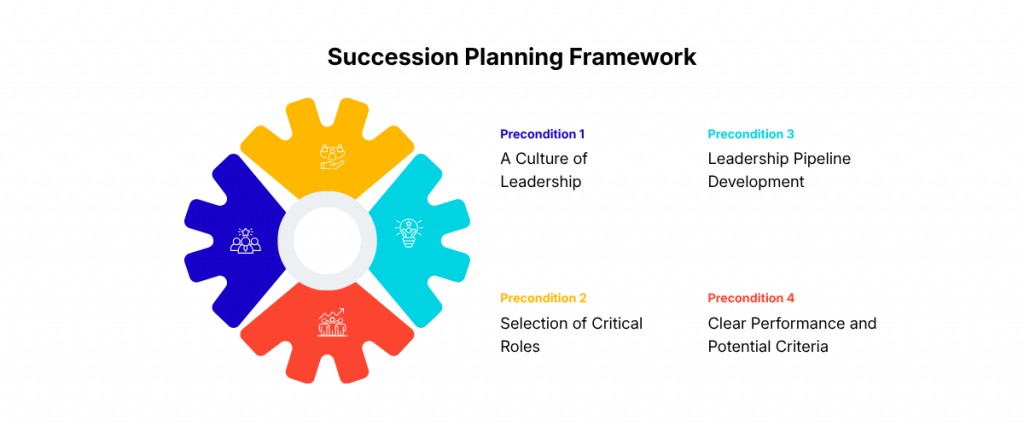
Precondition 1: A Culture of Leadership
Succession is not an activity that can be managed solely by the HR team. It needs executive sponsorship as well as a work environment where managers help to coach and mentor their reports as opposed to keeping the talent within their teams.
Precondition 2: Selection of Critical Roles
Not every position needs a formal succession plan. Organisations need to identify those functions that directly create revenue, control critical functions, mitigate regulatory risks or have critical technical expertise.
Precondition 3: Leadership Pipeline Development
There is a strong succession structure at all levels of the leadership pipeline from frontline supervisors and middle managers to executive directors. This prevents future talent bottlenecks.
Precondition 4: Clear Performance and Potential Criteria
In order to avoid bias and subjective decision-making, objective criteria must be developed to assess the current performance of an employee and their future potential to become a leader.
Succession Planning Process: 4 Key Steps
The implementation process involves four steps:
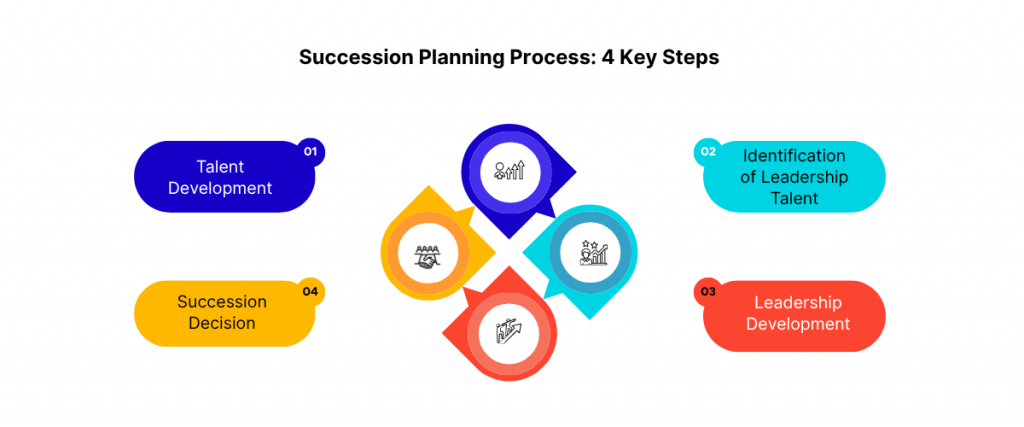
Step 1: Talent Development
Begin with creating the foundation through the development of learning programmes, skills matrices, and cross-training programmes for the entire organisation.
Step 2: Identification of Leadership Talent
Assess your employees and identify talented employees who are able to fill leadership positions within one, three, or five years.
Step 3: Leadership Development
Focus on target development for known successors. This encompasses executive coaching, cross-functional rotations, visibility assignments, and board presentations.
Step 4: Succession Decision
If one of the key positions is vacated, the leadership of the company knows who the employees are that could possibly replace the person and is ready for a smooth transition.
Succession planning process and strategy
1. Set the leadership pipeline to suit your organization’s needs
You’re creating or rebuilding a strong foundation for a system that’ll nurture people at multiple levels, with varying needs, at different frequencies, while staying closely aligned with what the business needs. It’s nerve-wracking to set up, but once done, it’ll run like a self-sustaining machine.
Here’s how you set it up right:
- Zoom out of your organizational lens, and map out your organization’s macro workflow – the entire throughput – how one function powers the other and ends up producing the output.
- Once you do that, hone in on every department. Zoom in on every function and map out all the processes that the department does.
- After that, categorize the functions into different levels, depending on the complexity involved and the order of increasing responsibility. Assign designations to each level. Once you do this for all departments, you’ll come up with a refined organizational structure.
- Come up with different sets of competencies – behavioral, functional (domain-specific), cross-functional, and core competencies with a level (1-10) required for the jobholder to perform effectively. Each level will have a higher set of competencies so that there’s a learning curve that requires the jobholder to develop holistically.
- Define each level of each competency, so there’s no ambiguity.
This exercise, when done right, can help you immensely. It’ll lay out roadmaps for employees in different roles, so they have a clear-cut vision of where they can go when they mature in their current role.
2. Communicate roles, responsibilities, and all expectations to employees
Right from the interview phase to onboarding, 90-day induction, to confirmation, convey competency expectations to employees, and instill hope in them that they can have a prosperous career with your organization, should they check off competency and experience requirements. This will avoid any duplication or misunderstanding.
3. Identify the link between performance and potential, and set standards for measurement
| Turn potential | Growth potential | Mastery potential |
| The person is able to do the work at the next level in 3-5 years or sooner | The person is able to do the work of bigger jobs at the same level in the near term | Able to do the same kind of work, at the same level, only better |
Performance is the ability of someone to do their current job responsibilities. The potential is a person’s ability to pull their weight and commit to growing and improving their capabilities to take on higher-order tasks.
Judging someone’s potential to be a leader is not easy. The first requirement is high performance, and then the attribute to rise to the occasion to help the team, get down to the trenches, pull off hard-to-do tasks for the team, go above and beyond, and so much more. But, simply put, it means the willingness to develop oneself to grow. That’s how you define potential.
As much as performance is important, potential – the ability to develop new skills, adapt, and take on challenges is also important. Consider if they are willing to step up, or if they only want to take up challenges at the same level.
4. Evaluate candidates at different points of the employee lifecycle
William J Rothwell, President at Rothwell & Associates, Inc. says, “Once people have been identified as potential successors, their development as leaders should be regarded as a strategic goal of the company.”
Only 22% of employees strongly agree that their performance is managed in a way that motivates them to do outstanding work. This isn’t just during performance reviews. Employees appreciate candid feedback, delivered right.
Evaluate them during different points in their time with your company – when they join, when they’re confirmed, when they’re promoted, when rise to the occasion to get something done, or any such important milestone. It’s in these important moments do you see someone’s potential and the leadership capabilities they have. Set up robust feedback and evaluation tools in your HR tech stack, so that all these crucial observations are recorded, and are referred back to when thinking about people who are leader-material.
5. Ensure learning and development is made part of everyone’s daily routine
Since you’ve set up unique competency needs for each designation, there’s a lot of growth required for anyone to move from one position to another. Let’s be honest, everyone is in a hurry, with jam-packed schedules that don’t really allow them to think about learning or attending a training program. Everyone wants to check off items on their never-ending to-do list. The best way to squeeze in learning in everyone’s schedules is to make it natural.
Affix one learning goal a day for everyone in the organization – it can be as simple as helping out a colleague on something they aren’t proficient in, reading a chapter of a book, etc, taking on stretch assignments, etc. Also, think about whether a candidate is likely to produce results in a different context. Are they capable of transitioning to a new set of values, and moving to a different working routine? If they are, introduce elements of the new routine into their schedule.
6. Set up a multi-level succession planning review committee and conduct reviews regularly
Succession planning isn’t something you do once a year and then pick up again after a year. It isn’t solely HR’s responsibility. For every position, ensure your review committee contains managers of two levels to oversee how the succession planning efforts go on. Make reviews for every quarter. CEO and their direct reports should be privy to performance-potential ratings for the leadership pipeline.
Having the two-level accountability using standards will greatly increase the odds of selecting the right people for key leadership positions.
How to Create a Succession Plan
Several steps are involved in creating a succession plan:
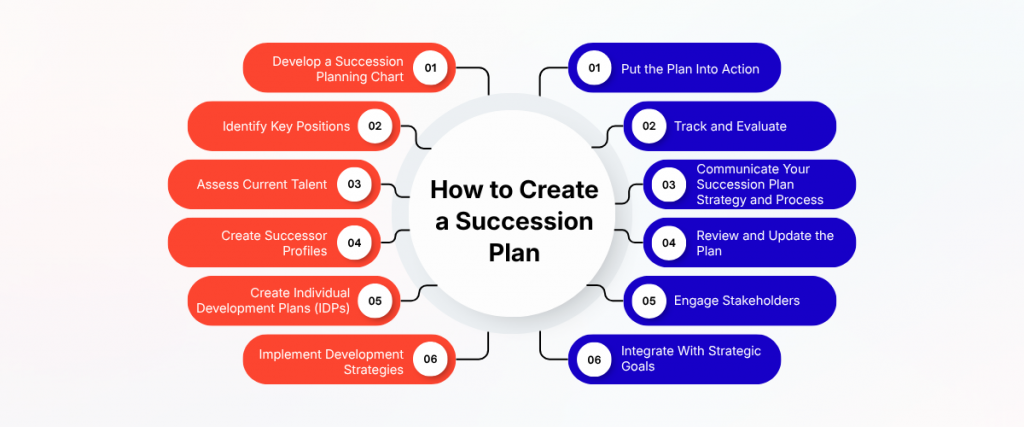
- Develop a Succession Planning Chart: Draw an organisational chart highlighting talent readiness, including critical positions and internal successors, along with their readiness status, whether ready now, in one to two years or in three years or more.
- Identify Key Positions: Work with the department heads to list all the critical positions within the firm. Ask the following question: What will be the effect of the absence of this position from your firm for three months?
- Assess Current Talent: Objective evaluation methods, including the 9-Box Matrix (an analysis of the performance and potential of employees), should be used in order to assess the current workforce and find high potentials among them.
- Create Successor Profiles: Prepare profiles detailing specific competencies, skills, leadership traits, and certifications needed for each particular job in order to inform successors about their obligations.
- Create Individual Development Plans (IDPs): Create individual development plans for successors selected in step three above. IDPs should contain information on skill gaps, deadlines, and learning objectives.
- Implement Development Strategies: Offer learning and development initiatives in the form of stretch assignments, temporary management coverage while managers are on leave, cross-functional projects, and executive mentoring.
- Put the Plan Into Action: Ensure that the succession planning process becomes an integral part of the HR processes. Make sure the internal pool is checked prior to initiating any external recruitment for key positions.
- Track and Evaluate: Keep track of performance metrics on a continuous basis, such as the internal promotions vs. external recruitment metric for key positions and the attrition rates of high-potential employees.
- Communicate Your Succession Plan Strategy and Process: Clearly articulate the succession planning process within your organisation. Even though the results of the individuals’ assessments should be kept private between the managers and subordinates, the general process must be clearly defined and fair.
- Review and Update the Plan: Review the succession plan at least twice a year. Objectives of the organisation change, employees leave, and the list of high-performing staff changes as well; therefore, the plan must be flexible enough.
- Engage Stakeholders: Make sure that executive leaders, board members, and department heads actively participate in the talent review process and develop candidates.
- Integrate With Strategic Goals: Align succession objectives with the long-term growth plans of the organisation. If the company wants to expand into new geographic locations or technologies in three years, the talent pool must reflect those requirements now.
Succession Planning Examples
Corporate Leadership Transition (CEO/Executive Level)
A COO gives 18 months’ notice of retirement. Two vice presidents are named as possible successors. Over the following year, both receive extra duties, investor-call responsibility, and direct mentoring from the CEO. When the COO leaves, one vice president steps up with no break in operations.
Critical Technical Succession
A principal architect who owns the legacy database announces retirement. A senior engineer with strong technical ability is given a two-year development plan. The engineer shadows the architect, earns advanced certifications, and gradually takes over maintenance work. The handover occurs without system disruption.
Common mistakes in succession planning
- Succession planning not going all the way down to the entry level.
- Focusing succession planning efforts only on the CEO or C-suite levels, and not nearly on other roles.
- When senior executives don’t perform, they fall short in team management. They don’t nurture and coach their direct reports to move up a leadership level.
- Selecting the wrong person for the organization. Skill and experience levels for two adjacent levels may be similar, but specific levels of skills may reveal significant differences.
- Showing results at one level is considered the basis for promoting someone.
- Leaving the wrong person in the job too long out of loyalty, or a false sense of compassion.
- A manager beginning to replicate behaviors almost identical to those that brought them an earlier success.
- Failure to seek or listen to feedback, or not taking action on feedback received from employees.
- Defining a job poorly, without any clarity, with no responsibility matrix if anything goes wrong in succession planning
Best Practices for Effective Succession Planning
Adopt a Long-Term Perspective
Avoid treating succession planning as an emergency checklist. Build leadership pipelines with a 3-to-5-year operational horizon in mind.
Ensure Structured Development
Do not rely solely on passive shadowing. Combine hands-on stretch assignments, classroom training, cross-functional rotations, and executive coaching.
Integrate Succession Planning with Talent Management
Link succession plans directly to performance reviews, compensation models, learning management systems (LMS), and recruitment strategies.
Measure Outcomes, Not Process
Evaluate success based on real business impact, like internal promotion rates, time-to-productivity for new leaders, and retention of high-potential talent, rather than simple plan completion.
Be Realistic & Communicate Clearly
Keep expectations grounded. Clearly inform candidates that being identified as a potential successor means they are being developed for future opportunities, not receiving a guaranteed promotion.
Measuring the ROI of succession planning initiatives
You’ve set the succession planning initiatives and seen them running for a while, after herculean effort and a lot of time. You need to steer it back to course if it isn’t serving your needs anymore. Look at the following metrics and determine if your succession planning initiative is serving you well or not:
- No. of vacant positions filled over time as a result of the succession plan
- Quality of performance of new hires
- No. of people hired within vs how many have been recruited from external talent sources
- Which talent sources are turning out to be the most fruitful resources in quickly finding replacements
- Turnover in areas/departments addressed by the succession plan (In 49% of organizations, limited advancement opportunities are a high retention challenge in the last 12 months)
- Time taken to fill key positions
How Can PeopleStrong Help With Succession Planning?
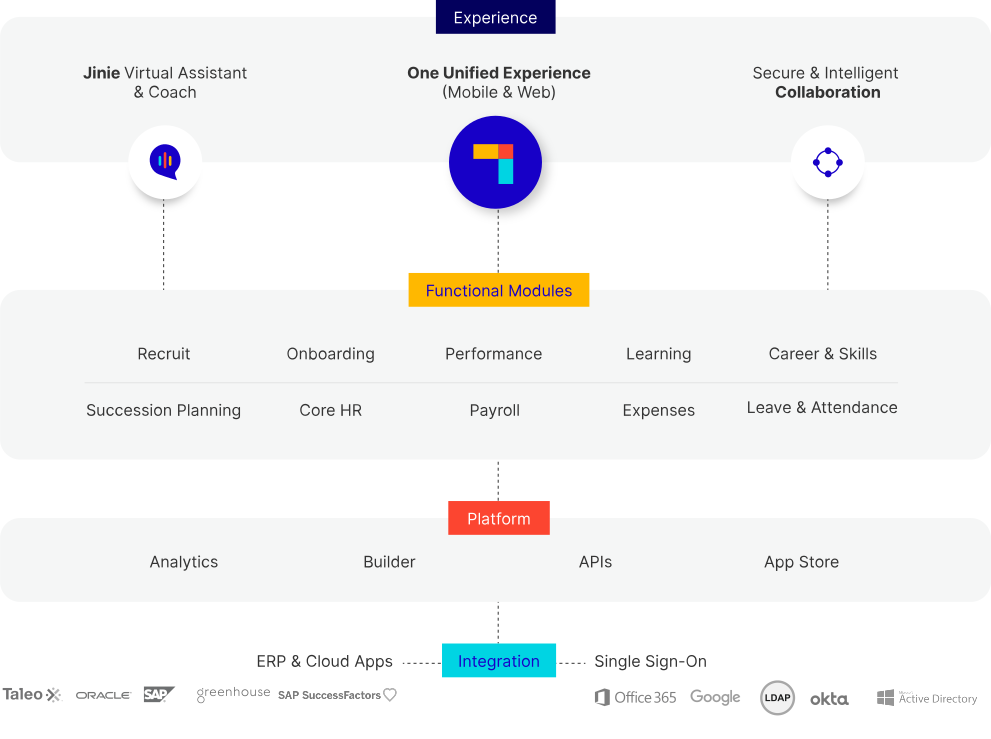
PeopleStrong can play a crucial role in succession planning by providing tools and expertise to help organizations formulate succession planning policies, procedures, and action plans that align with their strategic goals.
The platform assists in assessing present work or competency requirements and evaluating current employee performance to ensure that the right individuals are identified for future leadership roles. By enabling organizations to determine future work or company requirements and assess potential within their workforce, PeopleStrong helps close developmental gaps through targeted learning and development initiatives.
Additionally, our AI-assisted tech solutions help companies maintain talent inventories, ensuring that potential successors are tracked and developed over time. Furthermore, PeopleStrong supports the ongoing evaluation of these programs to ensure they remain effective and aligned with the evolving needs of the organization.
Contact us to get a real-time free product demo, and view how PeopleStrong can make your succession planning plans become a reality.
Frequently Asked Questions
What are the 4 steps of succession planning?
They are talent development, identification of leadership talent, targeted leadership development, and the actual succession decision.
What are the 5 P’s of succession planning?
The 5 P’s principle includes:
- Purpose: Determining what makes the succession plan necessary.
- People: Discovering potential employees to be included in the plan.
- Process: Developing a consistent process to assess individuals objectively.
- Product: Developing individual development plans (IDP).
- Perpetuity: Periodically evaluating and revising the plan.
How do you write a simple succession plan?
To draft a basic succession plan:
- Identify your organisation’s key 3 to 5 positions.
- Identify 1 to 2 internal successors for each position.
- Establish their timeframe for preparation.
- Define 2 to 3 key development activities that each must accomplish this year.
How do you measure the success of a succession plan?
Success should be evaluated based on quantitative parameters such as internal promotion rate of critical roles, retention rate of promising employees, speed of transition when there is an opening in the critical role, and performance of the new leader 12 months after promotion.
What is the difference between succession planning and replacement planning?
In contrast to replacement planning, which is a short-term and reactive method for filling a vacancy in case of an emergency, succession planning is a long-term and proactive practice designed for developing internal talent for filling future leadership needs.
How does succession planning software help HR teams?
Succession planning software consolidates data about talents, automates the process of creating 9-box talent matrices, records progress in developing employees, and offers real-time dashboards for leadership pipeline management within enterprise organisations.
What metrics determine succession planning success?
To evaluate how effective succession planning is, professionals usually use indicators like bench strength, fill rates, successful retention of top employees, and success of promoted managers after the first 12 months of their work.
How do you identify important positions for succession planning?
To determine which positions in succession planning are important, assess operational dependence, revenue contribution, technical specialisation, and executive visibility. Consider if a tenure without a person in that position would negatively influence operations, bring losses in revenues, or worsen relationships with clients.
What are the benefits of succession planning?
Some of the benefits of succession planning include continuity of operations, lower costs of recruitment, better chances of retaining the best employees, better mobility within the organisation, and a strong management framework for the future.