












 About Us
 Brand
 Career
 Contact Us



 +91-7314623098


Quick overview:
Payroll software helps Indian businesses manage salary processing, statutory compliance, employee records, and tax calculations through a centralised system. Key features to look for in 2026 include automated PF, ESI, and TDS calculations, flexible salary structuring, attendance and leave integration, employee self-service portals, payroll reports, audit trails, and HRMS and accounting integrations.
Key takeaways
- Payroll software simplifies salary processing by automating calculations, reducing manual errors, and improving employee transparency.
- The seven essential features to look for include statutory compliance, flexible salary structuring, and attendance and leave integration.
- Automated tax calculations, employee self-service portals, and payroll reports make routine payroll tasks easier to manage.
- Audit trails help maintain clear records of payroll changes and support internal reviews and statutory audits.
- HRMS and accounting integrations reduce repeated data entry and simplify payroll reconciliation.
- Avoid choosing software based only on price. Evaluate its compliance capabilities, security, scalability, integration options, and customer support before making a decision.
According to a recent survey, 67% of HR professionals in India rank payroll compliance as their biggest operational challenge. With the implementation of the new Labor Codes, this figure is expected to rise further.
These regulations, which came into effect in November 2025, have direct implications for payroll. This includes aspects like salary structuring, statutory deductions, wage calculations, and employee benefits.
For any Indian business, navigating these fresh regulations can be challenging, especially if its payroll software lacks the right features. So in this blog, we’ll list 7 payroll software features every Indian business should look for to simplify payroll processing without risking compliance.
Why Every Indian Business Needs Payroll Software
Managing payroll manually can be time-consuming for Indian businesses, especially with multiple employee-related responsibilities and regulatory requirements to consider. The tool with the right payroll system features help simplify these processes. Here’s how:
1. Simplifies Salary Processing
Calculating employee salaries involves several variables, including basic pay, allowances, bonuses, overtime, attendance, leave deductions, and reimbursements. Payroll software automates these calculations based on predefined salary structures and employee records. This helps HR teams process monthly payroll accurately and ensure employees receive their salaries on time.
2. Reduces Manual Errors
Manual payroll processing involves handling large volumes of employee data and performing repetitive calculations. Even a minor error in attendance records, salary inputs, or statutory deductions can result in incorrect payments. Payroll software minimises these risks by automating calculations and maintaining consistent payroll records. This automation helps reduce payroll errors, sometimes by as much as 90%!
3. Improves Transparency
Payroll software also provides access to detailed salary breakdowns and payslips through employee self-service portals. This allows employees to review their payroll information, download relevant documents, and raise queries when they identify discrepancies.
7 Payroll Software Features for Indian Businesses That Are a Must-Have in 2026
The right payroll management software features can save you hours every cycle and keep you audit-ready. Here are the seven you should check before you pick a tool:
| Payroll software feature | What it helps you do |
|---|---|
| Automated statutory compliance | Manage PF, ESI, professional tax, TDS, and Labor Code requirements |
| Flexible salary structuring | Create and update salary components based on employee compensation structures |
| Attendance and leave integration | Account for attendance, absences, overtime, and leave in salary calculations |
| Automated tax calculation and filing support | Calculate TDS and prepare tax documents and returns |
| Employee self-service portal | Give employees access to payslips, tax declarations, and reimbursement requests |
| Reports and audit trails | Track payroll expenses, statutory liabilities, and changes to salary records |
| HR and accounting system integration | Sync employee information and reduce manual data entry across systems |
1. Automated Statutory Compliance
Statutory requirements such as PF, ESI, professional tax, and TDS change with updates to government regulations. Look for payroll software that accommodates these changes and applies the relevant rates and rules during salary processing. It should also support wage calculations under the new Labour Codes, helping you maintain accurate records and minimise the risk of compliance errors or penalties.
2. Flexible Salary Structuring
Different employees may have different salary structures based on their roles, seniority, and compensation agreements. Go for payroll software that lets you create custom salary templates with fixed and variable components. It should also accommodate changes arising from the revised wage definition under the Labour Codes without requiring you to update every employee’s salary structure manually.
3. Attendance and Leave Integration
Attendance and leave records directly influence monthly salary calculations. Pick software that integrates with your existing attendance and leave management systems, allowing days worked, absences, and overtime to flow directly into payroll calculations. This reduces manual data entry and month-end reconciliation while ensuring accurate loss-of-pay deductions and employee payments.
4. Automated Tax Calculation and Filing Support
Income tax calculations can become complicated when employees have different tax regimes and investment declarations. Look for payroll software that automates TDS calculations based on applicable tax rules and employee declarations. Features such as tax computation reports, Form 16 generation, and quarterly TDS return support can further simplify tax administration and reduce filing errors.
5. Employee Self-Service Portal
Choose software that lets employees view and download payslips, update bank details, submit tax declarations, and raise reimbursement claims through a centralised platform. This improves information accessibility and reduces the volume of routine queries your HR team handles.
6. Reports and Audit Trails
Payroll reports give you useful insights into employee compensation, monthly payroll expenses, statutory liabilities, and overall payroll trends. When comparing solutions, look for ready-to-use reports and detailed audit trails that record changes to employee salary data, along with the user and timestamp associated with each update. These features make internal reviews easier and help you maintain clear records of payroll changes for statutory audits.
7. Integration with HR and Accounting Systems
Prioritise solutions that integrate with HRMS and accounting platforms, allowing employee information to flow between systems without repeated data entry. This improves data consistency and simplifies month-end reconciliation.
5 Common Mistakes You Should Avoid When Choosing a Payroll Software
It’s not necessary that a payroll solution that looks suitable turns out to be the same too. So when evaluating payroll software features, avoid these common mistakes:
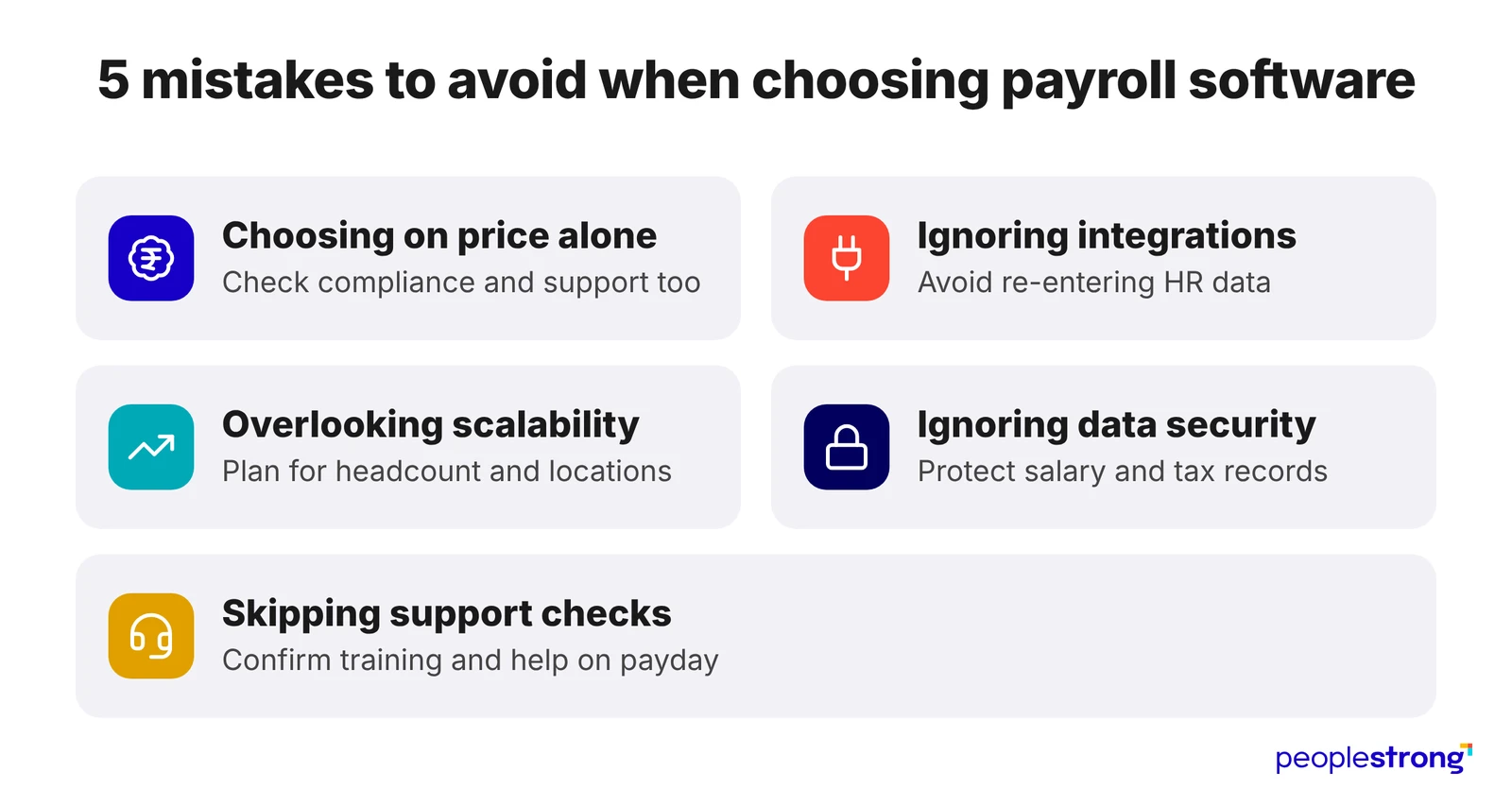
1. Choosing Software Based Only on Price
Choosing payroll software solely because it fits your budget can lead to limitations later. Low-cost solutions may lack essential features, integration options, or compliance capabilities that your business needs. Instead of comparing subscription prices alone, evaluate the software’s overall value and whether its features justify the investment.
2. Overlooking Integration Capabilities
Payroll software needs to work smoothly with your existing HR and finance systems. Without proper integration, teams may have to transfer employee information manually between platforms, increasing administrative effort and the risk of data discrepancies. Look for software that integrates with your existing HRMS, accounting tools, and attendance management systems.
3. Not Considering Business Scalability
Your payroll requirements may change as your business expands and hires more employees. Software that works for a small team today may struggle to accommodate a larger workforce or more complex salary structures later. Choose a solution that can handle increasing employee data and evolving payroll requirements without requiring frequent system changes.
4. Ignoring Data Security and Privacy
Payroll systems store sensitive employee information, including salary details, bank account information, and tax records. Choosing software without adequate security measures can expose this data to unauthorised access or breaches.
5. Not Evaluating Customer Support and Training
Even user-friendly payroll software may require technical assistance during implementation or when teams encounter processing issues. Limited customer support can delay payroll operations and make it difficult for HR teams to resolve problems. Before choosing a provider, evaluate its support channels, response times, and availability of training resources to ensure your team can use the software effectively.
Conclusion
Choosing the right payroll software can make monthly salary processing easier while helping you stay on top of changing compliance requirements. So before making a decision, assess your current payroll processes, employee requirements, and plans for business growth. Compare payroll software features based on how well they address these needs rather than simply choosing the tool with the most features.
Looking for a simpler way to manage payroll? Explore PeopleStrong. Our cloud-based payroll software helps you streamline salary processing, manage statutory compliance, and give employees easier access to their payroll information.
Get in touch with us today to find the right payroll solution for your business!
Frequently asked questions
How much does payroll software cost in India?
Most payroll software in India is priced per employee per month. The final cost depends on headcount and the modules you pick. Some vendors add one-time setup or data migration fees. Ask for a full quote covering implementation, training, and statutory updates so there are no surprises later.
Is payroll software suitable for small businesses and startups?
Yes. Even a small team has to meet PF, ESI, and TDS obligations, just like a larger company. Many cloud-based tools offer plans for small teams. You can start with core payroll and add modules as headcount grows, which keeps early costs low.
How secure is employee data in payroll software?
Reliable payroll software protects employee data through encryption, role-based access, multi-factor login, and regular backups. Check whether the vendor follows the Digital Personal Data Protection Act, 2023, and holds recognised security certifications such as ISO 27001. Also ask what happens to your data if you ever leave the platform.
Can payroll software handle employees across multiple states?
Yes, if it supports state-wise rules. Professional tax slabs, labour welfare fund contributions, and minimum wages differ across states. Good software maps each employee to a work location and applies the right rates automatically. Confirm during the demo that it covers every state where you have employees.
Does payroll software handle full and final settlement?
Good payroll software calculates full and final settlement automatically. It totals pending salary and leave encashment, adds gratuity or bonus where due, and deducts notice period recovery and outstanding loans. Since gratuity now follows the revised wage definition, check that the system applies it correctly at exit.
Can I switch payroll software in the middle of a financial year?
Yes, but plan it around a pay cycle boundary. You need to carry forward year-to-date salary, TDS, PF, and declaration data so tax calculations stay accurate for the rest of the year. Many businesses switch at the start of a quarter or financial year to keep reconciliation simple.