











 About Us
 Brand
Brand
 Career
 Contact Us



 +91-7314623098




When you are a team with great growth plans, you need to be able to leverage the best out of the current team you have and be proactive in empowering your team. SHRM studies say that for 78% of HR professionals, retaining top talent without spending too much is one of their top priorities for 2024. So, taking a proven, informed approach to nurturing the spark in your people, and bringing out the best in them will ensure they remain faithful to your organization and contribute to the best of their abilities.
One proven way to help them tap into their full potential is by crafting individual development plans for your employees, depending on their skills, and ambition, and supporting them as they channel their improved capabilities to support your mission.
This blog will tell you everything you need about implementing individual development plans and getting them right.
What is an IDP?
Individual Development Plans (IDPs) can be defined as a tool to assist an individual in career and personal development, and in reaching short and long-term career goals. To successfully reach one’s career planning is required and an IDP is the tool designed to assist in that task.
Most people do not meet their career goals by just aimlessly wandering through life from job to job. Gartner studies say that 71% of millennial workers say that the pandemic made them rethink the place that work should have in their lives. The work they do has to be meaningful to them, the company, and the people they work with, and IDP converges all three.
For an HR leader, or a people manager dealing with turnover, the issues arise from issues in the employee-manager relationship or a lack of growth opportunities in the organization. These are common reasons why people feel stuck and leave for a better future. SHRM reports say that upskilling and reskilling are important for 53% of organizations around the world. You should be integrating individual development plans for everyone to help people tap into their potential and become the best version of themselves.
Why is Individual Development Planning Important?
A potent individual development plan for employees is an essential link between individual professional development and the company’s overall growth. In the absence of development paths, high-performing members may get stuck, viewing their day-to-day responsibilities as a repetitive routine rather than a stepping stone toward a meaningful career.
Introducing such blueprints in your company will transform your talent management strategy from hiring people based on current skills to creating skills for the future. It will enable your managers to foresee future requirements for skills and to prepare a team resistant to unpredictable changes in technology and market conditions.
The benefits of individual development plans
For the Employer
Enhanced retention
Providing clear, structured career pathways acts as an exceptional cultural anchor. Employees who see a genuine, long-term commitment to their professional future are highly likely to reject external job offers, directly lowering an organisation’s voluntary turnover costs.
Higher productivity and engagement
When individuals understand exactly how mastering new skills supports their career goals and their company’s core milestones, their intrinsic motivation climbs. This professional clarity translates into greater focus, better daily output, and a deep sense of pride in their final work product.
Stronger succession planning
With an organised training framework, HR management can develop a stable pipeline of future leaders. Preparing employees for taking on more responsible positions in advance is essential to avoid critical threats associated with unforeseen executive departures.
Better team performance
Since each member in the team progressively improves his/her technical knowledge and soft skills, the collective potential of the whole department gets enhanced. This will help in undertaking complicated and valuable projects with full confidence.
For the Employee
A clear roadmap
An IDP strips away workplace ambiguity, turning vague career ambitions into a clear, visual, and chronological action plan. It outlines the exact projects, training courses, and performance milestones required to achieve their desired promotion or career pivot.
Goal accountability
Writing down specific development targets alongside firm completion dates fosters a powerful sense of personal ownership. This transparent framework helps employees structure their workweeks around high-impact learning initiatives rather than getting bogged down in daily administrative distractions.
Feedback opportunities
Integrating skill tracking into normal management workflows guarantees that growth remains a continuous, year-round conversation. It replaces stressful annual reviews with predictable, collaborative check-ins where professionals receive constructive coaching in real time.
Increased job satisfaction and motivation
Conquering challenging assignments and expanding your intellectual skill set make professional life deeply rewarding. Employees who regularly experience clear personal breakthroughs stay highly energised, creative, and emotionally connected to their daily tasks.
Greater confidence
Mastering complex operational workflows and stepping out of comfort zones naturally dismantles imposter syndrome. As an individual’s technical mastery grows, they feel empowered to take on greater project ownership, pitch bold ideas, and lead cross-functional initiatives.
Proactive learning and skill-building
An IDP shifts employees out of a passive, day-to-day execution mindset and turns them into active drivers of their own career paths. It builds an enduring habit of continuous learning, ensuring their professional skills stay highly relevant in an automated world.
Components of an Effective IDP
Your IDP shows every detail necessary for achieving your goal. You need to carve a clear path. Here are the essential components of an IDP.
1. An ongoing work plan
It’s not a static dynamic or a statement. It’s a living, breathing document, and needs to be updated regularly, referenced, and updated often. 9/10 millennials say their career development is very important, and so it should be constantly refreshed to get the most out of it. That’s why you need a robust tool to create, adapt, update and manage IDPs on a regular basis.
2. Growth goals
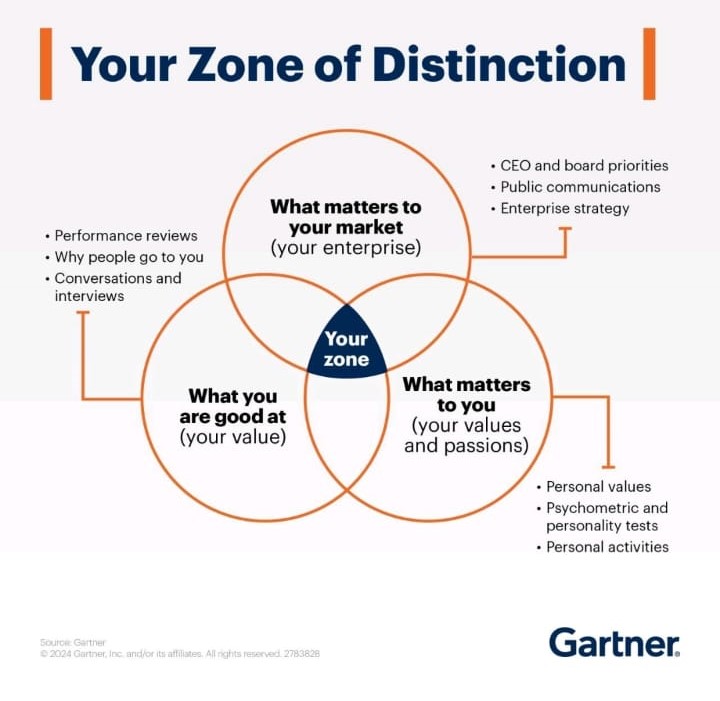
The core of IDP has three growth goals/buckets – knowledge, skills, and experiences you need to develop, to reach the milestone your employee set out for. Knowledge goals can be earning certifications or qualifying oneself, skills required can be a mix of hard and soft skills, and experiences can be managing a new team, getting into customer-facing roles, winning new business, or getting through a crisis, etc.
Depending on the goal the employee has set, they would require a mix of all three, with varying combinations. Always have 1-3 goals, depending on how long the goals will take. One goal won’t invigorate your employee, and more than 3 goals can be overwhelming.
You can help your employees identify growth goals using either of these two approaches:
| Approach 1 | Approach 2 |
| Things they are currently struggling with, that when solved or met with can make the employee super effective in a few weeks. | Things they need to move to the next role in the next 3-5, or 10 years, and the responsibilities they need to take up when they rise to the role. |
| Action plans | |
3. Skill bank to achieve each goal
If your employee wants to move to a managerial role in the next few years or eyeing a more senior role, they need a whole other (higher) skill set to handle the responsibilities of the role. The shift from an individual contributor to a manager is a hard one, where the employee will be faced with having to manage the very same people they were in the trenches with a while ago. It can be hard to diffuse conflicts between team members, which is why conflict resolution is crucial for any higher role. Gartner’s studies say managers who intervene meaningfully, rather than sweep conflicts under the rug will have a huge positive impact on the organization.
The above is just an example. Likewise, as people move vertically or horizontally in the organization, they need more soft skills, than hard skills to do their responsibilities effectively, and an IDP captures all these skills diligently.
4. A timeframe for each goal
Each step and action plan has to have a tentative date attached to it. Without a time frame, even well-intentional plans tend to be put off until later. IDP can be super short-term or have a 10-year vision. In most cases, it’s good to have both.
| Short term goals | Helps you make an immediate impact, so you can benefit from your results |
| Long term goals | Serves as a north star, and guides your vision |
Without having timelines in place, learning, and development take a backseat and pile up amidst pressing job demands, and only resurface whenever the employee starts rethinking their position in the company, or during the next performance review.
5. Measures to track progress
Expand upon the goal and give your employees very specific things to work towards. Measures to track how fast your employees climb the ladder can be through external validation (feedback from manager, and teammates), and internal validation (how confident, inspired, or competitive your employee feels).
When you craft the IDP, place review measures, or checkpoints in it. Incorporating scope for feedback ensures IDP isn’t forgotten. Set up IDP progress review meetings as part of your monthly 1:1s with your employees, so that they have time to work on their goals, and daily job duties without having to juggle between the two.
Best practices for creating IDPs
- IDP must be documented at every stage, and constantly updated. Recording ensures you check off every to-do item on time and helps manage progress.
- An IDP is not a substitute for a performance evaluation tool or a one-time activity – it should look like a partnership between employee and employer.
- IDP is for everyone and is not only for high-potentials, or if someone is struggling at work.
- You need to collaborate deeply with your team members and act as a catalyst in preparing IDP for your employees.
How to implement development plans
Your IDP will consider multiple factors including experiences, education, etc, and is an iterative process in itself. Here’s how you can implement it:
1. Start with Your Development Plan
Before introducing this methodology to your broader organisation, leaders should first draft their own individual development plans. Walking through the goal-setting process firsthand highlights potential administrative roadblocks and helps managers model growth mindsets authentically for their teams.
2. Prepare for Conversations with Employees
Avoid diving into these career alignments without proper preparation. Review your team member’s recent performance metrics, take note of their unique technical strengths, analyze their daily communication habits, and identify the upcoming business needs that match their natural talents.
3. Meet with Each Employee
Block out dedicated, high-focus one-on-one sessions away from immediate project deadlines. Use this space to listen intently, asking open-ended questions about what areas of the business they are most passionate about and where they want to grow over the next few years.
4. Help Employees Define Their Development Plan
Collaborate closely to refine their feedback into structured goals. Help them break broad ambitions into clear milestones using a balanced training approach, combining 70% on-the-job experiential projects, 20% direct peer mentorship, and 10% structured external courses.
5. Time the IDP process right
Many organizations carry out IDP as part of the annual review process or merge it into performance evaluation, which is not the ideal way to go about it. Individual development planning is a whole other exercise that’s more frequent and relevant to everyday work than performance reviews.
Set up IDP creation meetings after the reviews, or at a point when you think focused development is absolutely essential for your employee. IDPs are for everyone, so make sure you have time to work on reviewing and guiding the IDPs of every employee, without having to rush through them.
6. Share what’s possible for you to offer to your employees
Gartner studies say that only 46% of employees in the survey are satisfied with their career development. Companies fall short of meeting employee expectations due to a mismatch between what organizations can feasibly provide and what they can expect.
Prevent this falling out by being candid with them upfront. Share the vision, strategy you have for the team, and measurable goals with team members.
Harikrishnan Pratap, ex-Vice President of HR & Operations at DigitalXC, Athenahealth, and Cognizant says, “People have humongous potential, and if they’re not performing in a particular setting, offer them a change of setting first before jumping to any conclusions. In a manufacturing company I was working with, there was a talented HRBP who had amazing potential to climb up the ranks. She was a very promising candidate.
However, I received constant negative feedback from the business’s senior leadership stating she was rude, didn’t accommodate their requests, was standoffish, etc. When I spoke to her I understood that the leaders expected her to be available at every beck and call, and that was something she wasn’t comfortable with.
I knew she had potential, so I placed her in the training and development function and created an individual development plan accordingly, where she could perform as an individual contributor, and excel. That’s exactly what happened.”
7. Help employees choose which career path they want to take
Career stereotypes are almost non-existent, and will be obsolete in the near future. Studies say rising retirement ages, mid-career breaks, shifts across industries, contingent work, freelancing, creator economy, and other non-traditional employment methods make people rethink if they really need to commit to a workplace 9-5 for many years of their lives.
The people who do, have begun preferring remaining individual contributors, and have a better work-life balance, instead of moving to a managerial role and taking on more duties. That’s why it’s important to have different career paths laid down for different roles, so people can choose to pursue what they want for their career and life.
PandiMeena, a Senior Human Resource Business Partner at a renowned IT company says, “There was a senior leader who confided in us that he was taking care of his terminally ill daughter. He had to take time off frequently to tend to his daughter’s treatment. Since he was a trustworthy person, an excellent leader, and a good human, we made sure he got the right support he needed, to keep the job, and still be able to tend to his child. He was transferred to a less critical function, and given paid leave. He’s still one of our loyal employees. We knew he just wanted the right support at the right time, and we gave it to him.”
8. Set goals for two future roles in the roadmap
Now that you’re clear on how your employees want to proceed, draw out a roadmap based on where they want to go, in 3 years, 5 years, and 10 years. Each milestone in the roadmap requires a different version of themselves. Choose the first two goals (one is the immediate one, and one a little farther away), and ask your employees if they’d like to work on them.
9. Let employees self-assess themselves
Your employees will need to do a lot of introspection in this stage, after the goals have been set, and preferably take up strengths assessments to lay down their strengths, weaknesses, and opportunities they need to capitalize on. It’ll help them compare what skills they already have, and which ones they still need to get where they want to be. Gallup research shows that when employees know and use their strengths, they are more engaged (6 times more), have higher employee performance, and are less likely to leave the company.
Another hack to get this foolproof is using a grading scale for each competency, or skill needed, taking stock of the competency level you are currently in, and planning ahead.
10. Developing concrete action plans
The plan is almost coming to a conclusion now. You and your employees need to collectively figure out what tangible actions they can take to improve their skills, experience, and knowledge and attain their goals.
This is a very important stage, as each action must be practical, such as ‘completing a certification’, ‘spending 5 hours a week volunteering for social welfare activities’, ‘assisting the sales team in closing 5 leads’, or ‘resolving all customer issues in 24 hours without letting it escalate’, or ‘hire, onboard, train and evaluate an intern for the department’. It can be anything, depending on the goals you collectively set. But they have to be actionable and mapped to a timeline.
11. Have your employees choose an accountability partner
As your employees make progress, encourage them to come up with new actions, iterate, find an accountability partner, or bring in a tracking system. Check-in on your employee on their IDP every month. When they achieve their goals, you can discuss them with them and add new goals.
Bring in a buddy system in your team, where colleagues hold each other accountable for the action items they need to check off on their IDP every week. At the end of the week, have the team check in with each other, or seek help whenever they need it. Peer support and encouragement work wonders, and it’ll help employees push their limits when they feel like they’ve hit an impasse.
12. Celebrate every little progress
As soon as you see any little improvement, or promises being fulfilled, appreciate the employee openly. Public appreciation trumps every other type of recognition. Give them incentives that motivate others to show real progress. Incentives such as increased flexibility at work, a chance to work directly with the leadership, more visibility, cross-functional, high-value projects, etc.
Individual development plan examples
To help you design impactful growth paths, review these targeted individual development plan examples across diverse professional tiers:
Individual development plan example for leadership
- Core Focus: Enterprise Strategy & Large-Scale Governance
- Development Action: Shadow executive board meetings, complete an advanced organisational change management certification, and lead a high-stakes, cross-departmental business unit merger.
- Success Metric: Successful delivery of the consolidation project on time and within budget.
Individual development plan example for managers
- Core Focus: Empathetic Coaching & Operational Calibration
- Development Action: Complete a comprehensive conflict-resolution training series and implement structured, weekly career coaching one-on-ones with all direct reports.
- Success Metric: A measurable 15% improvement in department-level pulse survey scores within two quarters.
Individual development plan example for new employees
- Core Focus: Core Competency Mastery & Cultural Integration
- Development Action: Complete all specialised technical onboarding tracks, shadow a senior peer professional on client accounts for 30 days, and master internal platform workflows.
- Success Metric: Operating independently with full project ownership by day ninety.
Individual development plan examples for high-potential employees
- Core Focus: Accelerated Career Growth & Technical Innovation
- Development Action: Take on the role of principal architect on an experimental product line, mentor two junior team members, and complete a technical leadership masterclass.
- Success Metric: Successfully deploying the new product feature to beta testers ahead of the initial project schedule.
Individual development plan templates
To launch this talent development initiative instantly, copy and customise our clean, fillable individual development plan template:
Employee Name: _____________________ Reviewer Name: _____________________
Current Role: _____________________ Target Horisons: (6-12 Months Out)
1. Core Career Objective
Describe your primary professional focus or target role for the upcoming year:
____________________________________________________________________________
2. Targeted Skill Development
Identify 2-3 specific technical or soft-skill areas required to hit your objective:
* Skill A: ___________________________
* Skill B: ___________________________
3. The 70-20-10 Learning Action Plan
* Experiential (70%): Lead Project X or assume responsibility for Workflow Y.
____________________________________________________________________________* Relational (20%): Setup bi-weekly mentorship tracks with Senior Professional Z.
____________________________________________________________________________
* Formal (10%): Complete the certified training module or industry course by Q3.
____________________________________________________________________________
4. Resource Allocation and Milestones
What tools, platform access, or budget allocations are required to execute this plan?
____________________________________________________________________________
Sign-Off Employee: _________________ Sign-Off Manager: __________________
How to measure and track the success of IDPs
Evaluating your development programs requires looking past simple completion checklists. HR leaders should track the business impact of these initiatives by monitoring core human capital KPIs like internal mobility velocities and internal promotion fill rates. If a company can fill 70% of its senior openings using internal talent pipelines rather than relying on expensive external headhunters, it proves its development ecosystem is working effectively.
At the team level, managers should evaluate IDP success by cross-referencing completed learning paths against actual performance outcomes. For instance, if an engineer takes an advanced course on system architecture, look for a corresponding drop in software bugs or a noticeable acceleration in project deployment speeds over the next few quarters.
Common Challenges in Individual Development Planning and How to Overcome Them
The most widespread challenge organisations face is the “set-it-and-forget-it” trap. Teams often spend hours crafting beautiful development plans during their annual reviews, only to file the documents away and never look at them again. To overcome this, build short development updates directly into your normal monthly or quarterly check-ins, ensuring career development remains a live priority.
Another common roadblock is a lack of time due to heavy daily workloads. When project backlogs mount, learning initiatives are usually the first thing employees drop. Leaders must fix this by explicitly treating development time as normal working hours, giving teams the official operational air cover to step back from execution and focus on learning.
How can PeopleStrong in creating and managing IDPs?
SHRM studies say that 68% of HR professionals say one of their main priorities for 2024 is to reduce costs, and increase efficiencies. The best way to do that is to make use of existing talent in the best way possible, which starts with creating solid individual development plans for your employees.
Since IDPs are dynamic and have to be done collaboratively, with regular check-ins, target updating, and if required, pushing the goal post to push your employee’s limits. You can’t do all that in a subpar tool or a spreadsheet. You need a robust tool to help you do that seamlessly—a tool like PeopleStrong.
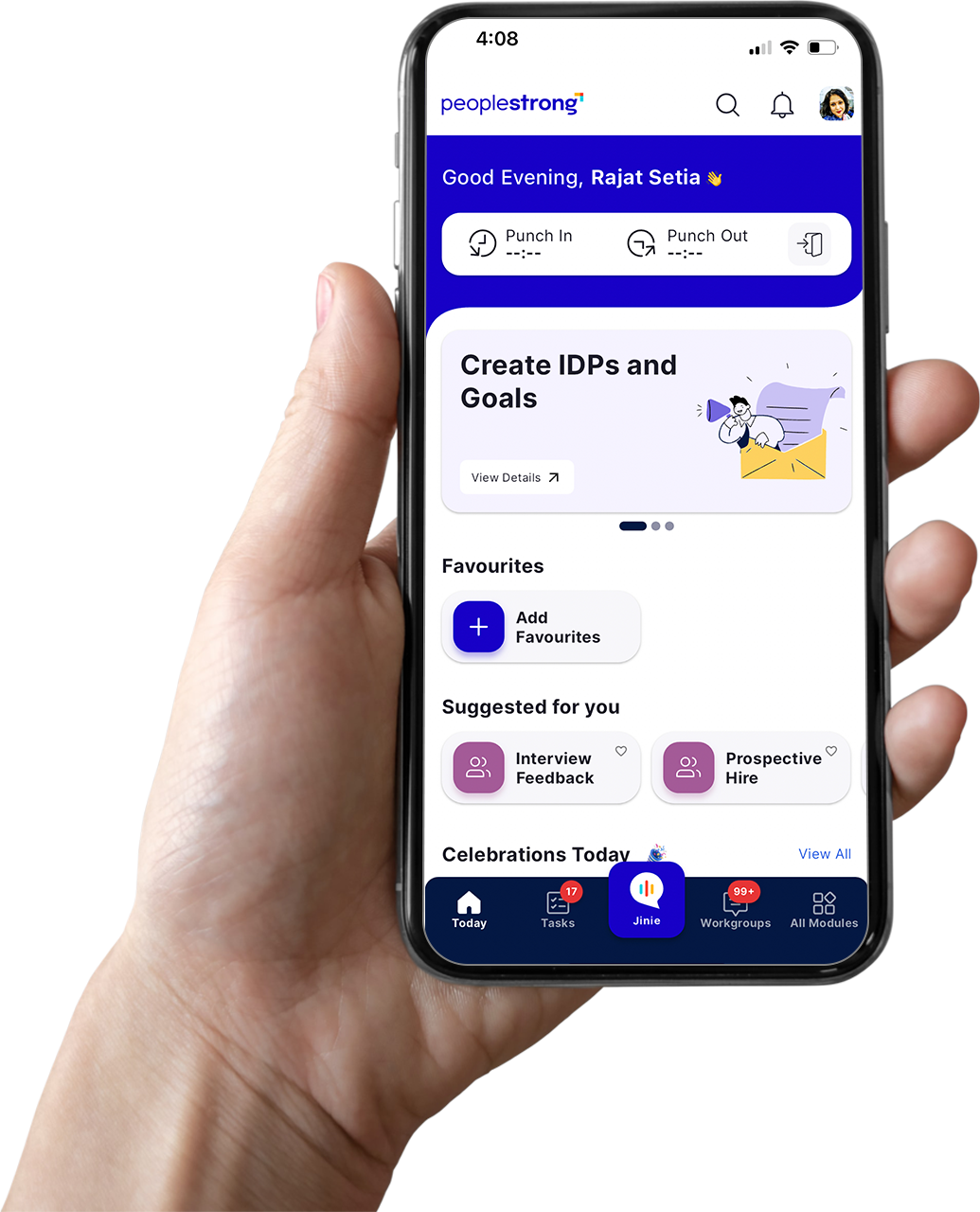
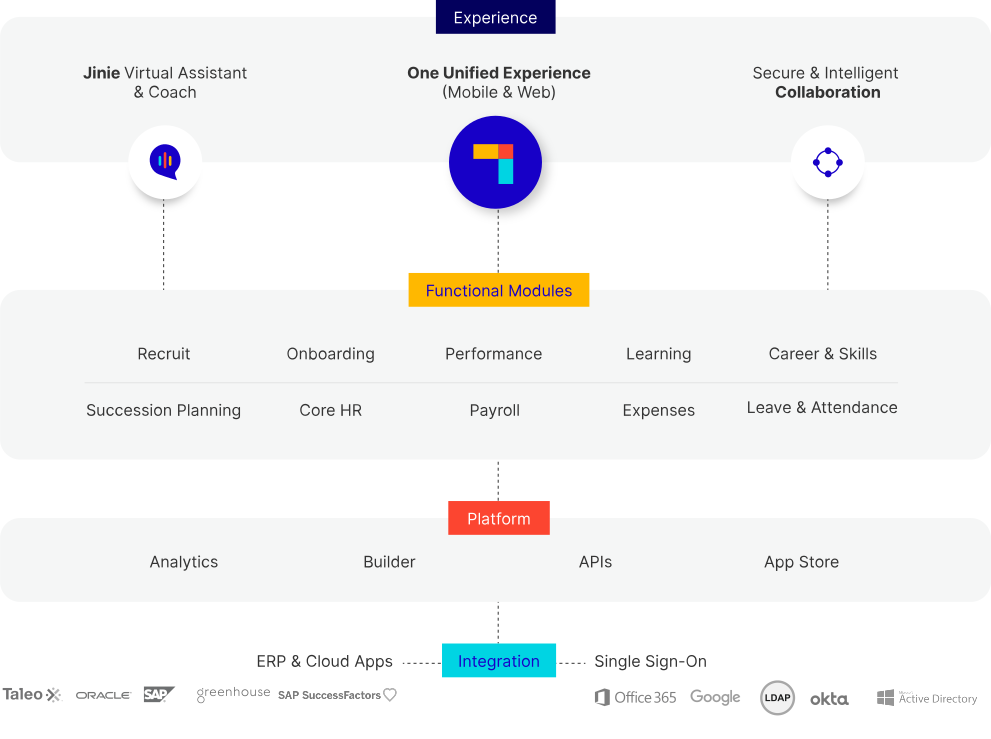
With an advanced, AI-powered full HCM suite, PeopleStrong makes information flow from skill mapping, and assessments, to performance evaluations to IDP smooth and straightforward. The easily customizable and interactive performance dashboards help you arrive at SWOT analysis for your team and at the eventual IDPs for individual employees.
Tracking, updating, and managing have never been easier – you can view collective or individual status all in one place, send reminders instantly, or set up automation to remind employees to follow up on their IDPs and resolve any issues they face.
Having implemented PeopleStrong in numerous enterprises throughout the globe, we can have the performance and talent management modules set up and running for your organization’s unique needs in record time.
Want to take a sneak peek at what the tool can do for you? Schedule a demo right here.
Frequently Asked Questions
Who creates an Individual Development Plan?
An IDP is a collaborative document co-created by the employee and their direct manager. The employee drives the process by defining their career goals and passions, while the supervisor adds valuable context regarding required competencies, business budgets, and corporate opportunities.
How often should an IDP be updated?
While the overarching career goals are typically mapped out during annual or bi-annual planning blocks, the actual document should be a live, evolving file. Teams should review and adjust milestones quarterly to adapt to changing project timelines and shifting organisational needs.
Can HR software help manage Individual Development Plans?
Modern HR software platforms like PeopleStrong simplify development planning by centralising the entire process. These platforms connect skill assessments, continuous feedback loops, and learning management modules into a single digital dashboard, allowing leadership to track skills gaps in real time.
How do development plans improve employee engagement?
They connect an individual’s daily, repetitive tasks directly to their long-term career aspirations. When employees see that their company is actively investing in their personal professional growth, their emotional commitment to the organisation’s overall success climbs.
How does one complete an Individual Development Plan?
Start by clarifying your long-term career goals, then audit your current skill sets to uncover your primary development gaps. Next, build a balanced mix of experiential assignments, mentorship tracks, and formal courses, and establish clear completion dates for each milestone.
What is HR’s role in creating individual development plans?
The HR team acts as the primary architect of the development ecosystem. They provide managers with structured templates, establish company-wide competencies, source external training platforms, and monitor high-level skills data to ensure workforce plans support long-term corporate growth.
What are the most common challenges HR faces when implementing IDPs?
The biggest challenges include dealing with low management buy-in, fighting survey and documentation fatigue across busy departments, navigating a lack of clear educational budgets, and moving past subjective performance reviews to collect clean, data-driven skill metrics.