











 About Us
 Brand
Brand
 Career
 Contact Us



 +91-7314623098



Data is the ultimate anchor for strategic decisions. But for many enterprises, human resource management has traditionally been a qualitative exercise, centred around people, culture, and sentiment. Though those elements will always form the core of an engaged workforce, today’s business world demands a different approach. Today’s corporate leaders don’t invest their money or take structural measures based on gut feel. They need hard evidence to prove their case.
Human resources reporting bridges the gap between people dynamics and business dynamics. In simple words, the process helps transform people operations into business intelligence, therefore enabling decision-making and enhancing performance.
What are HR Reports?
An HR report is an organised summary of employee data and critical human capital metrics. Instead of simply providing data, HR reports organise it to help identify trends and risks and to measure the effectiveness of the human resources strategy.
At an organisational level, HR reports play a critical diagnostic role by consolidating information from multiple systems, such as payroll, performance management, timesheet management, and recruiting, to provide a cohesive picture of employees. It can be either an overview of headcount information or detailed insight into compliance risks.
Why are HR reports so important?
If the HR data remains trapped in functional silos, management has no way to see what’s happening. By developing your reporting systematically, you create a clear picture of how to ensure sustainable development in many important spheres.
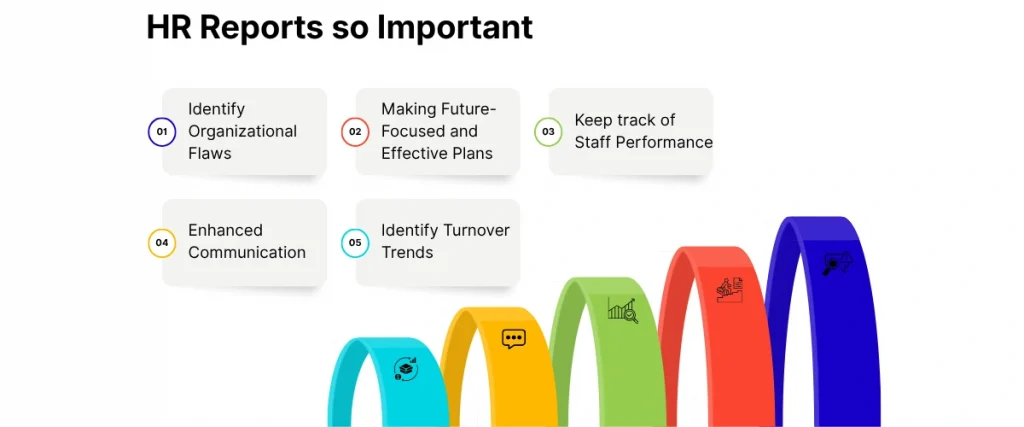
Identify organisational flaws
Every organisation faces some inefficiency, whether due to overstaffing, approval bottlenecks, or an unbalanced workload distribution. HR reports provide a way for leaders to identify the exact problem spots in processes, departments, and operations where the company loses money.
Making future-focused and effective plans
Workforce planning should never be done reactively. Should the company wait for a talent deficit before beginning its recruitment or training process, it would be too late. Through HR reporting, executives will be able to plan for the future by comparing current capacity with the organisation’s future goals. This will ensure that recruitment and training pipelines align with the organisation’s strategic plan.
Keep track of staff performance.
The strength of a business is measured by its aggregate performance. HR metrics provide a structured and unbiased way to assess how effectively performance targets are being achieved across different teams, departments, and geographies. This allows for effective identification of underperforming and top-performing employees, as well as the linking of individual performance to business goals.
Enhanced communication
HR alignment issues in organisations arise because of a lack of a common language. Numbers become that language. Using data-supported HR reports makes discussions with CFOs, COOs, and other business units more constructive and less confrontational. They foster institutional trust and ensure that everyone uses a single version of the facts.
Identify Turnover Trends
Turnover is detrimental to any organisation. While simple exit interviews cannot give all the information needed, HR reports can shed light on patterns that exist when good employees start leaving the company. This may occur after reaching certain tenure milestones, at certain management levels, or in response to changes in compensation.
Types of general HR reports with Examples and Templates
General HR reports provide a macro-level view of the organisation. They are essential for operational health checks and are frequently shared with executive leadership to maintain a steady pulse on the workforce.
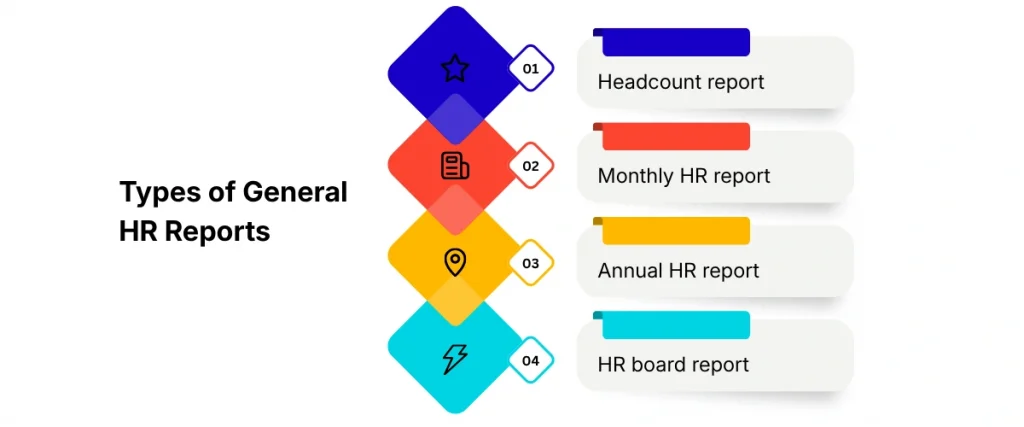
Headcount report
A foundational report that tracks the total number of employees within the organisation at any given time, categorised by key demographics and structural dimensions.
What to include in the report
- Total employee count (Full-time, part-time, contractors)
- Departmental and divisional distribution
- Geographic location data
- Tenure and age demographics
- New joiners and recent departures within the reporting period
Examples
An enterprise tech company uses a headcount report to monitor its regional expansion across Asia. The report reveals that while total headcount grew by 12% globally, the engineering team in a specific regional hub remains 4% understaffed relative to the quarterly hiring plan, prompting the talent acquisition team to reallocate resources.
Templates
| Metric | Q1 Actual | Q2 Projected | Variance (%) | Departmental Split |
| FTEs | 1,240 | 1,300 | -4.6% | Operations: 450, Tech: 400, Sales: 390 |
| Contractors | 150 | 130 | +15.3% | Tech: 110, Marketing: 40 |
| Total Headcount | 1,390 | 1,430 | -2.8% |
Monthly HR report
A retrospective summary designed for HR leadership and business unit heads to track operational progress, identify immediate challenges, and measure short-term variances against annual goals.
What to include in the report
- Monthly turnover and retention rates
- Time-to-hire and cost-per-hire for open positions
- Absenteeism and leave utilisation rates.
- Summaries of employee relations issues or grievances
- Progress on current HR initiatives or transformation projects
Examples
The monthly report for a manufacturing enterprise indicates a sudden 5% spike in casual leave during a specific shift. This prompts local operations managers to investigate working conditions and roster balance before the issue impacts production schedules.
Templates
- Executive Summary: A brief narrative of the month’s key highlights and operational bottlenecks.
- Talent Acquisition Dashboard: Open vs closed roles, pipeline velocity, and agency spend.
- Workforce Stability: Attrition rate (voluntary vs involuntary), absenteeism index.
- Action Plan: Top three operational priorities for the upcoming month based on current findings.
Annual HR report
A high-level, comprehensive review of the entire fiscal year. This report reflects on macro trends, evaluates the return on investment (ROI) of human capital initiatives, and sets the stage for the upcoming year’s strategic workforce plan.
What to include in the report
- Year-over-year (YoY) headcount and labour cost comparisons
- Total annual talent acquisition metrics and recruitment spend
- Annual performance distributions and promotion rates
- Total investment in training, upskilling, and development
- Progress against long-term diversity, equity, and inclusion objectives
Examples
An international logistics firm publishes its annual HR report, demonstrating that an investment in an internal leadership development program reduced external executive hiring costs by 22% over a 12-month period, validating the program’s continuation.
Templates
- CEO & CHRO Joint Statement: Strategic reflection on organisational resilience and talent triumphs.
- Financials of Human Capital: Total labour costs, benefits spend optimisation, and revenue-per-employee trends.
- Talent Sustainability Matrix: Internal mobility tracking, succession readiness across critical roles, and cultural health scores.
- Strategic Outlook: Next fiscal year’s workforce priorities and cultural pillars.
HR board report
A highly concise, strategically focused document tailored for the Board of Directors. It omits granular daily operations to concentrate strictly on governance, risk, executive succession, and high-level workforce metrics that influence shareholder value.
What to include in the report
- Executive succession readiness and critical-role vulnerabilities
- Compliance and legal risks, including major regulatory updates
- Macro workforce costs as a percentage of total corporate operating expenditure (OpEx)
- Top-line employee engagement indices and employer brand health
- Progress on major structural transformations (e.g., mergers, acquisitions, shared services migration)
Examples
Prior to a quarterly board meeting, the CHRO delivers a board report showing that the organisation’s executive succession readiness score has improved from 60% to 82% following a targeted retention program for Tier-1 leadership, mitigating a key institutional risk.
Templates
- Strategic Risk Register: Traffic-light system (Red/Amber/Green) tracking compliance, talent flight risks, and union/labour dynamics.
- Executive Bench Strength: Coverage ratio for C-suite and critical leadership nodes.
- Human Capital ROI: Correlating total talent investments directly with enterprise revenue growth.
Types of specialised HR reports
Specialised reports drill down into specific functions within human resources. They are designed for functional leaders who need granular data to optimise specific programmes and workflows.
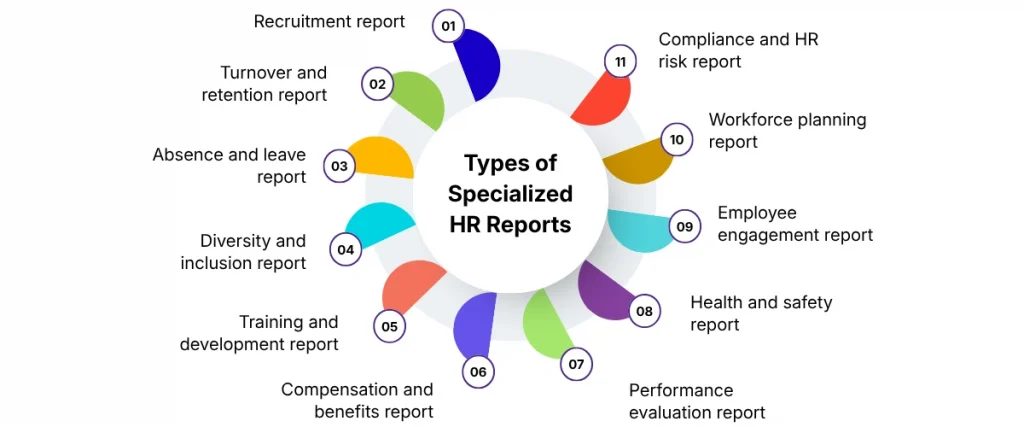
Recruitment report
Focuses entirely on the efficiency, cost, and quality of the talent acquisition pipeline.
What to include in the report
- Source-of-hire effectiveness (job boards, referrals, agencies)
- Funnel conversion rates (applied vs screened vs interviewed vs offered)
- Time-to-hire by department and job level
- Offer acceptance rates and reasons for candidate rejection.
Example findings
Analysis reveals that while LinkedIn yields the highest volume of candidates for sales roles, internal employee referrals produce hires with a 40% higher first-year retention rate, leading to a reallocation of the sourcing budget toward employee referral incentives.
Turnover and retention report
Examines how and why employees leave the organisation, helping to protect institutional knowledge and reduce recruitment costs.
What to include in the report
- Voluntary vs involuntary turnover rates
- Regrettable vs non-regrettable attrition metrics
- Turnover by tenure bracket (e.g., <90 days, 1-3 years, 5+ years)
- Exit interview thematic analysis (compensation, culture, career progression)
Example findings
The data indicates that 35% of voluntary departures occur within the first six months of employment. This specific finding points toward a systemic disconnect in the onboarding process or unrealistic expectations set during the interview stage.
Absence and leave report
Monitors employee availability, wellness trends, and the operational impact of time away from work.
What to include in the report
- Bradford Factor scores or similar absenteeism indices
- Unplanned vs planned leave ratios
- Leave utilisation rates across departments.
- Long-term sick leave trends and parental leave return rates
Example findings
An absence report highlights that a specific customer service department has an unusually high unplanned absence rate on Mondays. Leadership uses this insight to adjust shift schedules and introduce flexible work options, thereby resolving the bottleneck.
Diversity and inclusion report
Tracks demographic equity across all levels of the organisation to ensure compliance, meet corporate social responsibilities, and build a balanced workforce.
What to include in the report
- Gender, ethnic, and age distribution across management levels
- Pay equity gaps across comparable roles.
- Promotion and advancement rates across diverse demographic cohorts
- Inclusivity sentiment metrics derived from employee pulse surveys
Example findings
The annual audit reveals that while entry-level hiring achieves gender parity, the transition from mid-management to the director level results in a 15% drop in female representation. This prompts the creation of a targeted mentorship initiative for female leaders.
Training and development report
Evaluates the scale, engagement, and financial return of learning and development (L&D) investments.
What to include in the report
- Training hours completed per employee.
- Course completion rates and assessment scores
- Skill proficiency gains and internal certification rates
- Post-training performance changes or promotion correlations
Example findings
Employees who completed the advanced project management certification demonstrated a 14% increase in on-time project delivery over the subsequent six months, proving a clear business return on the L&D spend.
Compensation and benefits report
Assesses financial competitiveness against the external talent market and ensures internal equity.
What to include in the report
- Compa-ratio analysis (individual salary vs market median)
- Benefit utilisation rates (health insurance, wellness benefits, pension schemes)
- Total rewards expenditure broken down by department
- Correlations between compensation levels and high-performer turnover
Example findings
The report indicates that mid-level software developers have a compa-ratio of 0.82 relative to regional market standards, directly correlating with a recent drop-off in offer acceptance rates for that department.
Performance evaluation report
Synthesises appraisal data to map out capability distributions, identify top talent, and manage low performance.
What to include in the report
- Bell-curve distribution of performance ratings across teams
- 9-Box grid placements (Potential vs Performance)
- Goal completion percentages by department
- Tracking of individuals currently on Performance Improvement Plans (PIPs)
Example findings
The performance calibration report reveals that a newly formed business unit has given 80% of its staff the highest performance rating, leading HR to implement more objective calibration frameworks to prevent rating inflation.
Health and safety report
Critical for operational governance, physical workplaces, and maintaining compliance with labour laws.
What to include in the report
- Lost Time Injury Frequency Rate (LTIFR) and total recordable incidents
- Near-miss logs and hazards identified
- Safety training compliance percentages
- Cost of workers’ compensation claims
Example findings
The report highlights a reduction in near-miss incidents following the implementation of mandatory safety refreshers, confirming that proactive compliance training directly prevents workplace hazards.
Employee engagement report
Measures workplace sentiment, motivation, and psychological alignment with corporate objectives.
What to include in the report
- Employee Net Promoter Score (eNPS) or annual engagement indexes
- Sentiment scores on key pillars: Leadership, clarity of purpose, work-life balance
- Survey participation rates by department
- Correlation between high engagement scores and business unit productivity
Example findings
The data reveals that departments with high autonomy scores consistently score 20 points higher on the overall engagement index and report significantly lower burnout rates than highly centralised teams.
Workforce planning report
A forward-looking strategic analysis designed to balance talent supply with future corporate demand.
What to include in the report
- Retirement risk exposure over a 3-to-5-year horizon
- Skill gap analysis across core business functions
- Contingent labour spend vs permanent payroll projections
- Scenario modelling for upcoming business restructuring or expansion
Example findings
The workforce planning model warns that 30% of senior technical architects are eligible for retirement within the next 36 months, prompting leadership to immediately establish a structured knowledge transfer and succession initiative.
Compliance and HR risk report
Protects the enterprise from legal, regulatory, and reputational risks by auditing compliance with rules and guidelines.
What to include in the report
- Mandatory regulatory training completion rates (anti-harassment, GDPR, security)
- Visa and right-to-work audit statuses for global workforces
- Overtime limit breaches and mandatory rest period compliance
- Open labour disputes, grievances, or legal proceedings
Example findings
An internal audit flags that 8% of external contractors have engagements exceeding 12 months without contract reviews, highlighting a co-employment risk that requires immediate standardisation of contracts.
Best practices for quality HR reporting
Building a collection of HR report types is only half the battle. To ensure these insights drive real business action, follow these foundational principles of enterprise-grade reporting:
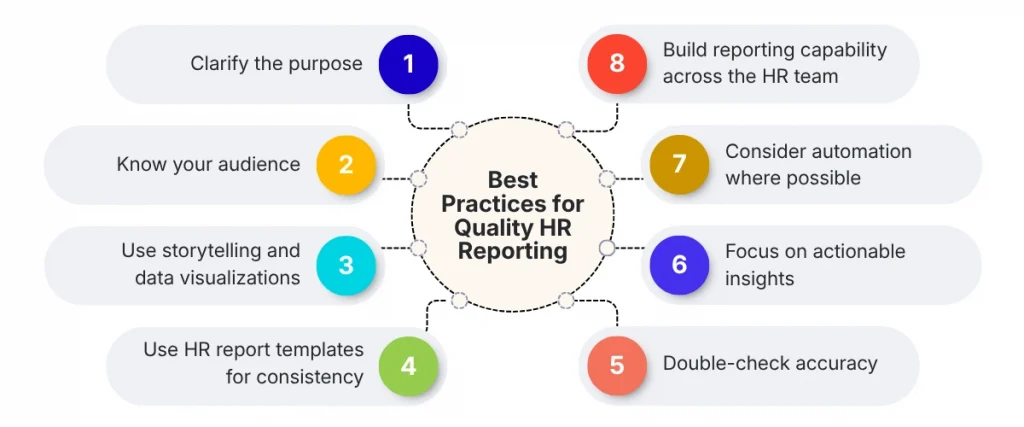
- Clarify the purpose: Never pull data just for its own sake. Before generating a report, define the specific problem you are trying to solve or the strategic question you need to answer.
- Know your audience: Customise the depth of information. A line manager needs granular, team-level daily metrics; a board member needs macro-level risk, cost, and succession data.
- Use storytelling and data visualisations: Raw spreadsheets invite confusion. Use clean dashboards, trend lines, and balanced data visualisations to make complex workforce trends understandable at a glance.
- Use HR report templates for consistency: Standardising your presentation layouts ensures that business leaders know exactly where to look for metrics month after month, speeding up executive review times.
- Double-check accuracy: People data is highly sensitive. A single incorrect calculation regarding turnover or payroll can undermine HR’s analytical credibility across the entire leadership team.
- Focus on actionable insights: A quality human resources report doesn’t just list what happened; it provides data-driven context on why it happened and recommends a clear path forward.
- Consider automation where possible: Manual data aggregation consumes valuable time and introduces human error. Automating recurring data feeds allows HR professionals to focus on strategic execution rather than administrative assembly.
- Build reporting capability across the HR team: Data literacy shouldn’t be the sole domain of a specialised analytics team. Train HR business partners and generalists to confidently interpret reports and apply data to their daily stakeholder conversations.
Why should you automate your HR Reports?
Relying on manual spreadsheets to track thousands of enterprise employees is a significant operational risk. Relying on manual updates means your data is already outdated by the time a report is compiled, formatted, and emailed.
Automating your reporting processes through an integrated platform delivers real-time visibility. Instead of waiting for the end of the quarter to discover a retention crisis, automated systems surface trends as they happen. This enables leaders to make proactive adjustments rather than conduct post-mortems.
Furthermore, automation eliminates human error in data collection, standardises compliance tracking across multiple jurisdictions, and frees HR teams from manual administrative work. This shift allows human resource leaders to spend less time building charts and more time executing data-driven talent strategies.
Challenges of HR reporting
Despite its value, implementing a reliable reporting ecosystem across a large enterprise comes with its own hurdles:
- Data Fragmentation: Information is spread across disparate point solutions and separate systems for recruiting, payroll, and performance, making it incredibly difficult to establish a single, reliable source of truth.
- Inconsistent Data Input: If different regional branches or business units enter employee records in different formats or with varying definitions, the consolidated macro data becomes unreliable.
- Privacy and Security Guardrails: Balancing transparency with strict global data privacy regulations (such as GDPR or local data residency laws) requires robust access controls.
- The “Analysis Paralysis” Trap: Having access to vast amounts of data can lead teams to track hundreds of superficial metrics without ever connecting them back to actual business outcomes.
How to choose the right HR Reporting software
Overcoming these challenges requires choosing an enterprise HR platform built for modern data needs. Look for software that offers:
- Unified Architecture: Avoid disconnected point solutions. Choose a platform that natively unites core HR, payroll, talent acquisition, and performance analytics into a single data lake.
- Configurable Role-Based Access: The platform must allow you to build custom dashboards tailored to different leadership tiers and automatically restrict access to sensitive personal details based on user permissions.
- Predictive Capability: True enterprise reporting goes beyond historical tracking. Look for platforms that leverage machine learning to deliver predictive analytics, such as identifying flight risks before an employee resigns.
- Local and Global Compliance Engines: Ensure the software vendor regularly updates its reporting structures to align with changing tax laws, statutory labour requirements, and regional data security mandates.
Conclusion
The shift from intuition-driven human resources to data-backed talent operations is no longer optional for enterprises looking to stay competitive. Quality HR reports don’t just protect an organisation from operational risk; they provide the clear strategic insights needed to optimise labour costs, build deep leadership pipelines, and create workplaces where high performers want to stay.
By implementing standardised HR report templates, committing to automated reporting workflows, and selecting an integrated software partner, HR leaders elevate their role. They transform HR from an administrative support function into an invaluable engine of business growth.
Frequently Asked Questions
How do you create an effective HR report?
An effective report starts with a clear business question. Identify the audience, pull clean data from a centralised system, focus on high-impact KPIs rather than superficial metrics, use data visualisation to highlight trends, and always close with actionable recommendations based on the findings.
What is an MIS report in HR?
A Management Information System (MIS) report in HR is a structured collection of workforce data used by mid- to senior-level management to monitor operational health, track performance against budgets, and streamline day-to-day decision-making regarding staffing and resource allocation.
How can HR reports be used to drive organisational success?
They identify hidden operational risks, such as critical skill gaps, high turnover in key departments, or rising absenteeism, allowing leadership to intervene proactively. They also measure the actual financial return on talent investments, ensuring budgets are spent effectively.
How do I design an HR report for manpower?
Focus heavily on structural metrics: total headcount, full-time equivalent (FTE) distributions, open vs closed requisitions, contractor ratios, budgeting variances, and future workforce demand forecasts mapped against current hiring pipelines.
How do I present an HR audit report?
Structure it around governance and risk mitigation. Begin with a clear, high-level executive summary; use a red-amber-green (RAG) rating system to highlight immediate compliance issues; provide data-backed context for each finding; and outline clear corrective actions with assigned owners and deadlines.
What should be included in a monthly HR report?
It should capture immediate operational pulses: current headcount movements, monthly attrition rates, recruitment pipeline status (time-to-hire), unplanned absence rates, and updates on any major employee relations cases or ongoing HR projects.
How often should HR reports be generated?
Operational dashboards tracking absenteeism or recruitment status should be monitored weekly or in real time. General workforce health and departmental reports are best suited for a monthly cadence, while comprehensive strategy and risk assessments are typically reviewed quarterly and annually.
What is the difference between HR reporting and HR analytics?
HR reporting focuses on the past and present; it organises and describes historical data to show what happened. HR analytics uses that data to dig deeper into the “why,” leveraging statistical models and predictive analytics to forecast future trends and outcomes.
How do HR reports improve decision-making?
They replace guesswork with objective numbers. Instead of guessing why a project is delayed or why costs are rising, a report can reveal exactly where talent shortages exist, which teams are overworked, or where compensation scales have fallen behind the market rate.
What tools are used for HR reporting?
Enterprises typically use a mix of native reporting suites within their core HR platforms, dedicated business intelligence tools (like Power BI or Tableau) integrated with their workforce databases, or specialised workforce analytics software.
What is the purpose of workforce reporting?
The ultimate purpose is to ensure that an organisation’s human capital directly aligns with and supports its broader commercial strategy, minimising operational risk while maximising workforce productivity and engagement.