













 About Us
 Brand
 Career
 Contact Us



 +91-7314623098


Quick overview:
KRA stands for Key Result Area and KPI for Key Performance Indicator. A KRA defines what an employee is responsible for achieving, while KPIs are the measurable targets that show how well they are achieving it. KRAs are broad and change rarely. KPIs are specific, time-bound and reviewed regularly.
Key takeaways
- KRA stands for Key Result Area; KPI stands for Key Performance Indicator.
- A KRA defines what an employee is responsible for; KPIs measure how well they deliver it.
- KRAs are broad, qualitative and rarely change. KPIs are specific, quantitative and reviewed often.
- Set 3 to 5 KRAs per employee and 2 to 3 SMART KPIs for each KRA.
- Review KPIs quarterly and avoid KPI fatigue by tracking only the metrics that move the business.
Two employees in the same team can work equally hard and still be judged very differently, because nobody agreed at the start of the year what good looks like. KRAs and KPIs fix that.
This guide explains what each term means, how they differ, examples by function, and how to set them for your team.
What is KRA?
Key Result Areas (some organisations call them Key Responsibility Areas) define the existing responsibilities of a role. They specify the outcomes that an employee is expected to achieve in alignment with broader organizational objectives. KRAs form the foundation upon which the Key Performance Indicators are built. They are what directly connect job design to business goals.
KRAs rarely change over time unless the scope of the role or organizational objectives shift. Your employees must always have clarity about their KRAs so that they are focused on the right tasks to achieve them.
Key Result Areas differ by industry, role, and business goals. Here are some examples of KRAs:
- Sales: pipeline management, revenue generation, or client retention
- Human Resources: employee retention, talent acquisition, or compliance
- Engineering: technical documentation, code quality, feature development
What is KPI?
How do you measure the effectiveness with which employees are achieving results within a well-defined KRA? Key Performance Indicators are the answer to this. They are specific, time-bound, measurable metrics used to track employees’ performance. Unlike KRAs, KPIs do change over time on the basis of business cycles, priorities, and targets.
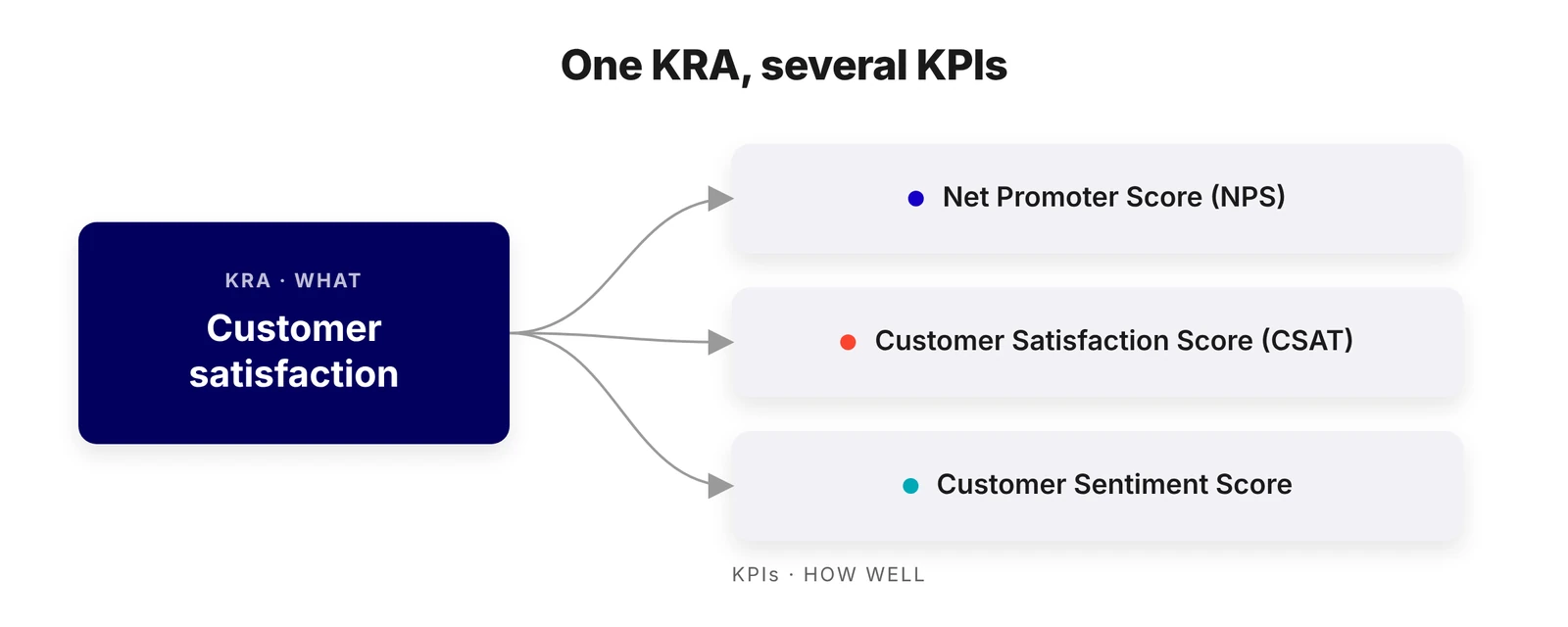
Usually, multiple KPIs are tied to a single KRA to accurately and transparently gauge success. Let’s take the Customer Success Department, for example. If Customer Satisfaction is a KRA, then the connected KPIs would be:
- Net Promoter Score (NPS)
- Customer Satisfaction Score (CSAT)
- Customer Sentiment Score
These are all quantifiable metrics that help organizations understand how well the employees are achieving results within their KRA.
Importance of KRAs and KPIs in HR
The importance of KRAs and KPIs in human resources cannot be overstated. Here’s why they matter in HR:
- No guesswork: Your employees know exactly what (KRAs) they are expected to achieve and how well (KPIs) they’re performing to get there. They don’t waste their time on tasks that don’t align with business objectives.
- Fair promotions: KRAs and KPIs reduce managerial bias in promotions. Decisions rest on clear targets and proven outcomes, alongside qualitative feedback.
- Better hiring: By tracking metrics such as time to hire and cost per hire in talent acquisition, you can cut down on expensive delays.
- Improved retention: With KPIs such as annual attrition rate and voluntary vs. involuntary attrition ratio, you can achieve your broader responsibilities of employee retention (KRA) and ensure resource optimization (business objective).
Difference Between KRA and KPI
Now that you have a better understanding of KRA and KPI meanings, let’s discuss their differences in further detail in this section.
KRAs and KPIs, though distinct from each other, work together in every department. Understanding their difference is necessary to create an effective performance management strategy for your employees.
The table below clarifies the difference between KPI and KRA in terms of their purpose, scope, nature, and role in performance evaluation, with examples:
| Aspect | KRA (Key Result Area) | KPI (Key Performance Indicator) |
|---|---|---|
| Full Form | Key Result Area | Key Performance Indicator |
| Purpose | Enlighten employees on the strategic direction of the company and communicate their responsibilities linked to the role | Monitor the performance and progress of the employees to drive actions |
| Nature | Qualitative | Quantitative |
| Scope | High-level and strategic | Focused and tactical |
| When It’s Set | At the beginning of the financial year or performance cycle. KRAs are first set at the departmental level and then at the individual level. | At the beginning of the financial year or performance cycle, immediately after KRAs are defined. |
| Stability | KRAs don’t change unless and until the scope of the role or business objectives change. | KPIs can change depending on how effectively targets are being achieved. |
| Role in performance evaluation | They determine what is expected of the employee. | They evaluate how successfully the employee is meeting the expectations using exact numbers. |
| Example | Department: Digital Marketing KRA: Brand Awareness & Lead Generation | KPI 1: Boost monthly organic traffic by 20% in the next quarter. KPI 2: Generate 1000 qualified leads in the next quarter. |
To summarize, KRAs provide strategic, high-level direction to employees, whereas KPIs drive actions to achieve the outcome.
What Benefits Do KRAs and KPI Offer to Organizations?
There are several benefits of using clearly defined KRAs and KPIs in your organization, including:
- You can boost customer success, which is the core of any business in any industry. A well-defined strategic KRA, such as higher customer satisfaction, is achievable by using KPIs such as reducing complaints by 40% and boosting retention by 50% in the next six months.
- Your business goals no longer seem unattainable or far-fetched dreams. When a larger goal is broken down into KRAs and KPIs, it becomes tangible.
- Your employees have crystal-clear clarity of their roles & responsibilities, and they work towards achievable, measurable outcomes.
- You can ensure strategic alignment of day-to-day activities with the core organizational goals.
KRA and KPI Examples by Function
The table below provides more examples of KRAs and KPIs by function:
| Functions | How KRA Works | How KPI Works | Example |
|---|---|---|---|
| HR | KRAs in HR focus on strategic goals such as workplace culture, employee retention, and talent acquisition. | KPIs measure data points that track the efficiency and success of those HR initiatives. | KRA: Recruitment & Onboarding KPI: Reduce average time-to-hire to under 25 days. |
| Sales | KRAs are broad outcomes related to customer acquisition, market penetration, and revenue generation. | KPIs track numerical targets like conversions achieved by individual sales reps or the entire sales team over a particular time period. | KRA: Revenue Growth KPI: Increase new customer acquisition by 20% quarter-over-quarter |
| Marketing | KRAs are business objectives like demand generation, market reach, and building brand awareness. | KPIs monitor metrics like engagement rate, conversion rate, and return on investment (ROI) for marketing campaigns. | KRA: Lead Generation KPI: Generate 500 marketing-qualified leads per month. |
How to Set Effective KRAs and KPIs
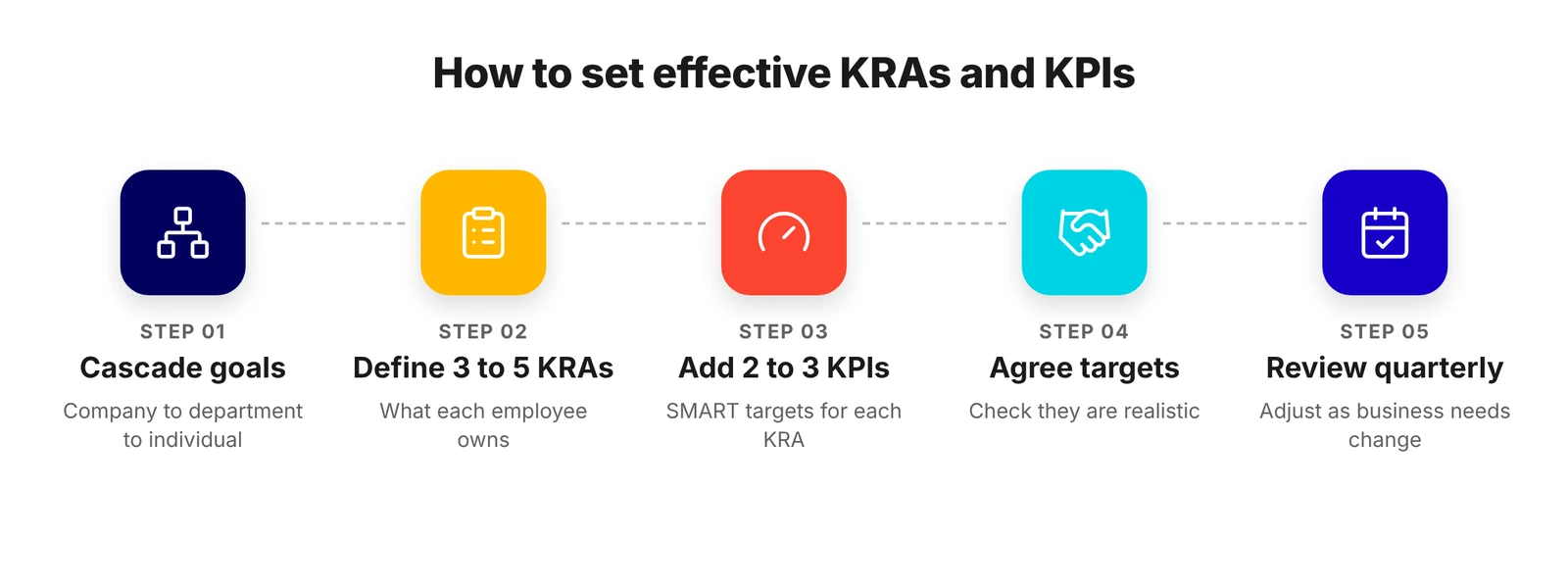
Follow this step-by-step process to set effective KRAs and KPIs:
- Cascade high-level, strategic company goals down to department and individual levels.
- Identify 3 to 5 KRAs for each employee. These outline what the employee is responsible for.
- Assign 2-3 KPIs to each KRA based on the SMART framework (Specific, Measurable, Achievable, Relevant, and Time-bound). These define how success is tracked.
- Discuss these targets with employees to make sure they are realistic. Be clear and transparent in your communication.
- Review employee performance every quarter and adjust KPIs as business needs evolve.
Things to Know After Assigning KRAs and KPIs
As an HR manager, your responsibilities don’t end after defining and explaining the KRAs and KPIs to employees. Here are the things you need to take care of after assigning them:
1) Review Them Quarterly
Have broader organizational goals changed? Has the scope of an employee’s job responsibilities grown? If yes, you need to recalibrate the KRAs and their corresponding KPIs. Even if they haven’t changed, you may need to readjust KPIs quarterly based on how well they support employee productivity and business objectives.
2) Reward Good Performance
Achieving KPIs and fulfilling KRAs can become a chore if they are not rewarded with recognition, promotions, or bonuses. However, don’t tie numbers too tightly to rewards, as you risk data manipulation or cutthroat behavior. Factor in qualitative feedback on company values and teamwork during appraisals.
3) Beware of KPI Fatigue
Do not overwhelm employees with too many metrics. Limit each employee to 3-5 core KRAs and 2-3 KPIs per KRA. Focus on metrics that truly drive the business forward!
Conclusion
Key Result Areas (KRAs) and Key Performance Indicators (KPIs) are dual pillars of a fair and effective performance management system. They act as a bridge between organizational strategy and individual accountability. In simple terms, KRAs define ‘what’ needs to be achieved, and KPIs define ‘how well’ the tasks are being performed to achieve it.
Ready to make performance reviews fairer and easier to run? Explore PeopleStrong’s performance management software.
Frequently asked questions
What are KRAs and KPI with an example?
Key Result Areas (KRAs) are individual job role responsibilities aligned with broader organizational goals. KPIs are quantitative metrics used to evaluate the performance of employees in fulfilling those KRAs. If ’employee engagement and retention’ is a KRA, its KPIs would be an Employee Net Promoter Score of 40+ and an annual turnover of less than 15%. This is an illustrative example.
How are KRAs and KPIs used in performance appraisal?
KRAs and KPIs ensure that your employees are evaluated fairly during performance appraisals and remove any chances of ambiguity and bias. While KRAs offer a destination to employees, KPIs act as a GPS tracker that shows if employees are actually reaching it.
Are KRAs and KPIs applicable to all industries?
Definitely. You can define and execute KRA and KPI in every industry, be it healthcare, education, manufacturing, retail, tech, hospitality, or others. Besides industry, they are applicable to every department, from sales and HR to engineering and customer support.
How do KRAs and KPIs work together?
In every industry, organization, and department, KRAs and KPIs always work together. KRAs describe long-term, qualitative outcomes that directly impact the growth of your company. But they are too broad to be easily tracked on their own. KPIs are SMART (Specific, Measurable, Achievable, Relevant, and Time-bound) metrics used to evaluate the effectiveness with which employees meet their KRAs.
Why should businesses track both KRAs and KPIs?
Both KRAs and KPIs are absolutely necessary. Without KRAs, your employees have no broader goals to meet and don’t have a clear understanding of their day-to-day responsibilities. Without KPIs, they would be blindly chasing numbers without the bigger strategic picture in sight. This would ultimately harm employee morale and business success.
What are KRAs and KPI for employees?
Key Result Areas define the job scope of an employee. On the other hand, Key Performance Indicators measure their success. KRAs offer qualitative, high-level strategic direction to employees, whereas KPIs are performance metrics that determine how well they are meeting their responsibilities and business objectives and keep them on the right path.