












 About Us
 Brand
Brand
 Career
 Contact Us



 +91-7314623098




How do you measure your organization’s health? If you’re only looking at financials, you might be missing the bigger picture. Only seasoned ones know the recipe for measuring the performance of an organization as a whole—and that, too, with ease. If you haven’t caught on yet, we’re talking about Balanced Scorecards.

As per statistics, about 44% of organizationsin North America use Balanced Scorecards to assess their performance and realign their strategies. In fact, around 80% have reported an improvement in their operating performance. Despite this, many organizations struggle with the correct adoption and implementation of this system.
In today’s blog, we will discuss Balanced Scorecards in depth. Join us as we explore their benefits, uses, examples, and everything else in between!

- Understand what is Balanced Scorecard
- Discover why the Balanced Scorecard is a great tool for organizations
- Learn about the four perspectives of the Balanced Scorecard
- Find out how you can develop a Balanced Scorecard for your organization from scratch
- Learn how to use the Balanced Scorecard for best results correctly
- Few examples of what the Balanced Scorecard looks like in different industries
What Is a Balanced Scorecard?
A Balanced Scorecard (BSC) is a strategic planning and management system that aligns an organization’s day-to-day business activities with its long-term objectives.
In the early 1990s, businesses primarily measured their performance using financial metrics such as revenue, profits, etc. Although essential, these criteria failed to provide a full picture of the organization’s actual health and success.
To resolve this issue, Dr. Robert S. Kaplan and Dr. David P. Norton created the Balanced Scorecard framework in 1992. This system measures an organization’s performance on four key aspects—financial, customer, internal processes, and learning and growth—for a more comprehensive and “balanced” assessment.
Why Use a Balanced Scorecard?
Shortly after its invention, the Balanced Scorecard concept picked up pace among small and large businesses across the world. Here are four significant reasons why:
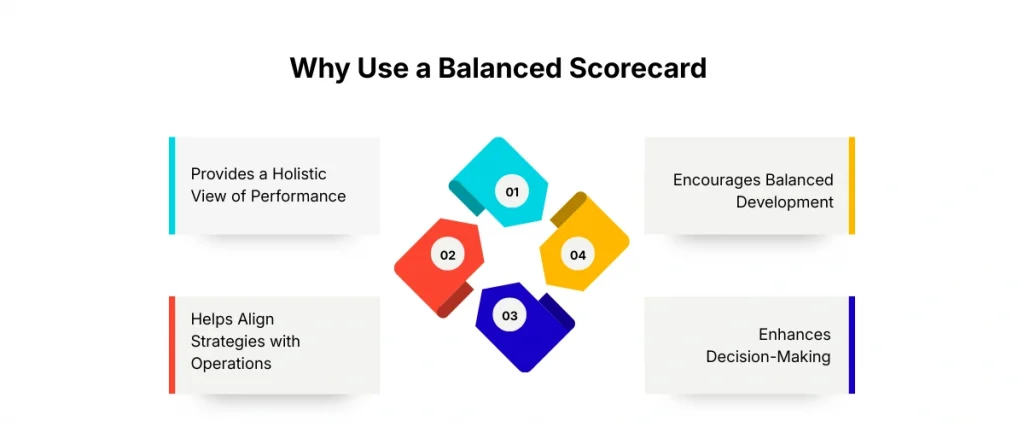
1. Provides a Holistic View of Performance
Generally, organizations pick a metric that’s central to their business (like revenue, profit, or market share) and base their entire performance evaluation around it. This approach is not only incomprehensive but also thoroughly misleading. However, a Balanced Scorecard avoids this. It lets you evaluate your organization’s performance on four distinct elements to provide a more holistic view of its standing.
2. Helps Align Strategies with Operations
As mentioned above, the Balanced Scorecard measures an organization’s performance on four major dimensions: financial, customer, internal processes, and learning and growth. This ensures that all daily activities related to these aspects are monitored and in proper alignment with the organization’s bigger strategies and objectives.
3. Enhances Decision-Making
The Balanced Scorecard provides data about an organization’s performance in financial, customer, internal, and future elements. It enables higher authorities to stay informed and make data-driven decisions for optimization.
4. Encourages Balanced Development
Perhaps the biggest reason why Balanced Scorecards became such a hit among organizations is because they encourage balanced assessment and development. By enabling you to oversee and control key aspects other than finances, they cultivate a practice of stabilized, all-round growth.
Who Uses the Balanced Scorecard?
Robert Kaplan and David Norton introduced the balanced scorecard in the early 1990s to address a growing problem: judging an organisation’s performance solely on financial metrics offered a narrow, backward-looking view. Since then, the framework has evolved well beyond corporate finance into a core management tool across public, private, and non-profit sectors.
Large corporations rely on the model to cascade overarching strategy down into clear, measurable operational targets across business units. This gives executive teams a reliable way to monitor whether everyday activities actually support long-term goals.
Small and medium-sized enterprises often adopt a streamlined version, focusing on a few core measures across each perspective to keep the administration manageable.
In public sector bodies and non-profits, where profitability isn’t the primary driver, leadership typically adapts the financial perspective to measure budget accountability, stewardship, and resource efficiency.
Internally, usage varies by department and seniority:
- Executive Leadership and Boards: For overall strategic oversight and tracking high-level progress.
- Finance Teams: To connect revenue and margin targets to underlying operational drivers.
- Operations Leaders: To monitor workflow efficiency, output quality, and service delivery.
- HR Departments: To map human capital management, such as skills development, engagement, and staff retention, directly to commercial outcomes.
- Strategy Consultants: To provide a structured foundation when designing performance management systems for clients.
Benefits of Using a Balanced Scorecard
The main advantage of a balanced scorecard is that it prevents management from focusing entirely on short-term financial returns at the expense of sustainable growth. By evaluating performance across financial, customer, operational, and development dimensions, leadership gains a realistic, forward-looking assessment of organisational health.
Strategic Alignment and Accountability
The framework helps bridge the gap between strategic planning and execution. As objectives filter down to specific teams, employees gain a clearer picture of how their day-to-day responsibilities contribute to broader corporate goals. This structure improves individual and departmental accountability, ensuring performance evaluations are based on relevant strategic targets rather than arbitrary metrics.
Informed Decision-Making
Combining quantitative financial metrics with qualitative operational indicators gives decision-makers a complete view of the business. Tracking leading indicators, such as staff capability, product quality, and customer satisfaction, helps predict future financial outcomes rather than simply reporting on past performance. Furthermore, its structured review process helps organisations adapt to changing market conditions without losing sight of their core direction.
Unfolding the Four Balanced Scorecard Perspectives
So far, we’ve discussed the importance of a Balanced Scorecard and touched base on its structure. However, to fully understand how it works, you will need to delve slightly deeper into its design.
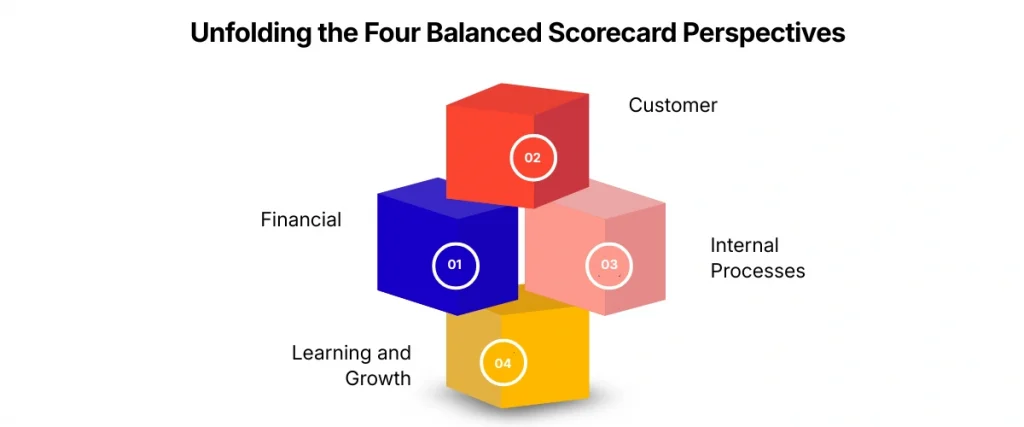
So, let’s explore the four elements of a Balanced Scorecard—financial, customer, internal processes, and learning and growth—in detail:
1. Financial
The financial perspective of a BSC aims to estimate an organization’s financial success and ensure all its strategies are aligned to yield profitable results. Key metrics include profit margins, revenue growth, and cost management.
2. Customer
The customer perspective of a BSC evaluates whether the organization is meeting customer expectations. It ensures that all its strategic moves garner customer satisfaction, loyalty, and retention. Common metrics include market share, customer satisfaction score, and Net Promoter Score (NPS).
3. Internal Processes
The internal processes perspective of a BSC measures the efficiency and effectiveness of key business processes to highlight areas for improvement. This enables organizations to deliver high-quality services and provide maximum value to their customers. Key metrics include quality control, cycle time, innovation rates, etc.
4. Learning and Growth
The learning and growth perspective of a BSC assesses aspects like employee development, technology advancement, culture, etc., of an organization to ensure it’s headed toward long-term success. Primary metrics include employee training, employee satisfaction, and innovation capacity.
Building a Balanced Scorecard
The process of building a Balanced Scorecard consists of several intense stages. But for your ease of understanding, we’ve clubbed them into three comprehensive steps. Check them out:
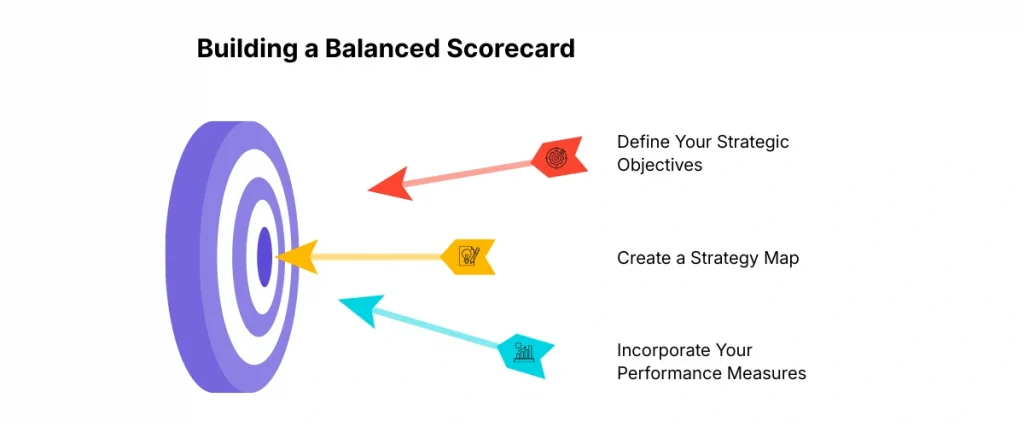
Step 1: Define Your Strategic Objectives
The BSC has four perspectives—financial, customer, internal processes, and learning and growth—and every organization has specific goals regarding each of them. So, start with identifying yours. Sounds overwhelming? Here’s a three-step formula for this:
- Be actionable
- Choose a perpetual objective
- Make sure it’s measurable
So, let’s you need to control production costs. A good financial objective would be to “Improve Cost Efficiency.”
Step 2: Create a Strategy Map
Earlier, people believed that the strategic objectives of each of the four BSC perspectives were independent of each other. However, that’s not so! If you look closely, each of the four BCS perspectives are interconnected. We’ll explain how:
Better Learning and Growth > Improved Internal Processes > Happier Customers > More sales (Finances)
So, it’s important to identify strategic objectives for each perspective and create a strategy map that highlights their cause-and-effect relationship. This will help you understand how improvements in one perspective can yield better results in another.
Step 3: Incorporate Your Performance Measures
Finally, it all comes down to performance measures—aka Key Performance Indicators (KPIs). For each of the strategic objectives that you have chalked out, define at least 1-3 KPIs. Make sure they are quantifiable, relevant, and target-oriented. This helps in progress measurement.
For instance, if your strategic objective is to “Improve Cost Efficiency,” a good KPI would be “Reduce cost per unit.”
How to Use a Balanced Scorecard?
Much like its development, the implementation of a Balanced Scorecard is also very systematic. Here are its four steps:
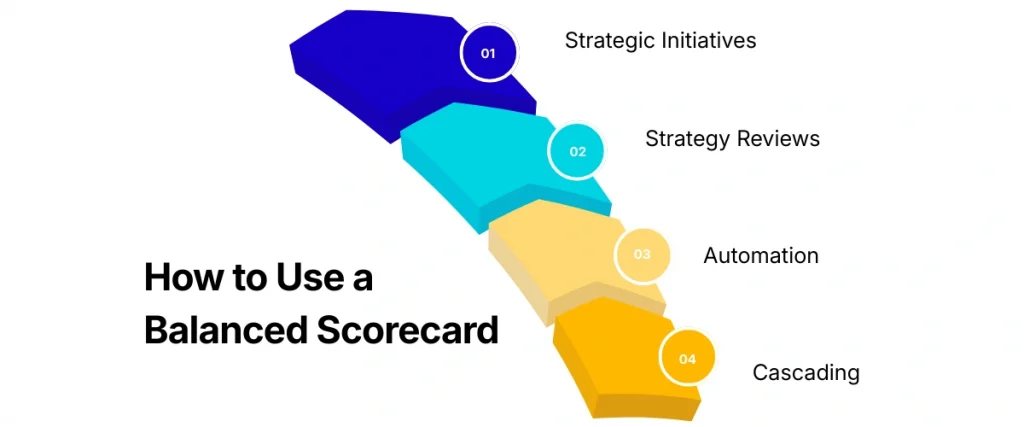
Step 1: Strategic Initiatives
Simply defining strategic objectives is not enough—you also need to formulate strong strategic initiatives to achieve them. For instance, to improve cost efficiency, minimize raw material wastage, or adopt new technology that reduces labor costs. These steps provide an actionable solution for attaining the objective.
Step 2: Strategy Reviews
You can implement as many initiatives as you want to. But if you do not review their effectiveness regularly, you might never achieve your objective in the first place. So, set up a review process to track the efficiency of your initiatives. This helps identify performance gaps and optimize actions as necessary.
Step 3: Automation
Implement effective performance management tools to automate the entire progress-tracking process. This will enable you to monitor growth and eliminate inefficiencies before they escalate.

Suggested Read:
9 Best Performance Management Software In India
Step 4: Cascading
Finally, cascade your Balanced Scorecard to ensure everyone in the organization—from top-level executives to managers and supervisors—is aligned with the organization’s goals and their roles and responsibilities for achieving them.
Examples of a Balanced Scorecard
Now that you know what a Balanced Scorecard is, here are some examples to give you an idea of how they are implemented across different industries:
1. Retail
In retail, a Balanced Scorecard can help drive revenue, improve customer experiences, optimize processes, and boost employee skills.
| Perspective | Strategic Objective | KPI | Target | Initiative |
| Financial | Increase revenue and profitability | Revenue Growth | 15% annual growth | Launch seasonal promotions |
| Customer | Enhance customer experience | Customer satisfaction score | 90% satisfaction rate | Improve in-store and online customer service |
| Internal Processes | Optimize inventory management | Stock turnover ratio | 4x per year | Implement advanced stock tracking |
| Learning and Growth | Improve employee knowledge | Employee training hours | 25 hours/employee | Develop e-training programs |
2. Healthcare
In healthcare, a Balanced Scorecard may help align financial goals, patient care, healthcare messaging, operational efficiency, and staff development.
| Perspective | Strategic Objective | KPI | Target | Initiative |
| Financial | Improve financial sustainability | Revenue per patient | 10% increase | Expand insurance partnerships |
| Customer | Enhance patient care | Patient satisfaction score | 95% patient satisfaction | Improve wait times and care quality |
| Internal Processes | Streamline hospital operations | Patient discharge time | 1 hour faster | Implement new discharge protocols |
| Learning and Growth | Foster continuous staff development | Staff training hours | 20 hours/employee | Launch ongoing professional development programs |
3. Technology
In tech, a Balanced Scorecard can measure financial growth, customer retention, operational speed, and innovation.
| Perspective | Strategic Objective | KPI | Target | Initiative |
| Financial | Increase product sales | Product revenue | 20% increase in revenue | Launch new product features |
| Customer | Improve user engagement | Customer retention rate | 85% retention | Enhance user experience |
| Internal Processes | Improve software development speed | Development cycle time | Reduce cycle time by 20% | Implement Agile practices |
| Learning and Growth | Foster innovation and creativity | R&D spending as %age of revenue | 10% of annual revenue | Increase R&D funding |
Pros and Cons of Balanced Scorecards
Like any management framework, the balanced scorecard brings clear advantages alongside practical implementation challenges.
Advantages
- Balanced Perspective: Combines financial data with non-financial performance indicators for a complete view of business health.
- Improved Strategic Execution: Connects abstract business strategy directly to daily operations and team targets.
- Long-Term Focus: Prevents short-sighted decision-making driven solely by quarterly financial results.
- Cross-Sector Flexibility: Works effectively across corporate, public sector, and non-profit environments.
- Clearer Responsibility: Ties team objectives and individual KPIs directly to organisational priorities.
Disadvantages
- Over-Complexity: Tracking too many metrics across all four areas can dilute focus and create unnecessary admin.
- Resource Intensive: Requires significant time, effort, and leadership commitment to design and maintain.
- Risk of Bureaucracy: Can easily turn into a mechanical tick-box exercise if management fails to review the data meaningfully.
- Dependency on Metric Selection: Poorly chosen KPIs can misdirect effort and encourage the wrong operational behaviours.
- Requires Cultural Buy-In: Needs consistent communication and senior leadership endorsement to work effectively across lower organisational tiers.
Conclusion
Measuring where an organization is headed is difficult but crucial. It can help you prevent fallouts that could be secretly impending upon the business. While keeping track of employee performance helps, it’s never sufficient. This is where the Balanced Scorecard comes into play.
This system is a must-have for every business because it helps you measure your organization’s performance and realign goals for optimization. So don’t wait—design your Balanced Scorecard today and monitor your organization’s holistic performance.
In this regard, you can check out PeopleStrong. An all-inclusive SaaS HR Tech 4.0 platform, PeopleStrong’s Performance Management Solutions automates various aspects of performance management to ensure it is efficient and result-oriented.
Get in touch today to learn more!

Frequently Asked Questions
Why is it called a Balanced Scorecard?
A Balanced Scorecard is termed “balanced” because it surpasses financial metrics to effectively address all the dynamic business aspects that could affect an organization’s performance and strategic planning, thus promoting a balanced evaluation.
What are the different types of business scorecards?
There are three main types of business scorecards: strategic, operational, and financial. A Balanced Scorecard combines all three, making it the most comprehensive.
What are the colors of the Balanced Scorecard?
Generally, a Balanced Scorecard consists of three colors—red, yellow, and green. Red signifies poor performance; yellow denotes moderate performance, and green stands for excellent performance.
What is the primary goal of a balanced scorecard?
The main goal is to translate high-level strategy into actionable, measurable operational objectives. It ensures leadership evaluates business health using a combination of financial results, customer experience, internal efficiency, and organisational growth capacity.
What are the four core perspectives of a balanced scorecard?
- Financial: Measures commercial results, such as revenue growth, profit margins, and cost efficiency.
- Customer: Tracks client satisfaction, retention rates, market share, and service perception.
- Internal Business Processes: Evaluates operational efficiency, cycle times, quality control, and resource utilisation.
- Learning and Growth: Assesses employee skills, corporate culture, training infrastructure, and technology adoption.
Is the balanced scorecard still relevant?
Yes. Decades after its creation, the framework remains widely used. Organisations continue to adapt it to support modern priorities, including digital transformation, hybrid workplace management, and ESG (Environmental, Social, and Governance) reporting.
How do you create a balanced scorecard?
- Clarify your core business strategy and top-level objectives.
- Map specific goals under each of the four perspectives.
- Select a small set of relevant Key Performance Indicators (KPIs) for each goal.
- Establish realistic performance targets and define required projects or initiatives.
- Set up a routine review process to track progress and update metrics as the business evolves.
Why should an organisation adopt a balanced scorecard?
Relying solely on financial reports shows where a business has been, not where it is heading. A balanced scorecard gives management a structured way to track the operational drivers that build long-term value, align teams around shared priorities, and make better-informed strategic decisions.