












 About Us
 Brand
Brand
 Career
 Contact Us



 +91-7314623098



Current organisational discussions regarding AI in human resources primarily emphasise use cases, vendors, and implementation timelines. However, empirical evidence suggests that greater attention should be directed toward the foundational conditions that influence the success of these initiatives.
The AI Ground Report 2026 surveyed more than 500 human resources leaders across 16 industries in India. Although 84% of organisations have initiated some form of AI activity in HR, fewer than half of active implementers report satisfactory outcomes. This disparity highlights a central issue: while adoption is widespread, successful outcomes remain limited, indicating a disconnect between organisational intent and actual delivery.
This gap is fundamentally architectural, reflecting underlying structural challenges within organisational technology frameworks.
Organisations that achieve successful AI outcomes do not merely acquire advanced tools; instead, they establish the essential conditions required for these tools to operate effectively.
A key finding of this research is that the fastest AI adopters, defined as those with the most active use cases and the most aggressive timelines, report the lowest satisfaction scores, averaging 3.14 out of 5. In contrast, organisations that combine active adoption with robust technology foundations achieve higher satisfaction scores, averaging 3.46. This difference underscores a structural issue: elevated activity on a weak foundation yields effort rather than meaningful outcomes. This pattern is consistent across industries, organisational sizes, and stages of adoption.
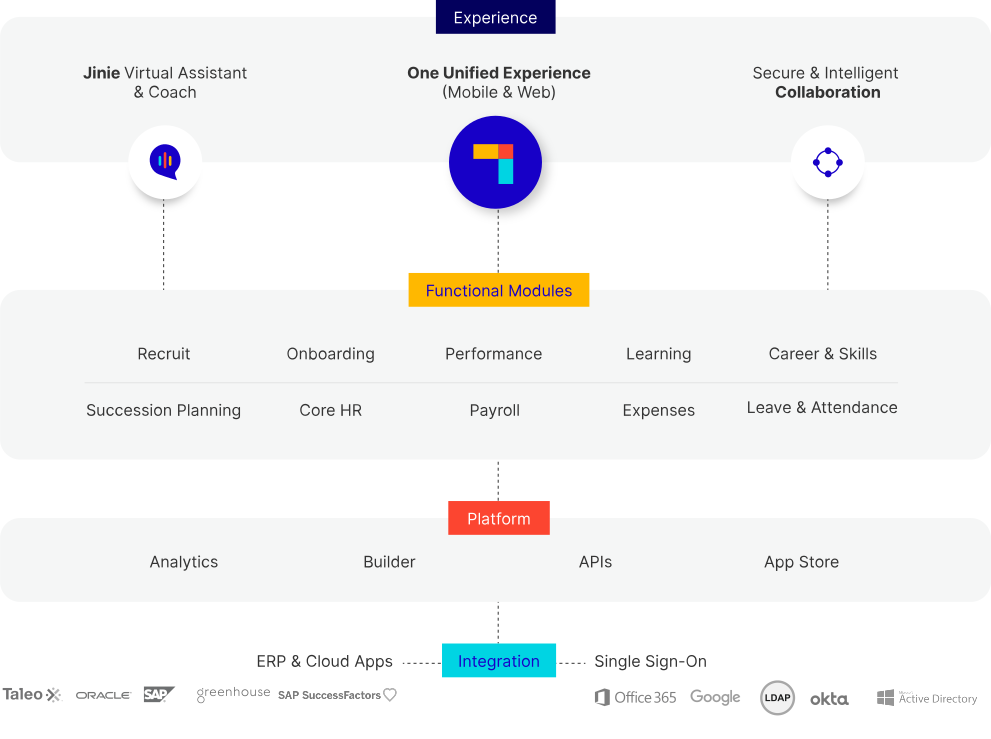
Four conditions consistently distinguish organisations that achieve results from those experiencing stagnation. The first is extensibility, which refers to whether the HR technology stack can respond to AI opportunities within weeks or requires prolonged IT involvement. The second is data coherence, indicating whether employee data resides on a unified platform or is fragmented across poorly integrated systems. The third is stack quality, encompassing the strength, scalability, and depth of platform capabilities. The fourth is consolidation, which concerns whether the architecture relies on a few comprehensive platforms or on multiple point solutions that require manual integration.
These four conditions operate as an interconnected system, where weakness in any single area limits overall effectiveness. For example, an organisation with strong extensibility but fragmented data will likely stall during the piloting phase. Similarly, clean data alone cannot compensate for a low-quality technology stack, as AI deployments will struggle to scale. The research clearly indicates that organisations with live AI implementations excel across all four dimensions. The most significant disparities between these organisations and those yet to begin are found in extensibility and data coherence, which are critical for transitioning pilots to production.
Data silos should not be viewed solely as an IT issue; they are the strongest predictor of whether an AI pilot will succeed or stall.
The data-related barrier warrants careful examination, as it influences the sequence for developing an AI action plan. Prior to implementation, most organisations primarily focus on cost and skills, both of which are valid concerns. However, these issues often resolve once leadership demonstrates a genuine commitment to the investment.
The research indicates that new challenges emerge after organisational commitment is established. Among organisations that have not yet begun, 34% identify data silos as a concern. This figure rises to 53% at the exploration stage. As organisations map AI use cases to their systems, limitations in data infrastructure become apparent. Integration issues follow a similar trend, becoming the primary constraint during piloting, cited by 59% of organisations, and remaining a significant challenge even for those operating AI at scale.
The data from the piloting stage represents one of the report’s most notable findings. Integration challenges affect both satisfied and dissatisfied organisations at nearly equal rates: 50.6% of dissatisfied organisations and 49.4% of satisfied ones cite integration as an issue. This suggests that integration is a universal challenge. In contrast, data silos create a 21-point satisfaction gap: 59% of dissatisfied piloting organisations cite them, compared with 37.2% of satisfied ones. This single variable at a specific stage produces a significant difference in outcomes. Therefore, addressing data architecture before scaling a pilot is currently the most impactful intervention for HR leaders.

Consolidation becomes increasingly difficult as more integrations are added to the technology stack.
The importance of consolidation warrants particular attention due to its cumulative impact throughout the adoption process. When organisations are asked to prioritise elements for redesigning their HR technology stack, consolidation consistently emerges as the top priority, with conviction increasing at each stage.
Among those not yet started, 7% name consolidation as their top redesign priority. At the exploring stage, that rises to 22%, driven by the direct experience of mapping use cases onto a fragmented architecture and finding that the map does not hold. Among organisations at the piloting stage, consolidation becomes the number one priority at 32%. Among already-live organisations, 31% say the same.
This conviction strengthens as the costs of fragmentation become apparent through practical experience. Each manually implemented integration introduces a dependency, and each dependency limits the scope of AI access, reasoning, and action. An AI agent operating on a unified data layer, with comprehensive access to organisational context such as structure, policies, approval chains, and personnel data, can perform at a level unattainable by tools reliant on fragmented inputs. For AI agents, a unified architecture is not merely an enabler but a prerequisite.
Ultimately, the data indicate that a robust AI action plan should begin with a thorough assessment of these four conditions before selecting use cases or engaging vendors. While use cases remain important, these foundational conditions determine which use cases are feasible and their delivery timelines.
The organisations that have crossed the satisfaction threshold in this research did not do so by moving faster or spending more. They did so by making the basic decisions first, often before the pressure to demonstrate AI progress became acute. That sequence, unglamorous as it is, is what the evidence consistently supports. And that is where the AI action plan should begin.