












 About Us
 Brand
 Career
 Contact Us



 +91-7314623098


Quick overview:
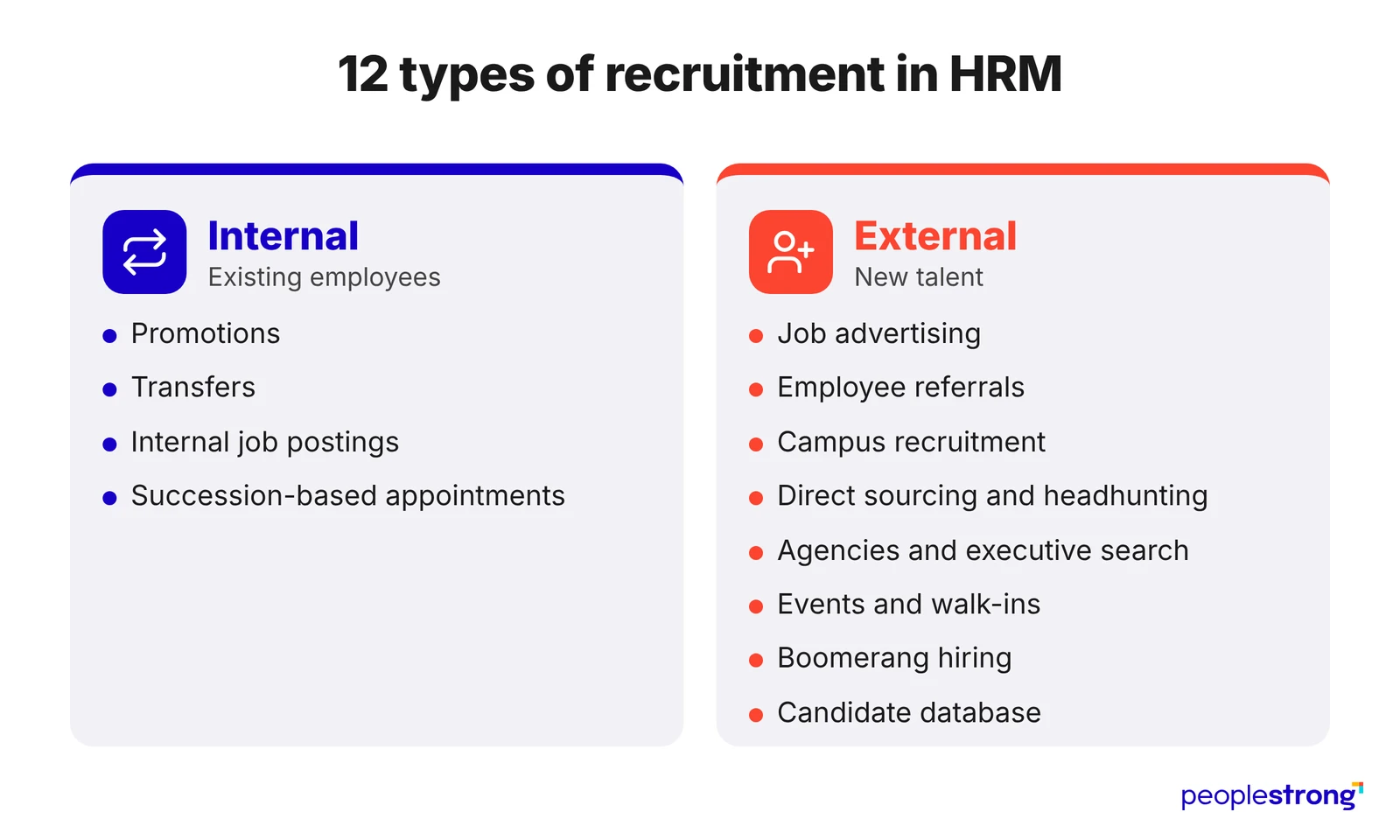
The two main types of recruitment in HRM are internal and external recruitment. Internal recruitment fills roles with current employees through promotions, transfers, internal job postings and succession-based appointments. External recruitment attracts outside candidates through job advertising, employee referrals, campus hiring, direct sourcing, agencies, recruitment events, former-employee networks and candidate databases. Choose the method based on the role’s requirements, available skills, hiring urgency and training capacity, and assess candidates against consistent job criteria.
Key takeaways
- Distinguish candidate sources from sourcing methods: Internal and external recruitment describe where candidates come from; advertising, referrals and campus hiring describe how employers reach them.
- Assess internal candidates for the new role: Strong performance in an existing position does not automatically establish readiness for different responsibilities. Plan how their previous work will be covered.
- Use external recruitment to address capability gaps: Target channels where candidates with the required skills and experience are likely to be found.
- Classify referrals and database candidates by employment status: An outside candidate remains external even if an employee recommends them or they’re found in an existing talent database.
- Match the method to the vacancy: Consider role seniority, confidentiality, hiring volume, urgency and the training needed before a new hire becomes productive.
- Measure hiring outcomes for comparable roles: Review qualified applicants, shortlist speed, offer acceptance, hiring cost, time to productivity, performance and retention when comparing sources.
A company advertises for a team leader while an experienced employee waits for a chance to progress.
Elsewhere, a manager promotes the strongest performer, only to discover that doing the work and managing people require different skills.
Both appointments begin with the same problem: the hiring method was chosen before the job was properly understood. Recruitment shapes who gets an opportunity, whose skills get noticed, and what a business can accomplish next.
Choosing where to look deserves as much thought as choosing whom to hire.
What is recruitment in HRM?
Recruitment in human resource management is the process of identifying a staffing need, defining the role, and attracting people who can do the work.
Selection assesses those candidates and determines who receives an offer. Employers often use “recruitment” more broadly to describe the entire hiring process.
Recruitment terms describe different parts of the hiring decision:
| Classification | What it tells you | Examples |
|---|---|---|
| Candidate source | Where candidates come from | Internal or external recruitment |
| Sourcing method | How employers reach candidates | Campus hiring, referrals, advertising |
| Agency arrangement | How a recruitment partner is engaged and paid | Retained or contingency recruitment |
12 types of internal recruitment
Internal recruitment considers existing employees for open roles.
Familiarity with the organisation can help, but employees still need to be assessed against the new position’s requirements.
1. Promotions
Use when: The vacancy carries greater authority or accountability and current employees have relevant experience.
How to do it: Write the new role’s scorecard before seeking nominations. Test the work the employee will inherit. For a first management role, use a coaching exercise, a prioritisation task and a difficult performance conversation.
Decision check: Strong results in the current job prove competence at that level. Approve the promotion only when the employee shows evidence of handling the next role’s decisions.
2. Transfers
Use when: An employee has adjacent skills suited to another team, function or location at a comparable grade.
How to do it: Map the employee’s current skills against the vacancy, test the missing skills and specify any training needed. Confirm changes to pay, hours, reporting lines and location before selection.
Decision check: Choose the candidate before negotiating the release date. Plan the handover and backfill separately, so the current manager’s staffing problem does not affect the decision.
3. Internal job postings
Internal job postings advertise vacancies through an employee careers portal, email, or another accessible channel. Employees can apply instead of waiting for nominations.
- Include: Responsibilities, eligibility requirements, assessment stages, and an application deadline.
- Avoid: Advertising a role after privately choosing someone. Employees need a genuine opportunity to compete, or they may stop taking future openings seriously.
Pro tip: Give unsuccessful internal applicants specific feedback so they know what experience they need for a future application.
4. Succession-based appointments
Example: A regional manager gains budgeting experience before being considered for a departing business head’s position.
Succession planning prepares employees for critical roles before vacancies arise. Recruitment happens when you assess and appoint a prepared employee to an opening.
Review point: Reassess potential successors as business requirements change. Preparation for yesterday’s role may not establish readiness for tomorrow’s responsibilities.
Before approving an internal move, decide who will cover the employee’s previous responsibilities. Include replacement and redistribution of that work in the hiring decision.
Types of external recruitment
External recruitment reaches people not currently employed by the organisation, expanding available skills and experience.
5. Job advertising
Employers publish vacancies on their careers website, general job boards, specialist platforms, or relevant offline channels. Advertising works when suitable candidates are actively searching.
- Include: The work, essential skills, location, working arrangements, and selection stages.
- Channel choice: A niche engineering board may produce fewer applications than a general portal but a more useful shortlist. Judge relevance before volume.
6. Employee referrals
Employee referrals bring candidates to the organisation through recommendations from current staff. Employees can help applicants understand the workplace before applying.
- Assessment rule: Referred candidates should meet the same standards as other applicants.
- Classification: Referrals of outside candidates are external recruitment, even through internal referral systems. Keep other sourcing channels open so hiring does not depend entirely on the people your workforce already knows.
7. Campus recruitment
Best suited to: Roles where employers can teach company-specific processes and support people entering the workforce. Internships and apprenticeships can also feed this pipeline.
Campus recruitment connects employers with students and recent graduates through colleges, universities, and training institutes.
- Assessment priority: Evaluate learning ability through practical exercises. Restricting applications to a short list of institutions can exclude capable candidates before their skills receive any attention.
8. Direct sourcing and headhunting
Direct sourcing involves approaching people whose experience appears relevant, including professionals who have not applied.
- Where to look: Professional networks, industry communities, and portfolio sites, especially for scarce expertise or candidates unlikely to browse job boards.
- Outreach priority: Explain the problem the person would own, the scope of responsibility, and why their experience prompted the approach. Give them a specific reason to respond.
9. Recruitment agencies and executive search
- Use contingency recruitment when: The role is established, several suitable candidates exist in the market and payment after placement suits the search.
- Use retained search when: The appointment is senior, confidential or difficult enough to require market mapping and direct approaches.
How to do it: Agree on the role scorecard, target market, excluded employers, salary range, candidate ownership, fee trigger, duplicate submissions, assessment duties and replacement terms before the search begins. Require every submitted profile to show how the candidate meets the agreed criteria.
10. Recruitment events and walk-ins
Best suited to: High-volume hiring for roles with fixed locations, shifts, start dates and entry requirements.
Recruitment events shorten hiring time by placing screening and first interviews in the same session.
Publish the pay range, location, shifts, minimum criteria and required documents beforehand so unsuitable candidates can rule themselves out.
- Preparation priority: Use pre-registration questions to confirm essential requirements. Assess every attendee with the same scorecard and give qualified candidates a clear next step before they leave. Measure qualified candidates and accepted offers, not total attendance.
11. Former-employee or boomerang hiring
Boomerang hiring brings former employees back into the organisation. Experience gained elsewhere may qualify them for a different role.
- Check first: Why the employee left and what has changed since their departure.
- Assessment rule: Earlier performance provides evidence, but you still need to check current suitability. Rehiring a former employee counts as external recruitment under a current-employment definition.
12. Candidate database recruitment
Best suited to: Recurring roles, urgent vacancies and searches with strong previous finalists.
Candidate database recruitment draws from people the employer already knows: previous applicants, former finalists, employee referrals, past contractors and candidates who joined its talent network. It works especially well for recurring vacancies and roles closely related to an earlier search.
Confirm the candidate’s recent experience, salary expectations, location, availability and interest before adding them to the shortlist.
Review previous interview notes against the new role’s criteria because an applicant rejected for one position may be well suited to another.
Follow applicable consent and data-retention requirements before making contact.
- Check first: Whether the candidate’s skills, expectations, and availability have changed.
- Classification: Recruitment type depends on the candidate’s current employment status. A former finalist stored in the company’s database remains an external candidate. A current employee found in the same system is an internal candidate.
How to choose the right recruitment method
Choosing a recruitment method involves three separate decisions:
- where suitable talent is likely to exist
- how to reach those candidates
- whether the search needs outside support
Begin with the capability the role requires. If employees already possess most of the necessary skills, review internal candidates and estimate the time required to close any gaps. An external search becomes more useful when the organisation needs expertise, market knowledge or experience it does not currently have.
The vacancy’s urgency also matters. A quick hire from the wrong source can create another vacancy several months later. Compare the time needed to recruit an external candidate with the time needed to prepare an existing employee. Include notice periods, onboarding and time to reach full productivity in the calculation.
SHRM’s 2026 Talent Trends research offers two useful lessons:
- 41% of surveyed HR professionals train existing employees for hard-to-fill roles. Reviewing skills and learning ability can uncover internal candidates whose job titles do not make them obvious choices.
- Social media was the most commonly used recruitment strategy, reported by 59% of respondents, but it ranked ninth for effectiveness in filling vacancies. A popular channel is not necessarily the right channel for a particular role.
Match the recruitment method to the hiring conditions:
- A role with a ready internal successor: Begin with internal recruitment and assess the employee against the full requirements of the position.
- A role requiring a new organisational capability: Search externally in professional communities, specialist job boards and competitor talent pools relevant to that expertise.
- A graduate or entry-level intake: Use campus recruitment, apprenticeships or open applications when the organisation can provide structured training and expects to hire several people with similar potential.
- A confidential or senior appointment: Consider retained executive search when discretion, market mapping and direct approaches to passive candidates are necessary.
- An urgent replacement: Review qualified internal applicants and strong previous finalists immediately. Open a targeted external search if those groups cannot provide a credible shortlist.
- A recurring high-volume role: Use the sources that have produced reliable hires for the same role, location and shift pattern.
Measure each source by:
- the number of qualified applicants it produces
- time to a credible shortlist
- offer acceptance
- hiring cost
- time to productivity
- performance and retention
Pro tip: Compare results within similar roles because a channel that performs well for sales hiring may perform poorly for engineering or senior leadership.
Make the next recruitment decision count
Every recruitment method shapes who enters the hiring team’s field of view.
Internal recruitment can uncover proven employees ready for greater responsibility, while external recruitment can bring in skills, experience and perspectives the organisation does not yet have.
Strong hiring teams choose the recruitment route based on the role, the available talent and the capability the business needs next. They also keep the process connected from sourcing and screening to evaluation and selection.
PeopleStrong’s talent acquisition platform helps bring these stages into one recruitment workflow, giving hiring teams clearer information as they assess each candidate.
A vacancy is temporary. The impact of the person hired can last for years. Make the search broad enough, the evaluation thoughtful enough and the final decision one that moves the business forward.
Frequently asked questions
What are the two main types of recruitment in HRM?
The two main types of recruitment in human resource management are internal recruitment and external recruitment. Internal recruitment fills a vacancy with an existing employee through a promotion, transfer or internal application. External recruitment seeks candidates from outside the organisation through sources such as job boards, recruitment agencies, campus hiring, social networks and employee referrals.
What are the main types of internal recruitment?
The main types of internal recruitment are promotions, lateral transfers, internal job postings and succession-based appointments. A promotion moves an employee into a role with greater responsibility. A lateral transfer places an employee in a different role at a similar level. Internal job postings invite eligible employees to apply, and succession plans prepare selected employees for roles expected to become vacant.
Is employee referral internal or external recruitment?
Employee referral is usually a form of external recruitment because an existing employee recommends a candidate who works outside the organisation. When an employee recommends a current colleague for another position within the same organisation, the process falls under internal recruitment. The candidate’s current employment status determines whether the referral is internal or external.
Is online recruitment a separate type of recruitment?
Online recruitment is a recruitment method, not a separate category based on candidate source. Employers use online recruitment for internal hiring through employee career portals and internal vacancy boards. They use it for external hiring through company career pages, job sites, social media and professional networks.
Can companies use internal and external recruitment together?
Companies can use internal and external recruitment at the same time by opening a vacancy to current employees and outside candidates. A combined recruitment process gives internal applicants an opportunity to progress and allows the employer to assess skills available in the wider market. Using the same job criteria and assessment process helps the hiring team compare every candidate fairly.