












 About Us
 Brand
Brand
 Career
 Contact Us



 +91-7314623098






Recruitment is one of the most crucial processes for any organization. Right from your output quality to your reputation—it significantly affects everything. However, determining the right recruitment budget can be challenging. About 20% of companies spend more than 60% of their HR budgets on talent acquisition.
Despite this, they remain vulnerable to problems like talent shortages, mismatched skills, and high employee turnover. This suggests that simply spending more isn’t the solution—organizations need a data-driven approach to optimize their hiring investments.
So, in today’s blog, let’s discuss Cost per Hire and how you can use it to calculate the most efficient recruitment budget for your company.

Suggested Read:
Recruitment Process Guide For HRs to Hire Top Talent
What is Cost per Hire?
Cost per Hire (CPH) is an essential recruitment metric. It indicates the total cost a company faces to hire a new employee. It’s a comprehensive figure that accounts for every recruitment-related cost. This includes job advertising fees, recruiter fees, interview costs, training expenses, etc.
What is the Formula for Cost per Hire?
If you want to determine the Cost per Hire (CPH) of your company during a period, here’s the formula you should use:
CPH = Total recruitment costs/Number of hires
Total recruitment costs include all internal and external expenses related to hiring a new employee. For example, recruiter’s salary, hiring team’s time, onboarding and training costs, travel expenses, relocation costs, etc.
The number of hires implies the total number of employees hired during that period.
Here’s an example:
Suppose a company wants to ascertain its CPH during the month of August. It spent a total of INR1,00,000 on recruitment and hired a total of 10 employees.
So, as per the formula, its CPH would be
= 1,00,000/10
= INR 10,000
This means the company spent INR 10,000 to hire each new employee.
Why Does Cost per Hire Matter?
Cost per hire isn’t just any figure; it’s a reflection of your hiring process’s efficiency. If you’re wondering why you should even take up the task of calculating it, here are some of its benefits you need to know:
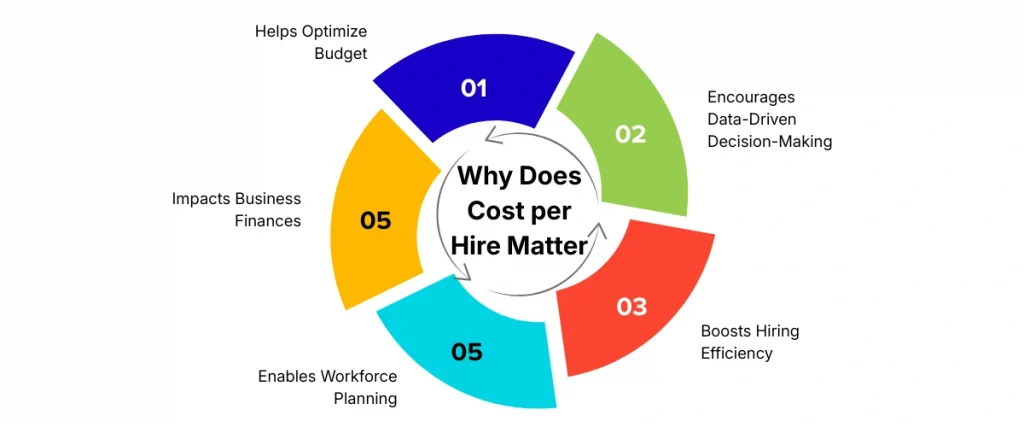
1. Helps Optimize Budget
Every organization has a fixed budget for recruitment. However, most fail to optimally use it, often leading to under/overutilization of resources. This negatively impacts talent quality, profitability, and overall hiring efficiency.
CPH prevents this. It helps HR managers analyze hiring costs so they can optimize them as per their needs. That’s not all—it also enables them to weave cost-effective hiring strategies for the future.
2. Encourages Data-Driven Decision-Making
70% of hiring professionals admit that data-driven insights improve their hiring quality. But do you know what’s the most important hiring data that contributes to these “insights?” You guessed it right—CPH.
Cost per hire allows companies to compare hiring costs across different roles, departments, and locations. This helps them identify the best recruitment sources, leading them closer to top talent pools.
3. Boosts Hiring Efficiency
A higher CPH indicates inefficiencies, while a lower one demonstrates better hiring effectiveness. However, organizations that don’t track this metric remain oblivious to these details.
More often than not, every hiring process has certain hidden potentials for improvement that are not obvious qualitatively but can enhance hiring results when addressed. Tracking CPH not only helps you identify these opportunities but also suggests ways you can optimize them.
4. Enables Workforce Planning
According to statistics, 90% of hiring managers struggle to find skilled candidates for a role. This acute shortage has made early workforce planning a top priority for businesses. However, it’s impossible to estimate future hiring needs entirely without accurate CPH data.
Cost per hire not only helps you ascertain your present hiring costs. It also reveals hiring expenses for the future, helping you anticipate costs for seasonal hiring or expansion plans.
5. Impacts Business Finances
Cost per hire impacts a company’s financial health in several direct and indirect ways.
Firstly, it ensures you hire the best talent at the best cost, making sure no funds are wasted due to inefficiencies in the hiring process. Secondly, improving recruitment strategies enables companies to attract and retain top talent, ultimately enhancing productivity and long-term profitability.
Steps to Calculate Cost per Hire
Ascertain how much you spend in hiring a new employee for your organization—follow these steps to calculate Cost per Hire (CPH):
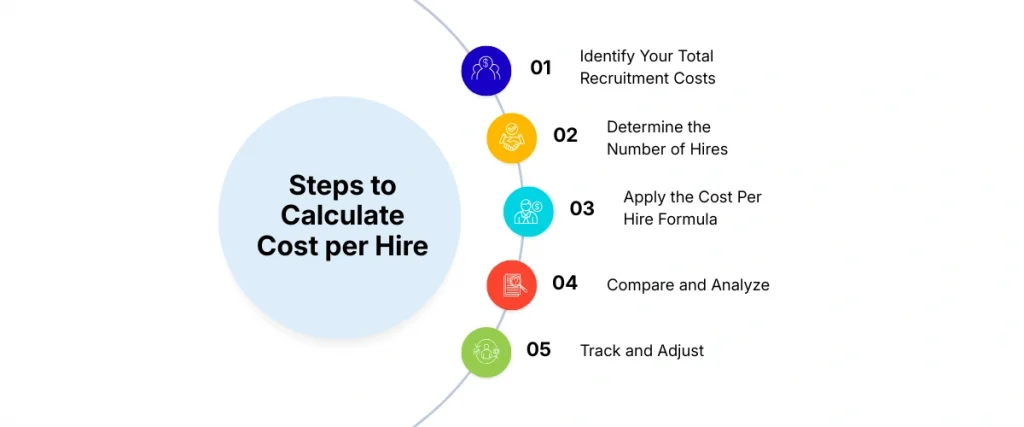
Step 1: Identify Your Total Recruitment Costs
First and foremost, gather all internal and external costs you incurred during the hiring process. This includes:
- Job advertising fees (online job boards, social media ads, etc.)
- Recruiter salaries or agency fees
- Background checks and pre-employment assessments
- Interview costs (travel, accommodations, or assessment tools)
- Employee referral bonuses
- Onboarding and training expenses
Step 2: Determine the Number of Hires
Now that you have gathered all the costs, count the total number of employees your organization hired within a specific period. It can be monthly, quarterly, half-yearly or annually. However, make sure the count only consists of successful hires and not all the applicants.
Step 3: Apply the Cost Per Hire Formula
Next up, apply the standard CPH formula. It is the total recruitment cost divided by the total number of hires.
Step 4: Compare and Analyze
Now that you have your cost per hire data, compare it against industry standards. If your cost is too high, look for areas that can be optimized to control the cost. For instance, if you rely on third-party recruiters, strengthen your internal hiring process to bring down your CPH. This will gradually help you eliminate inefficiencies from your hiring process.
Step 5: Track and Adjust
Finally, keep monitoring your CPH to ensure it’s always optimized for efficiency. Keeping records of CPH trends helps in budgeting and making data-driven hiring decisions.
How Do You Use the Cost per Hire Metric?
Quantify Your Cost per Hire
Measure cost per hire consistently across monthly, quarterly, or annual reporting periods to establish a reliable recruitment benchmark.
Analyse the Results
Review fluctuations in recruitment spending and identify the factors contributing to increases or decreases in hiring costs.
Compare Across Departments
Different functions often have different recruitment costs. Analysing cost per hire by department provides more meaningful insights than relying solely on organisation-wide averages.
Research Industry Standards
Comparing internal performance against industry benchmarks can provide useful context and help organisations assess recruitment efficiency.
Apply What You’ve Learned
Use recruitment data to optimise sourcing strategies, allocate budgets more effectively, and improve overall hiring performance.
Factors Affecting Cost-Per-Hire
An organization’s cost per hire is driven by several internal operational choices and external market variables:
- Role Seniority and Specialization: Sourcing entry-level talent is highly cost-effective, whereas recruiting senior executives or specialized technical experts requires extensive sourcing and often incurs expensive third-party agency fees.
- Hiring Process Efficiency: Protracted interview cycles consume significant internal HR labor hours. Furthermore, slow timelines increase candidate drop-out rates, forcing the company to reinvest capital to restart the search.
- Employer Brand Strength: A reputable employer brand naturally attracts high volumes of quality candidates through organic, low-cost channels. Unknown or poorly perceived brands must invest heavily in premium job advertisements and external sourcing.
- Agency Reliance: Over-reliance on external recruitment firms significantly inflates expenditures, as agencies typically charge a steep percentage of the new hire’s annual salary.
- Employee Referral Programs: Sourcing candidates through current employees’ networks minimizes marketing and screening costs, requiring only a modest internal bonus payout upon a successful placement.
- Recruitment Technology: Managing pipelines manually on spreadsheets drains administrative resources. Implementing a modern Applicant Tracking System (ATS) automates workflows, directly reducing the internal labor cost per hire.
Tips to Reduce Your Cost per Hire
Is your cost per hire too high? Don’t worry—check out these seven tips to reduce it:
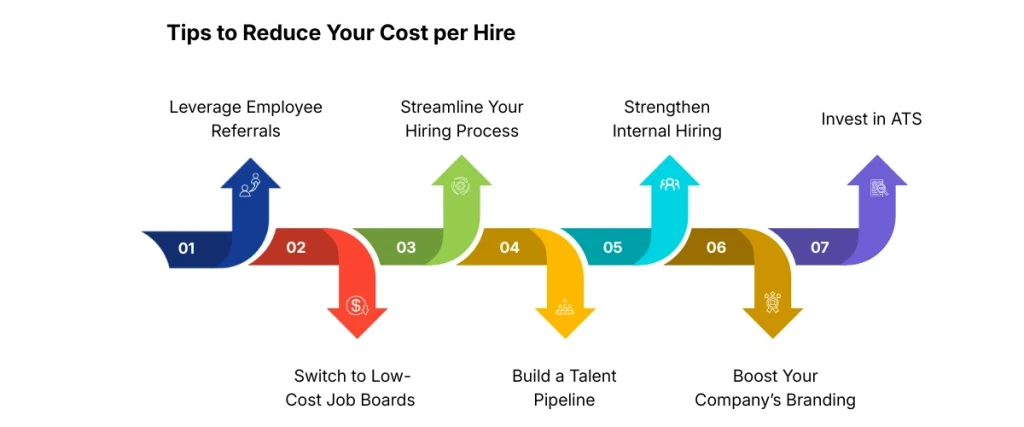
1. Leverage Employee Referrals
As per data, as many as 84% of companies rely on employee referral programs to fill up open positions. They reduce job advertising costs, recruiter costs, and other related expenses, significantly reducing your CPH.
2. Switch to Low-Cost Job Boards
Instead of posting your hiring requirements on paid job boards, leverage free platforms like LinkedIn and Facebook to reach a wide set of audience and spread the word about the opportunity in your company—without any cost!
3. Streamline Your Hiring Process
A lengthy hiring process—with multiple rounds and stages—not only complicates hiring but also increases its costs. So, simplify your hiring process. Instead of multiple one-on-one interviews, conduct a group interview to save both time and resources.
4. Build a Talent Pipeline
Don’t reach out to third-party platforms, agencies, or recruiters every time there’s an open position in your organization. Instead, maintain a register of past applicants/pre-screened candidates to find the best fit for future roles and reduce your recurring costs.
5. Strengthen Internal Hiring
Turn to internal hiring methods like promotions or transfers, especially if the role that needs to be filled doesn’t require exclusive skills or expertise in a niche. This will save money and expedite your onboarding process.
6. Boost Your Company’s Branding
Companies with a strong brand value seldom have to reach out to candidates or third-party job boards to recruit in their organization. Rather, they attract candidates to apply to their company, reducing the need for paid advertising and external recruiters.
7. Invest in ATS
An Applicant Tracking System (ATS) is a tool that automates several steps in the hiring process, such as reviewing CVs and screening candidates. It also improves candidate sourcing and minimizes the need for external recruiters.
How AI and Automation Bring Hiring Costs Down
Automated Sourcing
AI-powered sourcing tools can help recruiters identify relevant candidates more efficiently by analysing skills, experience, and role requirements across talent pools.
Smart Screening
Automated screening solutions can assist recruiters by prioritising candidates that closely match role requirements, reducing manual review effort.
Streamlined Scheduling
Interview scheduling tools help coordinate candidate and interviewer availability more efficiently, reducing administrative workload.
Interview Analytics
Advanced recruitment platforms can provide structured insights from candidate assessments and interview feedback, supporting more consistent hiring decisions.
Continuous Optimisation
AI-powered recruitment analytics help organisations monitor hiring performance, identify bottlenecks, and continuously improve recruitment processes. According to LinkedIn Future of Recruiting Report, recruiting teams are increasingly using AI and data-driven hiring practices to improve recruitment efficiency, candidate quality, and overall hiring outcomes.
Conclusion
Tracking Cost per Hire (CPH) isn’t just about managing recruitment expenses—it’s about ensuring your hiring process is both efficient and effective. A well-optimized CPH helps attract top talent without unnecessary costs, ultimately strengthening your workforce and improving business performance. By leveraging data-driven insights, companies can refine their hiring strategies, reduce inefficiencies, and make smarter talent decisions.
So, if you’re looking for a smarter way to optimize your hiring costs while securing the best talent, focus on your CPH!
In this regard, you can check out PeopleStrong. An all-inclusive SaaS platform, PeopleStrong’s robust Recruitment Solutions can help you optimize your CPH and boost your hiring efficiency.

FAQs
Why is cost per hire an important metric to track?
Cost per hire helps organisations understand the financial efficiency of their recruitment efforts. By tracking this metric, HR and business leaders can assess hiring expenditure, evaluate recruitment channels, identify opportunities for optimisation, and plan future workforce investments more effectively. It also provides valuable insight into the return on recruitment spending and supports data-driven hiring decisions.
What is the average cost per hire?
The average cost per hire varies depending on factors such as industry, geography, organisation size, and role complexity. According to research from the Society for Human Resource Management (SHRM), average hiring costs can vary significantly across organisations. Rather than relying solely on external benchmarks, organisations should monitor their own trends over time to evaluate recruitment efficiency and budget allocation.
Should the cost per hire include the hiring manager’s time?
Yes. Many organisations include hiring manager time as part of their internal recruitment costs. This may include time spent reviewing applications, conducting interviews, participating in assessments, and making hiring decisions. Including these costs can provide a more comprehensive view of the resources invested throughout the recruitment process.
Does cost per hire include onboarding and training costs?
Typically, cost per hire focuses on the expenses associated with attracting, assessing, and hiring a candidate. Onboarding, induction, and training costs are usually measured separately as part of employee onboarding or learning and development investments. However, organisations may choose to track these metrics together when evaluating overall hiring effectiveness.
How does cost per hire compare to time-to-fill?
Cost per hire measures the financial investment required to recruit an employee, while time-to-fill measures the number of days needed to fill a position. Both metrics provide different perspectives on recruitment performance. Monitoring them together helps organisations balance hiring efficiency, recruitment costs, and workforce planning objectives.
What’s the difference between cost per hire and cost per applicant?
Cost per hire measures the total recruitment investment required to successfully hire an employee. Cost per applicant measures the amount spent to attract each candidate into the recruitment process. While cost per applicant helps evaluate sourcing effectiveness, cost per hire provides a broader view of overall recruitment efficiency and outcomes.
How do I know if my recruiting budget is enough?
Recruitment budgets should be aligned with workforce planning objectives, anticipated hiring volumes, and historical recruitment costs. Organisations can estimate future requirements by reviewing previous hiring data, projected workforce growth, and expected market conditions. Regularly monitoring recruitment metrics can help ensure budgets remain aligned with hiring needs.
What’s a good benchmark for cost per hire?
A useful benchmark is one that aligns with organisational goals while supporting the attraction of quality talent. Recruitment costs should be evaluated alongside metrics such as quality of hire, retention rates, and time-to-fill. Comparing results against industry benchmarks can provide additional context, but internal performance trends often offer the most meaningful insights.
How does AI-powered predictive hiring impact the overall ROI of recruitment strategies?
AI-powered predictive hiring can help organisations make more informed recruitment decisions by identifying patterns associated with candidate success, performance, and retention. By improving candidate matching and reducing hiring inefficiencies, organisations may strengthen hiring outcomes while improving the overall return on recruitment investments.
Can a high employee retention rate significantly reduce an organisation’s annual cost per hire?
Yes. Higher employee retention can reduce the frequency of recruitment activities, resulting in lower hiring costs over time. When organisations successfully retain employees, they often spend less on sourcing, advertising, interviewing, and onboarding replacement talent. Retention strategies can therefore contribute to both workforce stability and recruitment efficiency.
What are the primary internal and external variables included in a 2026 cost per hire calculation?
Internal costs may include recruiter salaries, recruitment technology, employee referral programmes, assessment tools, and hiring manager time. External costs typically include job advertisements, recruitment agency fees, background verification services, employer branding campaigns, and candidate travel expenses. Tracking both categories provides a more accurate view of total recruitment expenditure.