












 About Us
 Brand
Brand
 Career
 Contact Us



 +91-7314623098







Enterprise leaders often find their teams managing a dense mix of goals, metrics, and dashboards. Two terms dominate these management discussions: OKRs (Objectives and Key Results) and KPIs (Key Performance Indicators).
While both frameworks measure performance, treating them as interchangeable is a mistake. KPIs tell you if your current business engine is running smoothly. OKRs push you to build a new engine entirely.
This guide breaks down the core differences between OKRs and KPIs, explains how senior leadership can deploy both effectively, and shows how HR teams can use these tools to align company strategy with daily execution.
What Are OKRs?
OKRs are a goal-setting framework that sparks innovation and growth. Here’s a clear breakdown of how to understand an OKR.
Objectives: These are the “what” statements. They define the ambitious targets you want to achieve. For example: “Become the industry leader in customer experience” or “Develop software that redefines the market.” These statements are qualitative. They inspire teams to perform better.
Key Results: This is the “how.” Key Results translate the above objectives into measurable metrics. They help you to know if you’re achieving the objective. Examples include “Increase customer satisfaction score by 15%” or “Launch the new product within budget and 6 months.” Key Results are quantifiable. They show milestones to success.

The Benefits of OKRs
Organizations can turbocharge their way of working with OKRs. Here are the advantages.
- Alignment and Focus: OKRs ensure everyone in the organization is moving in the same direction. All team members are aligned with the corporate objectives.
- Stretch Goals: They encourage setting ambitious goals that push the boundaries of what’s considered achievable. In this way, OKRs foster innovation and growth.
- Transparency and Communication: When OKRs are openly shared across all levels, communication and transparency are naturally promoted.
One of the best ways for businesses to start their OKR journey is to use OKR-based Performance Management software from PeopleStrong. Real-time data, collaboration tools, and agile features empower businesses to make informed decisions, boost performance, and achieve strategic goals efficiently.


Suggested Read:
What is OKR? A Comprehensive Guide for HR Professionals
What Are KPIs?
KPIs can be thought of as data-driven performance trackers. They tell you how well you’re moving towards your goals.
KPIs provide concrete numbers to assess performance and identify areas needing improvement.
The Benefits of KPIs
KPIs offer many advantages to team members and organizations.
- Data-Driven Decisions: KPIs provide hard data to support decision-making processes. They ensure objectivity and avoid guesswork.
- Improved Performance Measurement: Evaluating performance becomes precise with quantifiable KPIs. Employees can clearly see if they’re on track or need to adjust course.
- Tracking Progress Over Time: Monitoring KPIs over time allows companies to identify trends, predict future performance, and ensure continuous improvement.
Understanding the Difference: KPI vs. OKRs
Let’s break down a comparison of OKR vs KPI based on the parameters of purpose, focus, measurability and timeframe.
| PARAMETER | OKRs | KPIs |
|---|---|---|
| Purpose | Set ambitious goals and foster innovation. | Measure progress towards existing goals. |
| Focus | Qualitative (Objectives) and Quantitative (Key Results). | Primarily quantitative and data-driven. |
| Measurability | Objectives are qualitative, but Key Results are measurable | Designed to be specific and quantifiable. |
| Timeframe | Typically set quarterly with regular check-ins | Can be tracked over various timeframes. |
| Structure | Objective (Where to go) + Key Results (Proof of progress). | Metric + Baseline Target + Current Value. |
| Best for | Driving strategic shifts, launching new initiatives, or transforming team capabilities. | Monitoring core business health, operational efficiency, and standard outputs. |
Many organizations today are turning to OKRs over traditional KPIs because of their emphasis on ambitious goal-setting and alignment.
OKRs encourage an agile and focused approach, promoting innovation and employee engagement. In contrast, KPIs tend to be granular and short-term.
OKRs also drive strategic thinking and foster a culture of achievement. They are transparent and collaborative for better communication and alignment across teams, as this ultimate guide to OKRs reveals.
Why Use HR OKRs?
HR professionals must embrace HR OKRs and facilitate the transformation from a reactive personnel function to an active strategic partner. OKRs facilitate the accomplishment of meaningful organisational reform.
Aligns with Organisational Goals
HR OKRs guarantee that talent management strategies directly support financial initiatives, growth, and operational objectives. If there is a need for business expansion, HR OKRs ensure that recruitment speed meets the necessary leadership capabilities.
Provides Focus and Prioritisation
HR teams are bombarded with numerous requests every day. This is why implementing OKRs helps them protect their teams against irrelevant tasks, concentrating on only 2 or 3 revolutionary ideas each quarter.
Maintains Accountability and Measurement
HR executives can show their projects’ influence on business and report it to the board by linking broad qualitative aims (e.g., “improving the culture of a company”) with specified concrete outcomes.
Encourages Continuous Improvement
With the help of OKRs, HR teams test their programmes and update the strategies they used previously.
How HR Can Employ OKRs
Enhancing Recruitment and Onboarding
- Objective: Redesign/engineer the onboarding experience to minimise days-to-productivity for the new hires.
- Key Result 1: Cut down days-to-first-code-commit of new hire from 21 to 7.
- Key Result 2: Reach and retain at least a 30-day onboarding satisfaction score of above 90% from new employees.
- Key Result 3: Make role-specific training modules for new hires, complete 100%.
Bettering Employee Engagement and Morale
- Objective: Develop across hybrid teams a culture of openness with trust as the foundation.
- Key Result 1: Go up to 80% participation from 55%.
- Key Result 2: Bring back employee eNPS score up to +35 from +15.
- Key Result 3: All line managers to be trained on remote performance coaching frameworks; train 100%.
Facilitating Diversity, Inclusion, Equity and Belonging
- Objective: Create a diversity-conscious leadership pipeline at all business units.
- Key Result 1: Increase female representation in director-and-above roles from 22% to 30%.
- Key Result 2: Ensure all job descriptions are audited and that 100% biased words are removed.
- Key Result 3: Ensure, on average, 85%+ of interview panels have diversity hires.
OKRs in Action: Examples for Different Departments
The best way to understand how OKRs work is to examine some examples from different departments. Here are some of them.
Keep in mind that each department can set more than one objective, and there can be various different results.
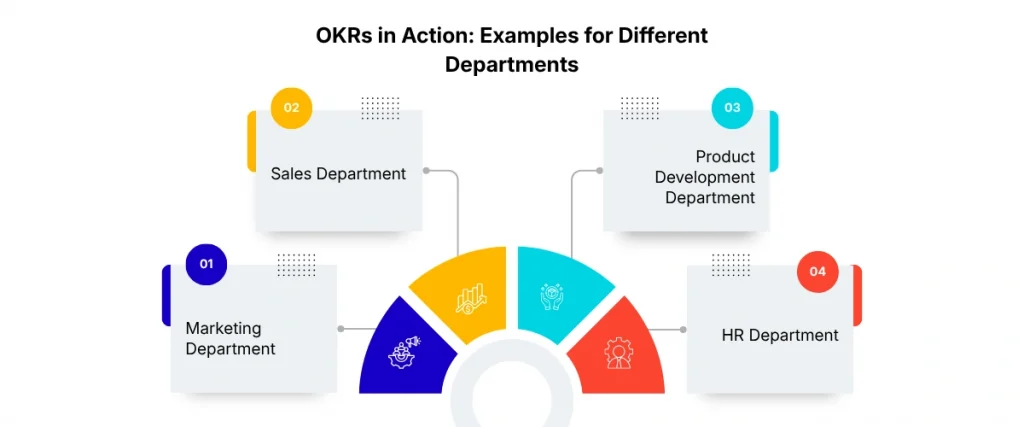
OKRs Example for Marketing Department
🎯 Objective: Increase brand awareness by 20%.
✅ Key Result 1: Grow social media followers by 15%.
✅ Key Result 2: Achieve a 5% click-through rate on marketing campaigns.
OKRs Example for Sales Department
🎯 Objective: Secure 10% market share within a year.
✅ Key Result 1: Increase conversion rate by 7%.
✅ Key Result 2: Shorten the sales cycle by an average of 2 weeks.
OKRs Example for Product Development Department
🎯 Objective: Launch a new product that captures 8% of the market.
✅ Key Result 1: Achieve a customer satisfaction score of 90% on the new product.
✅ Key Result 2: Deliver the product on time and within budget.
OKRs Example for HR Department
🎯 Objective: Modernise global compensation and benefits structures to curb voluntary attrition.
✅ Key Result 1: Complete a 100% market-pay benchmark audit across all technical roles.
✅ Key Result 2: Roll out flexible benefits packages to all regional offices.
✅ Key Result 3: Reduce voluntary turnover among top performers from 12% to below 6%.
Why Use HR KPIs?
While OKRs push change, HR KPIs measure the baseline performance of the business.
Align with Strategic Objectives
HR KPIs guarantee that all the metrics, such as headcount increase, talent acquisition expenses, and retention rates, stay consistent with budgetary plans.
Monitor Key Metrics
KPIs serve as red flags. Sharp changes in voluntary attrition rate or absenteeism indicate management problems even before affecting the profit and loss statement.
Drive Performance Improvement
Setting up baselines helps managers have an objective assessment standard of individual, team, and departmental performance.
Improve Decision-Making
Having objective HR metrics allows making decisions based on real data in connection with budgeting for development, salary increases, or recruiting headcount.
How HR Can Use KPIs
Measure Performance
Tracking metrics like revenue per employee or sales quota attainment helps leadership evaluate productivity across functions.
Set and Monitor Goals
KPIs provide stable, long-term targets that teams can work toward continuously over annual operational cycles.
Identify Trends and Patterns
Monitoring metrics like time-to-hire or turnover rates over multiple quarters reveals underlying operational bottlenecks and seasonal trends.
Benchmarking and Comparison
Comparing internal HR KPIs against external industry standards helps leadership identify where the company trails market competitors.
Drive Accountability and Transparency
Clear metric dashboards remove ambiguity, showing everyone across the enterprise exactly how performance is measured.
Evaluate HR Strategies and Policies
KPIs determine the effectiveness of new HR strategies. If a new wellness initiative doesn’t lower the absenteeism KPI within the next six months, then the approach must change.
Illustrating KPIs with Examples
Now, let’s explore how KPIs work across business areas with some relevant examples of metrics.
Department: Sales
- Customer Acquisition Cost (CAC): This KPI measures the average cost of acquiring a new customer.
- Customer Satisfaction Score (CSAT): This KPI tracks customer satisfaction with a product or service.
- Net Promoter Score (NPS): This KPI indicates customer loyalty and likelihood to recommend your brand.
Department: Finance
- Revenue Growth: This measures the increase in sales over a specific period.
- Profit Margin: Indicates the profitability of a business.
- Return on Investment (ROI): Evaluates the efficiency of an investment.
Department: Marketing
- Website Traffic: Measures the number of visitors to a website.
- Conversion Rate: Indicates the percentage of website visitors who complete a desired action (e.g., purchase, sign-up).
- Customer Lifetime Value (CLTV): Estimates the total revenue generated by a customer over their lifetime.
- Social Media Engagement: Measures the interaction with a brand on social media platforms.
Department: HR
- Voluntary Turnover Rate: The percentage of employees who decided to leave the organisation within a specific time frame.
- Time-to-Hire: The average duration from the moment a job vacancy appears until the moment a candidate accepts the offer.
- Offer Acceptance Rate: It shows the proportion of all job offers made to candidates that have been accepted.
Which is Better: OKRs or KPIs?
When trying to figure out whether OKRs or KPIs are better, comparing them is like comparing the steering wheel and the speedometer of a car – one is no less important than the other.
- KPIs inform you how fast you travel and whether the engine is overheating. They provide an insight into the baseline health of the vehicle.
- OKRs tell you where you want to drive and show the various routes to achieve your destination.
Thus, while a company that leverages only KPIs will keep things running smoothly, there will be a danger of stagnation because nobody is motivated to be creative and innovative. Conversely, a company implementing only OKRs will set lofty goals while disregarding problems with operations.
Best Practices for Setting OKRs and KPIs
OKR Best Practices
- Keep Them Few and Focused: Limit the number of OKRs to a maximum of 3 to 5 for each department every quarter.
- Separate from Compensation: Avoid linking rewards to performance because it inhibits risk-taking and creates uncertainty.
- Make Them Public: Transparency is the key to successful onsite cooperation.
- Review Bi-weekly: Make sure to track progress so teams can adjust tactics midway through the quarter.
KPI Best Practices
- Focus on Quality Over Quantity: Limit the number of measures being used but make sure they have impact.
- Set Clear Thresholds: Mark measures with red, yellow, and green colouring to indicate the current level of performance.
- Assign Clear Owners: Provide responsibility to each of the KPIs to get better results.
- Automate Data Collection: Use integrated systems to provide information in real-time.
Choosing Between OKRs and KPIs
When to Use OKRs
- Launching a new product, entering a new market, or reshaping company culture.
- Solving a complicated issue requiring interdepartmental cooperation.
- Fostering rapid growth or activity needing teams to overwork.
When to Apply KPIs
- Keeping track of daily organisational efficiency and vital functions.
- Operational processes under management, for instance, payroll and customer support.
- Giving information about long-term financial stability and legal compliance.
Combining OKRs and KPIs
The most successful business leaders take advantage of KPIs to see the potential for OKRs.
As an example, if the HR department pays attention to the KPI regarding the time to hire and notices that instead of 30 days, the actual figure is 60 days (KPI goes bad), this information may be considered a prerequisite for implementing OKRs:
- Aim: Restructure the recruiting pipeline to receive the best candidates quicker.
- Immediate Result 1: Decrease the time of hiring from 60 days to 30 days.
- Immediate Result 2: Implement automation of the candidate selection process to analyse documents in 24 hours.
- Immediate Result 3: Raise the ratio of interviews with candidates to the job offers from 5:1 to 3:1.
Conclusion
Mastering performance management means finding the right balance between stability of operation and strategic ambition. KPIs would guarantee the health, efficiency, and profitability of the organisation’s essential processes. OKRs would present organisations with ambitious goals to focus on innovative projects, entering new markets, and seeking the possibilities for scaling and developing them.
Having both techniques in their arsenal allows the enterprise leaders to control the level of baseline processes and goals of change at the same time.
FAQ’s About OKRs vs KPIs
Why do some organizations favor OKRs?
While both OKRs and KPIs are valuable tools, some organizations see OKRs as offering a strategic edge. Here’s why:
- Future-Oriented Goals: OKRs push for ambitious objectives that drive innovation. KPIs primarily track progress toward existing goals.
- Alignment and Ownership: The collaborative nature of the OKR setting fosters a sense of shared purpose and ownership across all levels. KPIs are valuable for individual tasks but may not promote broader organizational alignment.
- Adaptability: OKRs’ regular review cycle allows for adjustments based on changing market conditions, while KPIs can be less responsive to these dynamic situations.
How often should OKRs be reviewed?
Typically, OKRs are reviewed quarterly, with check-ins throughout the quarter to assess progress. This review cycle ensures objectives remain relevant and key results continue to accurately reflect the path to success.
Can KPIs be qualitative?
Most KPIs are quantitative, focusing on measurable data, but some qualitative KPIs can be used for areas like employee satisfaction or team culture. These qualitative KPIs should be clearly defined and have methods for measurement, such as employee surveys with standardized questions or a scoring system for team collaboration. The key is to ensure that qualitative KPIs are also objective and track progress over time.
What are the five elements of OKRs?
There are five essential components of a well-defined OKR:
- High-level goals
- Achievable objectives
- Ongoing tracking of KRs
- Coordination between teams
- Use of the environment without penalty
What are the four elements of effective KPIs?
Effective KPIs have four essential features:
- Having precise metric definitions
- Possessing exact reporting targets
- Having an accountable individual or team in charge of the KPI
- Having defined reporting time intervals
Can OKRs replace KPIs?
No, they are used for different purposes. While OKRs are applied to bring innovations, KPI is a tool to monitor the baseline health of the company. If KPI is replaced with OKRs, the key segments will not be controlled.
How do OKRs and KPIs work together?
A KPI points out the segment having performance shortcomings, which becomes the ground for generating an OKR, helping to overcome the shortcomings.