











 About Us
 Brand
Brand
 Career
 Contact Us



 +91-7314623098


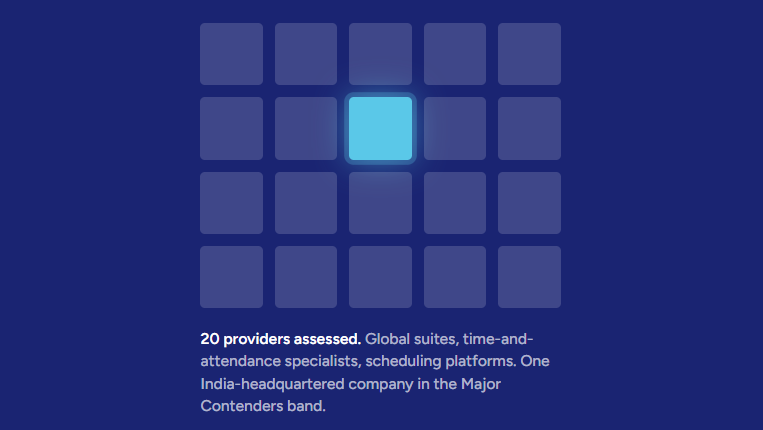

Few weeks ago Everest Group named us the only India-based company on its agentic AI in HR list. This week they published their PEAK Matrix for workforce management products, and PeopleStrong is a Major Contender. Different report, different analyst team, same conclusion about the platform.
Of the two, this is the one I’d choose to be measured on. Agentic AI is the story everyone wants to talk about, and I’ve done my share of talking. Workforce management is what our customers run their operations on. It’s the 6am punch at the plant gate, the roster for a 220-key hotel, the leave balance that decides whether a sales rep gets paid for Friday. When it works nobody notices, and when it doesn’t the mistake shows up in someone’s salary. To be assessed on that, against vendors who have owned the category for a decade, and to land in the upper half of the Major Contenders band, says the foundation is sound. Everything we’re building on top of it depends on that being true.
What the assessment measures
The PEAK Matrix is Everest’s flagship vendor evaluation, and it’s the one enterprise buyers actually use to build shortlists. Every provider is scored on two axes. Vision and capability covers whether you can deliver: functionality, technology, delivery footprint and roadmap. Market impact covers whether the market agrees: adoption, portfolio breadth and the value customers report back. Twenty vendors made this year’s cut, from the global suites to the pure-play scheduling and time-and-attendance players, and each lands in one of three bands: Leaders, Major Contenders and Aspirants.
We’re a Major Contender, in the upper half of the band on both axes. Two details matter for how you read that. First, Everest’s own footnote lists nine of the twenty vendors as assessed without provider input, on public information and buyer interviews alone. We weren’t one of them; our score reflects a full briefing, a product demonstration and reference customers. Second, market impact is a lagging measure. It rewards deployments already in production and customers already reporting value. That is where I expect our position to move, and the reason is the work described further down.
The full report includes a profile for each vendor with strengths and limitations, and the chart itself. It’s available through Everest Group and worth the read if you’re evaluating this category.
Why workforce management is the product I care about most
Most enterprise HR software assumes an employee at a desk with a laptop and a manager down the corridor. Our customers’ workforces mostly don’t look like that. They run plants across three shifts, retail networks across four hundred towns, hospital floors that never close and field forces that live in their cars. For those people the HR system is the attendance system, full stop. If the punch doesn’t register, the shift swap doesn’t go through or the overtime isn’t calculated the way that state’s rules require, nothing else on the roadmap matters to them.
So our workforce management was built from the frontline backwards, and it sits on the same record as payroll. An approved leave, an overtime hour or a shift differential doesn’t get reconciled at month end, because it’s already in the run. The compliance layer is the one Indian manufacturing and Gulf employers actually deal with, state by state and emirate by emirate, not a generalised version of it. And it’s where the WFM Agent went live first, because “when is my shift tomorrow” and “why is my overtime short” are the most frequent questions in any frontline workforce.
What workforce management covers at PeopleStrong today
The capabilities Everest assessed, in plain language. All of it runs on the same worker record as CoreHR and payroll.
| Time and attendance | Punch, biometric, geo-fenced and app-based capture across sites, with exceptions raised to the supervisor the same day rather than discovered at month end. |
| Shifts and rosters | Multi-shift scheduling, swaps and roster gaps for plants, stores and hospitals, with each site’s rules configured rather than hard-coded. |
| Leave and absence | Policies by entity, state and grade, running on the balances payroll uses, so an approval is final the moment it’s made. |
| Overtime and compliance | Statutory computation for India and the Gulf, reflected in the payroll run directly, with an audit trail for every change. |
Across all of it: the WFM Agent inside Jinie MAAX, answering and acting on shift, attendance and leave questions in the apps people already use.
Tracking what happened is table stakes. Deciding what should happen, with every stakeholder holding their own controls, is where this category goes next.
From tracking to planning
Workforce management has traditionally been about recording what happened, meaning who came in, who didn’t and for how many hours. The larger prize is deciding what should happen, which is workforce planning. In most large Indian and Gulf companies that still lives in a spreadsheet an HR business partner emails around every January, and the answer to “how many people did we actually hire against the plan” is nobody’s job to know.
We’ve spent the past few months building a manpower planning module with one of India’s largest conglomerates, across their FMCG, paper, hotels and technology businesses, and across India and the UAE. The first design decision, and the one that shaped everything else, was that planning is not an HR activity. It’s a negotiation between six roles, and each of them needs their own view, their own controls, and nothing else.
Six roles, six sets of controls
Each role has its own home screen and menu, sees only its own scope, and takes actions only it is permitted to take. Every action lands in a single audit log. Access is governed by a role matrix the customer administers, so the same product runs on different governance in different companies.
| Planner HR business partner | Builds the plan for their business and country, seeded from live HRIS headcountAdds net-new positions with a mandatory justification, edits backfill and transfersRound-trips the plan through Excel with three-layer validation on uploadSubmits, and can edit again only if the plan is sent back |
| Demand owner Business head | Sees their own business unit and nothing elseFirst approval on every line in their scopeRaises change requests after lock when the business changes, with a delta and a reasonTracks fulfilment of their lines once handed to hiring |
| Cost guardian Finance and the CFO office | Sees cost, monthly phasing and variance against the allocated budget, in local currencyApproves every line above the first cost tier, and can send a plan back to reduce cost before approvingChooses the cost method: average, median or band midpointReads plan versus actual from quarterly payroll feeds |
| Plan sponsor CHRO | Final approval on the largest lines, and the authority to lock a versionConsolidated view across countries, with FX applied, against total budgetYear-on-year headcount and cost, with every version and change request visibleApprove-all-and-lock when the chain is complete |
| Demand consumer Talent acquisition head | Receives a demand for every approved line the moment a plan locks, without re-keyingGets a backfill alert when a resignation hits a planned line in the HRISReports pipeline health back against the plan, line by lineSees only what has been approved, never the draft |
| Config owner Administrator | Sets the cost tiers that route approvals, in rupees or dirhamsMaintains FX rates, dimensions, the role matrix and the notification matrixSwitches on a hiring freeze for specific business units, which blocks submission outrightOwns the full audit log across every plan |
Roles and thresholds shown are from a customer prototype and are configurable. A three-tier example used in the build: lines under ₹2 crore route to two approvers, up to ₹15 crore add Finance, above that add the CHRO.
The second decision was that the plan should keep itself honest. Once a version is locked, three things happen without anyone touching a keyboard. Every approved line becomes a hiring demand. A resignation recorded in the HRIS against a planned line raises a backfill alert to the right people. And quarterly actuals from payroll are laid against the locked plan so variance is a fact, not an argument. Approvals that sit untouched for seven days escalate automatically, because a plan that waits on one inbox is a plan that slips.
The plan’s life cycle
One annual plan per business and country. Seeded from the record, costed live, approved by tier, locked into a snapshot, and then kept true by what actually happens.
| Seed from the record | Existing headcount and notice-period leavers pulled from the HRIS, read-only. Planners add net-new positions and a justification. |
| Cost, live | Compensation per line from payroll: bundled CTC in India, or basic plus allowances, statutory, medical and gratuity in the UAE. Phased by join month. |
| Approve by tier | Small lines route to two approvers, larger ones add Finance, the largest add the CHRO. Thresholds set by the customer. |
| Lock the snapshot | An approved plan becomes a numbered version. Every approved line becomes a demand for talent acquisition automatically. |
| Track reality | Resignations raise backfill alerts against the right line. Change requests carry a delta and a reason and produce a new version. |
| Plan versus actual | Quarterly actuals from payroll against the locked plan, per business, per country, consolidated at group level with FX applied. |
A working prototype with a customer, not yet a released product.
None of this is possible for a planning tool bolted onto an HR system, because the headcount, the compensation and the resignation event live in three different places. It’s possible for us because they live in one. That is the same argument I made about agents six weeks ago, and it is what Everest is measuring when it scores vision and capability. Own the record, and everything downstream gets simpler.
What’s next in workforce management
- Manpower planning from prototype to product, with the Excel round-trip kept for the planners who still live there.
- Roster intelligence. The WFM Agent flagging tomorrow’s gaps tonight and proposing cover within the rules of the site.
- Same-day attendance exceptions. Raised to the supervisor when they occur, not in a report the next morning.
- India and the Gulf on one plan. Multi-country payroll and compliance so the same roster rules and the same plan work across both.
- Conversation as the default interface. Shift swaps, leave and overtime queries handled end to end where frontline employees already are.

Xponential, 18 November, Mumbai
Our product conclave, where we’ll show where all of this goes. If you’re a customer, expect a call from us.
Thank you
This assessment belongs to the engineers who keep the punch service up at every shift change, the implementation teams who have configured overtime rules for every state by hand, and the customers who let us into their plants and stores to see how work actually happens. Two analyst reports in six weeks is a strong signal, and it’s theirs.
If you run a frontline workforce and want to see any of this on your own sites rather than on a slide, my team will set it up. And if you’re shortlisting workforce management vendors, read the report. We’re the only name in that band that grew up where your workforce does.