











 About Us
 Brand
 Career
 Contact Us



 +91-7314623098


Quick overview:
Compensation is everything an employer provides in exchange for an employee’s work. It falls into two categories. Direct compensation is paid in cash: wages, salary, bonuses, and commission. Indirect compensation is anything non-cash: health insurance, retirement contributions, and paid leave. Equity and stock options are long-term incentives, usually grouped with indirect compensation.
Key takeaways
- Compensation is everything an employer provides in exchange for an employee’s work.
- Direct compensation is cash: hourly wages, salary, bonuses and commission.
- Indirect compensation is non-cash: equity, stock options and benefits such as insurance and retirement plans.
- In India, total pay is often expressed as cost to company (CTC).
- Set pay in four steps: research the market, weigh candidate variables, build the total package, and review it regularly.
How can two employees with a similar base salary end up with a significant difference in their total income? The difference lies in their compensation. Understanding the types of compensation is necessary to create and maintain a strong, motivated workforce.
This guide is for you if you want to understand what employee compensation is, its types, their importance, and how to determine the right package for your employees.
What is Compensation?
Total employee compensation refers to the holistic package of base salary, monetary rewards, tangible benefits, and non-monetary perks that an employee receives from their employer in exchange for their work, time, and services provided.
In India, this is often expressed as cost to company (CTC), which bundles fixed pay, variable pay, and employer contributions such as EPF and gratuity.
Beyond a basic paycheque, compensation management in human resource management (HRM) is used to maximise employee retention, boost workplace performance, reduce turnover, and attract employees with in-demand skills to the organisation.
Why is Compensation Important?
Fair and competitive employee compensation is important for the following key reasons:
- Boosting performance: Including performance-based bonuses, commissions, stock options, or other incentives motivates employees to deliver their best work – a win-win for themselves as well as the organisation.
- Attracting top talent: Competitive pay gets candidates through the door. Holistic perks such as subsidised childcare, parental leave, or paid time off make your offer stand out and help retain your best people.
- Maintaining pay equity: Your organisation stays committed to fair pay, eliminating any disparity between men, women, or other marginalised groups.
What are the Different Types of Employee Compensation?
Employee compensation falls into two main categories: direct and indirect. Direct compensation is cash paid to employees for their work. Indirect compensation is non-cash value, such as benefits and perks, that does not count as take-home pay.
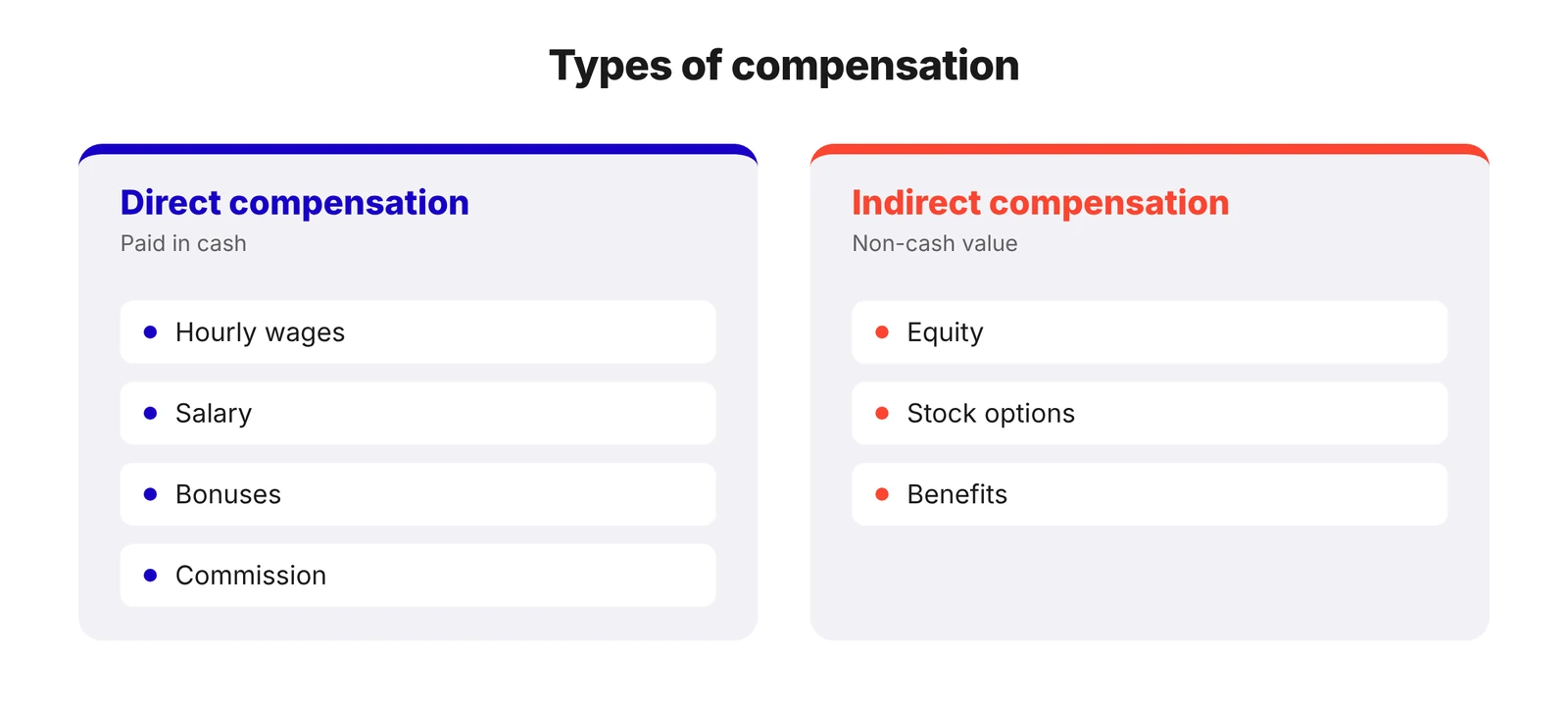
Here are the primary types of direct compensation you should know:
1. Hourly wages
This form of direct compensation is offered to employees in exchange for their time and labour. You must comply with minimum wage laws for your industry. Often provided to contract, part-time, semi-skilled, or unskilled workers, hourly wages also include any overtime pay outside of the contract.
2. Salary
Awarded mostly to full-time employees, a salary is monetary compensation usually paid monthly in exchange for their work. Both salary and hourly wages make up an employee’s base pay.
3. Bonuses
In addition to hourly wages or salary, companies often include fixed or variable bonuses in an employee compensation package to reward exceptional performance and boost retention. They may be paid quarterly, annually, or after project completion.
4. Commission
Commission is common in sales roles. It is money earned on the sales an employee closes, calculated as a percentage of the revenue or profit those transactions generate. A payout that depends only on hitting a target is better described as a bonus.
Beyond the four major types of direct employee compensation discussed above, other forms exist, such as deferred bonus plans and piece-rate pay. Deferred bonus plans, for example, pay performance-based bonuses to employees at a later date instead of immediately. Companies use this form of bonus as an employee retention tool.
Piece-rate pay is another form of direct employee compensation paid to workers for output rather than time. This form of compensation is common in agriculture and manufacturing, where workers are paid based on the number of units they produce.
Now, let’s talk about types of indirect employee compensation:
1. Equity
A common form of indirect compensation in high-growth companies, equity is a non-cash pay offered to employees through an ownership stake in the company. This is a great option if preserving cash flow and tying employee performance to your company’s long-term growth is important to you.
2. Stock
Instead of providing immediate ownership, you can also offer stock options, which give your employees the right to purchase company shares in the future at a fixed price (also known as the strike price). If your company’s stock price increases above the strike price after a certain period (vesting period), employees can buy shares at a discount and profit from the difference. This is another great component to include in total employee compensation to promote retention.
3. Benefits
Employee benefits include several types of compensation, including retirement plans, life insurance, health insurance, pet insurance, and legal insurance. Depending on your employees’ needs, you can include suitable benefits in their total compensation package.
How Do You Determine the Compensation You Should Offer?
Now that you understand the types of compensation in HRM and their significance, let’s talk about how you can determine the right compensation using four key steps:
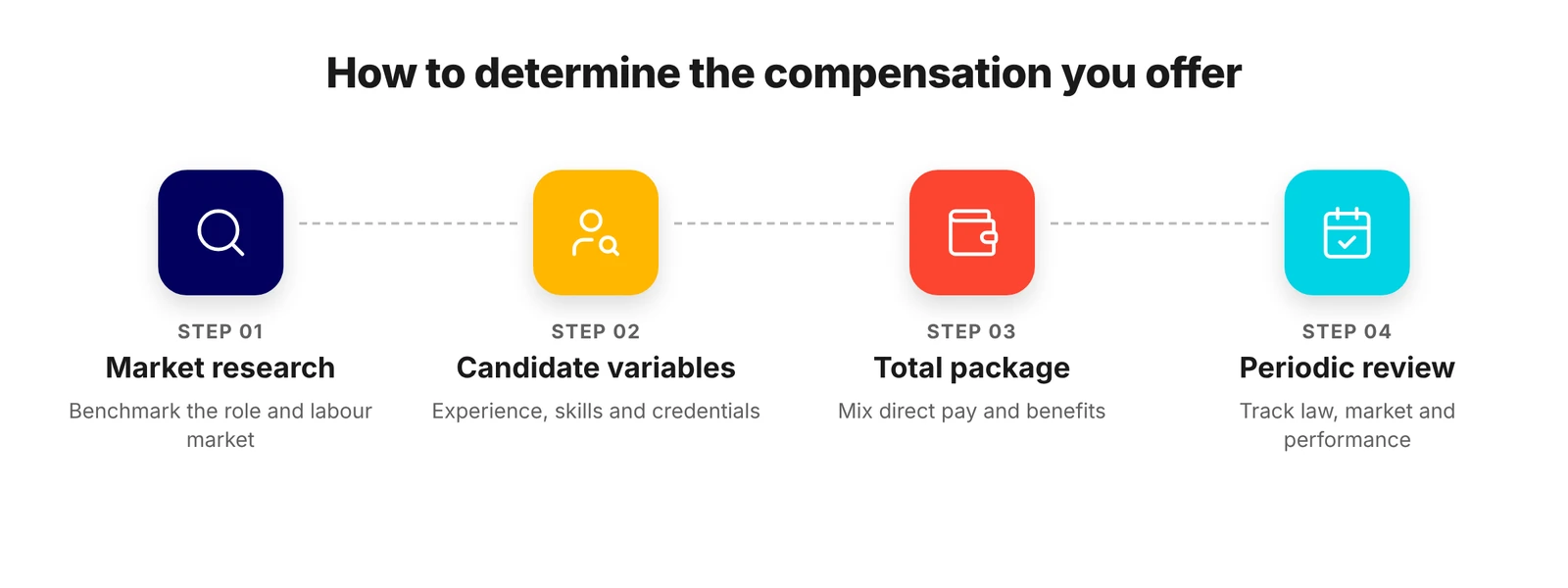
1. Conduct Market Research
Your employee compensation management process must begin with deep research on the labour market, trends, and industry salary benchmarks for the role you’re hiring for. Use reliable compensation management software to streamline the process and maintain compliance with labour laws.
2. Consider Candidate-Specific Variables
The first step, i.e., gives you a baseline for employee compensation. You also need to factor in the candidate’s or employee’s years of experience, leadership capabilities, skills, and credentials before building the right package.
3. Create a Total Compensation Package
The next step is, of course, structuring the package that lays out the total compensation offered to the individual, including direct and indirect forms. If your base salary budget is constrained, consider offering other benefits such as flexible hours, profit-sharing, or performance bonuses to make your offer more attractive.
Here’s an important piece of advice: Do not lead with the highest number your company can offer. Present an offer that stands somewhere in the upper-middle of your target compensation range, so that it leaves room for negotiation if the candidate or employee decides to counter.
It’s important to keep the conversation respectful, 100% transparent, and confidential. Avoid any vague or dismissive statements while explaining the total compensation package.
4. Review and Update Compensation Periodically
You must review and update employee compensation plans to reflect the changes in legal requirements, employee expectations, business performance, and market conditions. It helps ensure that your compensation management plan continues to support employee motivation, retention, and recruitment.
Conclusion
Understanding the types of compensation in HRM is essential for attracting the best talent to your company, as well as for retaining them. Beyond just base salaries, employees often compare benefits, bonuses, and stock options to evaluate their total compensation package. Depending on your organisation’s goals and job roles you want to fill, it’s important to create a well-structured package that includes the right mix of direct payment and benefits.
A well-built pay structure only works if it’s processed accurately every month. See how PeopleStrong’s payroll software helps HR teams manage salary, variable pay and statutory deductions with fewer errors.
Frequently asked questions
What is total compensation?
Total employee compensation combines both direct and indirect forms of monetary rewards provided in exchange for their work, including hourly wages or salary, commissions, performance bonuses, retirement fund matches, stock or equity options, etc.
How do performance bonuses work?
Often evaluated during the annual performance review, these bonuses are additional financial compensation awarded to employees who meet key performance indicators (KPIs) or pre-established goals. Such bonuses are not guaranteed and completely depend on an individual’s measurable success.
What are stock options?
Stock options give your employees the right (not obligation) to buy the company’s stock at a fixed price or strike price. They must, however, buy or sell that stock within a specific timeframe. If the share price increases in the future, employees can make a profit by selling it at the strike price. If it doesn’t, they let it expire and lose the non-refundable premium they paid to buy the stock.
What is commission-based compensation?
Usually calculated as a percentage of profit, revenue, or sales generated by the employee, commission is a type of compensation common in target-driven industries like retail, insurance, and real estate.
Is employee recognition a form of compensation?
Although employee recognition is not a type of compensation, it is an integral part of the employee experience. Intangible recognition in the form of shout-outs, thank-you notes, and verbal praise is important for your employees’ intrinsic motivation. However, they can be tied to monetary (direct) compensation in the form of spot bonuses, gift cards, or cash rewards.
What is the difference between direct and indirect compensation?
Direct compensation in the form of hourly wages, salaries, commissions, or bonuses is paid directly to employees in the form of cash. On the other hand, indirect compensation, such as stock, retirement matches, and insurance, is non-cash benefits that are not part of their take-home income.
What are some emerging trends in compensation?
Some of the emerging trends in employee compensation are hyper-personalised rewards, use of artificial intelligence (AI) for benchmarking, greater pay transparency, and equity.
Are work-life balance initiatives common in compensation?
Yes, work-life balance initiatives form an integral part of employee compensation. They can be direct and indirect monetary benefits, such as paid time off, childcare, paid parental leave, or wellness programs. Non-monetary initiatives include flexible working hours and remote work options.
How do career development opportunities impact compensation?
As a form of non-monetary employee compensation, career development opportunities allow employees to upskill, thereby helping you mitigate turnover. This also allows you to fill critical leadership roles in your company internally.
What are the 5 types of compensation beyond salary?
Beyond base salary, you can offer various types of compensation such as stock options, bonuses, flexible work arrangements, benefits, and professional development opportunities.