












 About Us
 Brand
Brand
 Career
 Contact Us



 +91-7314623098






Organisational culture defines the shared assumptions, values, and behaviours driving how a company operates day-to-day. While mission statements outline aspirations, actual culture stems from leadership actions, rewards, and boundaries. Research underscores its bottom-line impact, showing that companies with strong, aligned cultures experience up to a 4x increase in revenue growth. Operating across four primary configurations, namely Clan, Adhocracy, Market, or Hierarchy, organisations balance routine operations with long-term goals.
Culture heavily influences performance, as 77% of job applicants evaluate company culture before applying, while 82% of leaders view culture as a competitive advantage. Because leadership sets the tone for acceptable workplace dynamics, executives must actively evaluate and adjust cultural traits to support strategic shifts, ensure organisational resilience, and maintain a high-performing workforce over time.
What is Organisational Culture?
The academic foundation of the field belongs to Edgar Schein, who defined culture as the shared assumptions a group learns while solving its problems, assumptions that have proved reliable enough to be transmitted to new members as the correct way to perceive, think, and behave.
Schein distinguished three levels. Artefacts are the visible surface, including dress norms, office layout, rituals, and language. Espoused values are the organisation’s stated commitments. Basic underlying assumptions are what members actually believe, and these are usually undocumented.
The question of what organisational culture is, in practice, is answered at the third level. Does a missed commitment attract support or blame? Can a junior employee challenge a senior colleague in a meeting and remain in good standing? New joiners decode the real answers within weeks and adjust their behaviour accordingly. Every organisation transmits its actual culture to every cohort it hires, whether or not it intends to do so.
A further distinction deserves emphasis. Climate describes how people feel in a given quarter, making it measurable and volatile. Culture describes the deeper set of defaults that persists across leaders and reporting periods.
Importance of Organisational Culture
The strategic impact of organisational culture is often summarised by the boardroom maxim that culture eats strategy for breakfast.
- Strategy vs. Culture in Decision-Making: Strategy governs high-level leadership choices, but culture governs the daily micro-decisions made across the organisation.
- Talent Acquisition and Retention: Prospective hires evaluate real workplace culture through external networks, while cultural misalignment remains the primary driver of turnover.
- Governance and Risk Mitigation: Operational risks and compliance failures almost always manifest within internal cultural norms long before escalating into public crises.
- Post-Merger Integration (M&A): Cultural incompatibility consistently stands as a leading cause of failed corporate integrations and lost deal value.
- Compounding Operational Impact: Transparent cultures enhance information flow and decision-making, whereas fear-driven cultures systematically suppress critical data.
Characteristics of Organisational Culture
| Characteristic | Description | Alignment with Competing Values Framework |
| Innovation & Risk-Taking | The degree to which employees are encouraged to experiment and take calculated risks. | Adhocracy Culture (Focus on dynamic creation & agility) |
| Attention to Detail | Whether high precision and exactness are expected, or approximation is tolerated. | Hierarchy Culture (Focus on process control & standardised execution) |
| Outcome Orientation | Determines whether final results dominate evaluation over the methods used to achieve them. | Market Culture (Focus on competitive achievement & goal completion) |
| People Orientation | The weight given to employee well-being, growth, and fairness when making decisions. | Clan Culture (Focus on internal integration & employee support) |
| Team Orientation | Evaluates whether work activities are organised around collaborative groups or individuals. | Clan Culture (Focus on team cohesion & consensus) |
| Competitiveness | Assesses whether aggressive rivalry and market dominance are embraced over steadiness. | Market Culture (Focus on external competition & speed) |
| Stability | The emphasis placed on maintaining predictability, security, and order versus driving disruption. | Hierarchy Culture (Focus on institutional stability & risk control) |
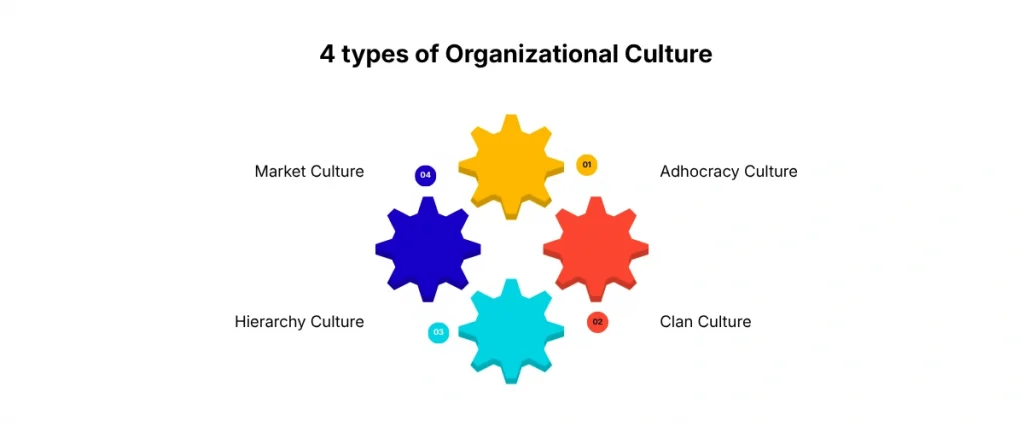
4 Types of Organisational Culture
The framework positions organisations on two axes: internal versus external orientation, and flexibility versus stability. Four quadrants follow.
Adhocracy culture
The term was popularised by Alvin Toffler in Future Shock, and the underlying idea is straightforward: organise around the opportunity rather than the organisation chart. Teams form for a project, dissolve, and reform. Authority follows competence rather than position.
Advantages and drawbacks
The strengths are speed and adaptability. Adhocracies identify openings early and attract individuals motivated by ownership rather than defined roles. The weaknesses are the same characteristics in excess: weak process discipline, role ambiguity that depletes some employees, and a high tolerance for failure within which genuine experimentation and disguised incompetence remain indistinguishable for extended periods.
Developing an adhocracy culture
Reserve budget for experiments with no assured return. Acknowledge intelligent failures publicly, providing specific details. Keep approval chains short. Most established companies fail at this because they attempt innovation inside a control system, a contradiction their employees identify immediately.
Adhocracy in real life
IDEO’s design practice, with its short cycles and improvised teams, is a well-documented case. SpaceX’s development cadence operates on similar logic. Pharmaceutical research divisions present instructive hybrids, running adhocracy in discovery and hierarchy in clinical trials, by deliberate design.
Clan culture
Clan cultures resemble families. Leaders act as mentors, loyalty and tradition carry weight, and the organisation invests substantially in developing its own people. Participation is broad, and cohesion serves as the binding mechanism.
Advantages and drawbacks
Engagement is genuinely high, and it shows in retention and discretionary effort. Coordination is inexpensive because trust substitutes for documentation. As the organisation grows, however, insularity develops. Interpersonal comfort begins to outweigh candour, underperformance is tolerated beyond reason, senior external hires struggle to enter networks built over years, and groupthink becomes a material risk because disagreement acquires the character of disloyalty.
Developing a clan culture
Structure mentorship rather than assuming it occurs by establishing formal buddy systems, apprenticeship-style rotations, and internal mobility as a default. Establish forums in which junior employees speak first and senior leaders speak last, a small ritual with measurable effect.
Clan culture in real life
Toyota is frequently cited, featuring lifetime employment traditions and deep internal development. Many Indian IT services firms operated substantially clan-like cultures in their early decades, functioning as campus environments with notably low attrition before scale and labour market conditions drew them toward market-orientated practice.
Hierarchy culture
Hierarchy cultures descend from Max Weber’s model of bureaucracy. The association is not a criticism, as the model remains the most reliable architecture for delivering consistency at scale. Such organisations are built on structure, procedure, and clearly defined authority. Risk is identified and contained, while stability and efficiency serve as the measures of success.
Advantages and drawbacks
The strengths are predictability and fairness. Rules applied uniformly protect the organisation from caprice and employees from favouritism, and compliance-intensive industries genuinely require this operating system. The weaknesses are familiar to anyone who has worked within one: decision velocity is slow because every path passes through approval gates, rule compliance gradually becomes the objective rather than the instrument, and capable employees conclude that the organisation cannot use their judgement, leading them to take it elsewhere.
Developing a hierarchy culture
Invest seriously in process design, documentation, and decision rights, because a hierarchy is only as sound as its rules. Construct deliberate exceptions, such as accelerated channels for time-sensitive decisions and protected routes for proposals that challenge current procedure.
Hierarchy culture in real life
Public administration, public-sector banks, and insurance operations rely heavily on this model. McDonald’s offers a less commonly cited example: the company’s effective product is consistency across tens of thousands of locations, and that consistency is a hierarchy culture functioning exactly as designed.
Market culture
Market cultures are demanding and outward-facing. The organisation’s purpose is to compete and win. Targets are explicit, and the scoreboard is public.
Advantages and drawbacks
Market cultures execute effectively. They are unambiguous about what success requires, rapid in reallocating resources toward results, and resilient under competitive pressure. The costs are internal. Collaboration erodes when each unit defends its own number, quota pressure produces short-termism and metric manipulation, and burnout and attrition rise accordingly.
Developing a market culture
Make targets genuinely transparent, including the uncomfortable ones. Tie reward to outcomes honestly. Maintain shared metrics that require collaboration between units, because an unmodified market culture will otherwise optimise itself into silos.
Market culture in real life
General Electric under Jack Welch remains the canonical case and also the cautionary one. Vitality curves and forced rankings spread widely, damaged collaboration wherever adopted, and were eventually discontinued at GE itself. Fast-moving consumer goods sales organisations and brokerages operate recognisably market cultures.
Other Types of Organisational Culture
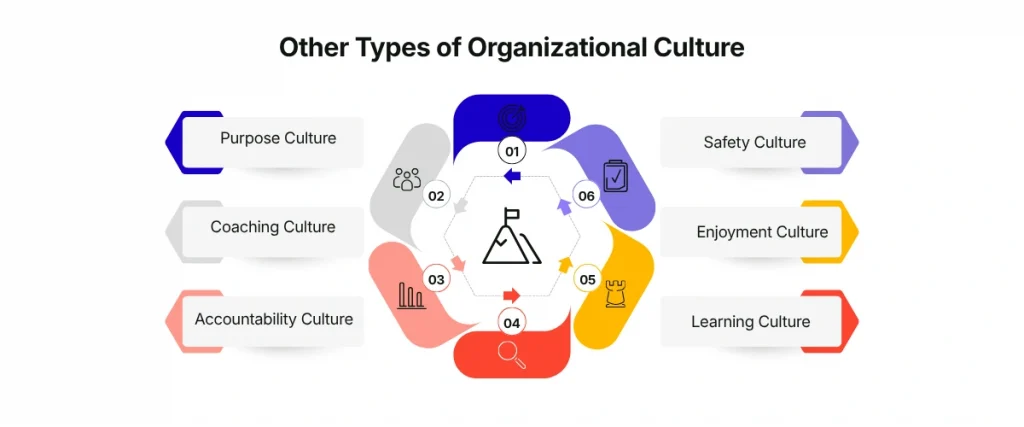
The four archetypes describe overall orientation. A second vocabulary, used by practitioners, describes emphases that can be layered onto any quadrant. The types below are best understood in that sense.
Purpose Culture
Decisions are filtered through a stated mission beyond profit. Patagonia’s environmental commitment shapes sourcing and product decisions. The Tata group’s ownership structure, with majority stakes held by philanthropic trusts, lends its purpose claims an institutional credibility most corporate mission statements lack. The test is what occurs when purpose and quarterly earnings conflict. If earnings prevail every time, the purpose is ornamental.
Coaching Culture
Developing people is a core managerial obligation rather than a human resources programme. Google’s Project Oxygen research placed coaching behaviour at the top of what makes managers effective. The reliable indicator is whether leaders are promoted partly on the strength of the people they have developed.
Accountability Culture
Commitments are binding, ownership is explicit, and standards apply at every level. Key Result Areas and Key Performance Indicators function only within such a culture, because measurement unsupported by norms is a ceremony. The failure mode is descent into blame culture, which is what accountability becomes in the absence of psychological safety.
Learning Culture
Project reviews are conducted without scapegoating, curiosity is a hiring criterion, and expertise is shared rather than hoarded. Amazon lists learning and curiosity among its leadership principles, while Toyota’s Kaizen tradition is the most durable example at an industrial scale. Training programmes are artefacts; a learning culture is what exists when employees admit errors voluntarily.
Enjoyment Culture
Warmth and genuine pleasure in shared work are permitted. This is also the most frequently simulated culture in business, because its artefacts are inexpensive to acquire. A games room communicates nothing of consequence. The reliable indicator is whether informal warmth among colleagues is unremarkable or exceptional.
Safety Culture
Human life and wellbeing override production pressure. Commercial aviation rebuilt its operational culture after the 1977 Tenerife disaster and now trains junior crew to challenge captains. The Columbia and Chernobyl enquiries are standing counterexamples, as in both cases the information existed and hierarchy prevented its movement upward. Genuine safety culture is visible in stop-work authority that any employee can exercise without career consequence.
Order Culture
Discipline, punctuality, and adherence to standard procedure, with 5S practice in manufacturing serving as a familiar expression. Logistics, hospitality, and healthcare operations depend substantially on order culture, and customers register its absence immediately, even where they cannot name it.
How to Identify Your Organisational Culture
Self-description is unreliable here, because people report aspiration rather than reality. Observation is the superior instrument.
Begin with promotions. Who advanced over the past two years, and what were they actually rewarded for? Promotion criteria constitute the most honest statement of culture any organisation issues. Then examine critical incidents, such as what became of the person who missed a visible commitment or delivered unwelcome news early. Attend the stories the organisation retells, because what is retold is what is taught. Observe a meeting in which a junior employee disagrees with a senior one, as the exchange that follows is more informative than any engagement survey. Finally, map the subcultures. Sales and finance within the same company frequently operate with different cultures, which is unproblematic if deliberate and corrosive if unexamined.
How to choose the right organisational culture for your business
Culture selection is a strategy question before it is a HR question.
Consider Organisational Goals and Direction
Strategy determines the required cultural profile. Competition on innovation in an immature market requires ad hoc defaults. Competition on cost and reliability in a regulated market requires hierarchy, and the organisation would damage itself attempting otherwise. Most real organisations are composites, and this is unobjectionable where the composition is deliberate. A pharmaceutical company may legitimately run adhocracy in discovery, hierarchy in manufacturing, and market culture in commercial operations. The failure mode is not mixture; it is incoherence.
Understand Your Team’s Working Styles
Audit how the current workforce actually prefers to work through structured interviews and observation rather than assumption. Senior specialists will resist structure and disengage quietly, whereas early-career teams may require precisely the structure that senior staff resist. Culture can also be shifted over time through recruitment, which is why ambitious change programmes begin at the hiring stage.
Assess Your Culture Using OCAI
The Organisational Culture Assessment Instrument, developed by Cameron and Quinn, asks respondents to distribute 100 points across the four types in six dimensions, once for the culture as it exists and once for the culture as it should be. The gap between the two is the substantive finding: an organisation that perceives itself as a clan but needs to be a market has named its change agenda in a single chart. Self-report flatters, particularly at senior levels, and results should be treated as the beginning of a discussion rather than a verdict.
How to Change Your Organisational Culture
Culture change fails most often because it is attempted as communication rather than as system change. The sequence that succeeds follows a structured path.
Diagnose honestly using OCAI, structured interviews, and exit data. Translate strategy into three to five observable behaviours rather than adjectives, noting that escalating dependencies within 48 hours is a behaviour while collaboration is not. Begin with executive conduct, because the organisation reads its leaders as data, and the composition of the leadership calendar and the promotion list will shift culture faster than any town hall.
Realign the systems that allocate status, including hiring criteria, promotion evidence, reward distribution, and performance conversations. Where these contradict the stated change, the systems prevail. Equip middle managers deliberately, since they transmit culture daily and can defer adoption of any initiative indefinitely without open opposition. Use symbols honestly, retire rituals that encode the old culture, and construct a small number that encodes the new one.
Measure behaviour rather than sentiment alone. Pulse scores move early and may signify little, whereas better indicators include decision turnaround times, attrition among strong performers, the proportion of improvement proposals originating at the frontline, and the speed with which unwelcome news reaches leadership.
Finally, calibrate expectations. Meaningful culture change typically requires eighteen months to three years and regresses under pressure before it holds. Organisations that succeed treat regression as information and reassert the behaviours.
Challenges of Building a Strong Organisational Culture
- Leadership Behaviour Gap: Change is delegated downward while executive actions remain unchanged, creating a disconnect that every organisational level notices.
- Middle Management Resistance: Middle managers carry existing habits into daily operations and can outlast cultural initiatives they were never trained to support.
- Scale and Geographic Drift: Regional growth creates isolated subcultures that naturally pull apart without active, deliberate counteraction.
- Hybrid Work Friction: Remote and hybrid setups hinder cultural transmission by reducing informal contact and day-to-day observation.
- M&A Integration Strain: Acquisitions import distinct workplace cultures overnight, with leaders routinely underestimating the alignment effort required.
- Measurement Impatience: Cultural shifts require long-term investment, but quarterly reporting demands often disrupt progress because budget costs are immediate while results take time.
- Surface-Level Perk Trap: Treating perks and amenities as substitutes for genuine culture consumes resources better spent reforming core systems like promotion criteria.
Negative Impact of Culture-Strategy Misalignment
The most documented case remains DaimlerChrysler. The 1998 merger, announced at approximately $36 billion, joined Daimler-Benz’s formal, engineering-led hierarchy in Stuttgart with Chrysler’s informal, improvisational culture in Auburn Hills. Executives on both sides subsequently described decision-making conflicts that no integration committee resolved. The projected synergies never materialised, and within a decade Chrysler was divested at a fraction of the transaction value.
The internal version is quieter and more common. A bank declares an agile transformation involving cross-functional squads, new rituals, and new vocabulary, yet budget approvals, risk sign-offs, and career paths remain untouched. The squads conduct their stand-ups, then queue for existing approvals, and within a year the transformation is merely a vocabulary layered over an unchanged operating system. Employees conclude rationally that the change was never substantive. The strategic cost can be stated simply: a strategy requiring behaviour the culture does not produce will be announced, resourced, and partially attempted, with shortfalls attributed to markets, timing, or talent in roughly that order.
HR’s Role in Shaping Organisational Culture
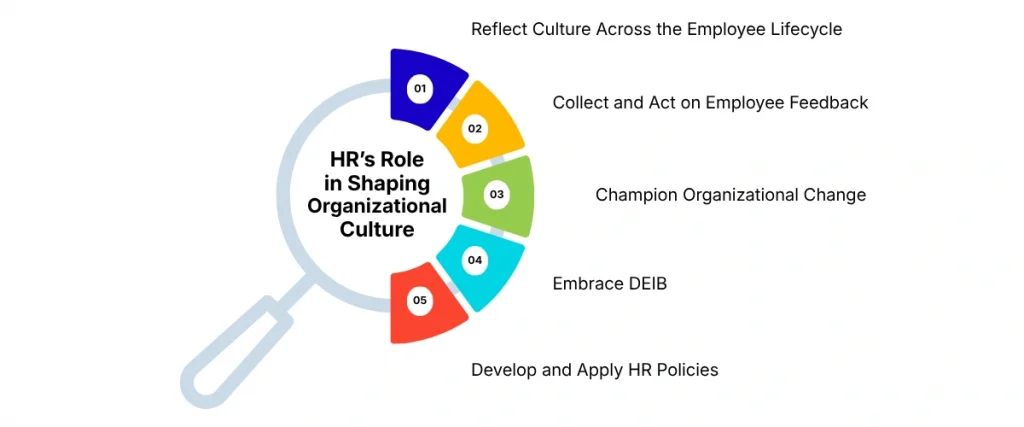
A single framing clarifies this domain: leadership owns the culture, and HR architects it. Where that division fails, leaving HR to carry culture alone, the effort becomes a programme that can be disregarded at limited cost.
Reflect Culture Across the Employee Lifecycle
Each lifecycle stage transmits or contradicts the intended culture. Job advertisements signal it through language. Onboarding is the highest-leverage transmission point, because newcomers form their model of the organisation in the first weeks. Performance management determines whether behaviours carry weight or only results do. Exit interviews, aggregated and trended, complete the diagnostic loop.
Collect and Act on Employee Feedback
Surveys and pulse instruments are only as valuable as what follows them. The reliable pattern involves publishing results alongside a record of actions taken, including reasoned refusals. The failure pattern is annual consultation followed by no visible change, which teaches the organisation that feedback is ceremonial.
Champion Organisational Change
HR designs the mechanics of change, including diagnosis, behavioural definitions, system realignment, and manager enablement. It also holds the mirror, which is the more demanding role. Advising a leadership team that their observed conduct contradicts the transformation they funded is uncomfortable work, yet it is precisely the work that determines success.
Embrace DEIB
Diversity, equity, inclusion, and belonging describe for whom the shared defaults actually function. A culture of candour operating only for the confident and senior is not a culture of candour. Practical levers include hiring and promotion audits, pay equity reviews, and psychological safety as the enabling condition for every other norm.
Develop and Apply HR Policies
Policies are codified culture. A flexible work policy declares whether the organisation trusts its people or intends to supervise them. Even drafting style transmits a signal, as documents written in plain language on the assumption of good faith tell employees what the organisation believes about them.
Conclusion
Organisational culture is best understood as the company’s operating system: invisible while it functions, decisive when it fails, and considerably harder to replace than any application running on it. Every organisation has a culture, chosen or not, and the only genuine choice is whether it is designed deliberately or inherited by default. Culture is read from behaviour, above all from the promotion list, never from the values statement. It can be changed, but only through systems and strictly at the speed at which leadership behaviour changes.
The organisations that manage this successfully are rarely those with the most articulate culture documentation. They are those in which employees, asked what the organisation rewards, answer without hesitation, and their answer corresponds directly to the strategy.
FAQ’s of Organisational Culture
How do you improve organisational culture?
Begin with diagnosis rather than communication. Establish the gap between the current culture and the one the strategy requires, translate the target into observable behaviours, and realign hiring, promotion, and reward systems accordingly. Secure visible executive modelling, equip middle managers, and measure behaviour rather than sentiment. The effort should be expected to run across several years.
What does a good organisational culture look like?
Not necessarily an agreeable one. A sound culture means coherence, meaning stated values, rewarded behaviour, and strategy point in the same direction. Reliable markers include trust in situations involving unwelcome news, candour between levels, clarity about what constitutes good performance, and accountability applied evenly, including to senior leaders.
What is an example of organisational culture?
Recognisable organisational culture examples include Zappos under Tony Hsieh as clan culture; McDonald’s as hierarchy culture, delivering consistency across tens of thousands of locations; Netflix as market culture, featuring its keeper test and high-performance norms; SpaceX as adhocracy, iterating hardware faster than competitors’ approval cycles; and Patagonia as purpose culture, with commitment embedded in ownership and product decisions.
What are the elements of corporate culture?
Shared underlying assumptions, espoused values, norms and expectations, symbols and rituals, leadership behaviour, and the systems and practices that reward and reinforce the remainder. Schein’s three-level model of artefacts, espoused values, and underlying assumptions remains the cleanest structure for locating where operative culture resides.
What are the 7 characteristics of organisational culture?
Innovation and risk-taking, attention to detail, outcome orientation, people orientation, team orientation, competitiveness, and stability. Every organisation occupies a position on each dimension, and the resulting profile, rather than any single dimension, is what distinguishes one culture from another.