












 About Us
 Brand
 Career
 Contact Us



 +91-7314623098


Quick overview:
POSH stands for Prevention of Sexual Harassment. It is India’s law, the Sexual Harassment of Women at Workplace (Prevention, Prohibition and Redressal) Act, 2013, which requires every employer to prevent sexual harassment and handle complaints through a fixed process. Workplaces with 10 or more employees must set up an Internal Committee, and a complaint must be filed within three months of the incident.
Key takeaways
- POSH stands for Prevention of Sexual Harassment and refers to India’s POSH Act, 2013.
- Every workplace with 10 or more employees must set up an Internal Committee of at least four members.
- A complaint must be filed within three months of the incident, extendable by up to three more months.
- The inquiry must finish within 90 days, and the employer must act on recommendations within 60 days.
- Employers must publish a POSH policy, run awareness programmes and file annual reports.
An employee receives repeated sexual messages from a colleague. Another employee is told a promotion depends on a “favour”.
Who can they approach? And what happens if the manager is the problem?
In India, the answer lies in POSH. The full form of POSH is Prevention of Sexual Harassment, and it refers to the POSH Act, 2013, the POSH law that requires workplaces to prevent sexual harassment and handle complaints through a defined process.
For employers, this isn’t optional. The POSH rules set out who must sit on the Internal Committee, what a POSH policy must cover, and the deadlines for every complaint.
This guide explains the POSH meaning, the rules, and the complaint process, so employees know what to expect and employers know what to put in place.
What is POSH? Full Form and Meaning
The POSH full form is Prevention of Sexual Harassment.
India’s POSH Act, 2013 protects women against workplace sexual harassment and establishes a complaint mechanism.
A POSH policy explains how an organisation puts those protections into practice, which includes prohibited behaviour, reporting contacts, and procedures.
It sets out:
- what employers must do
- who can seek protection
- how complaints should be handled
What Counts as Sexual Harassment?
Unwelcome sexual conduct can include touching, sexual remarks, requests for sexual favours, or showing pornography.
Remember, physical contact is not necessary, and one incident can qualify. Also, ordinary workplace disagreements do not automatically fall under POSH.
Why is POSH Important in Corporate Workplaces?
An employee turns down a client visit because she dreads travelling with a colleague who makes sexual comments.
Eventually, she loses access to assignments that could advance her career.
Harassment can change which opportunities someone feels able to accept.
POSH in corporate workplaces gives employees a formal way to challenge this behaviour without having to depend on a sympathetic manager. It also gives the person accused a fair opportunity to respond.
Employees should be able to answer three practical questions:
- What behaviour can I report?
- Who will receive my complaint?
- What happens after I submit it?
If these answers are difficult to find, the organisation has work to do.
Where Does the POSH Act Apply?
The POSH Act covers organised and unorganised workplaces across India: offices, factories, shops, hospitals, educational and sports institutions, NGOs, and households employing domestic workers.
Coverage extends to places visited for work and employer-provided transport. In addition, work-related online harassment can also raise POSH concerns.
Key POSH Compliance Requirements for Employers
1. Constitute a Proper Internal Committee
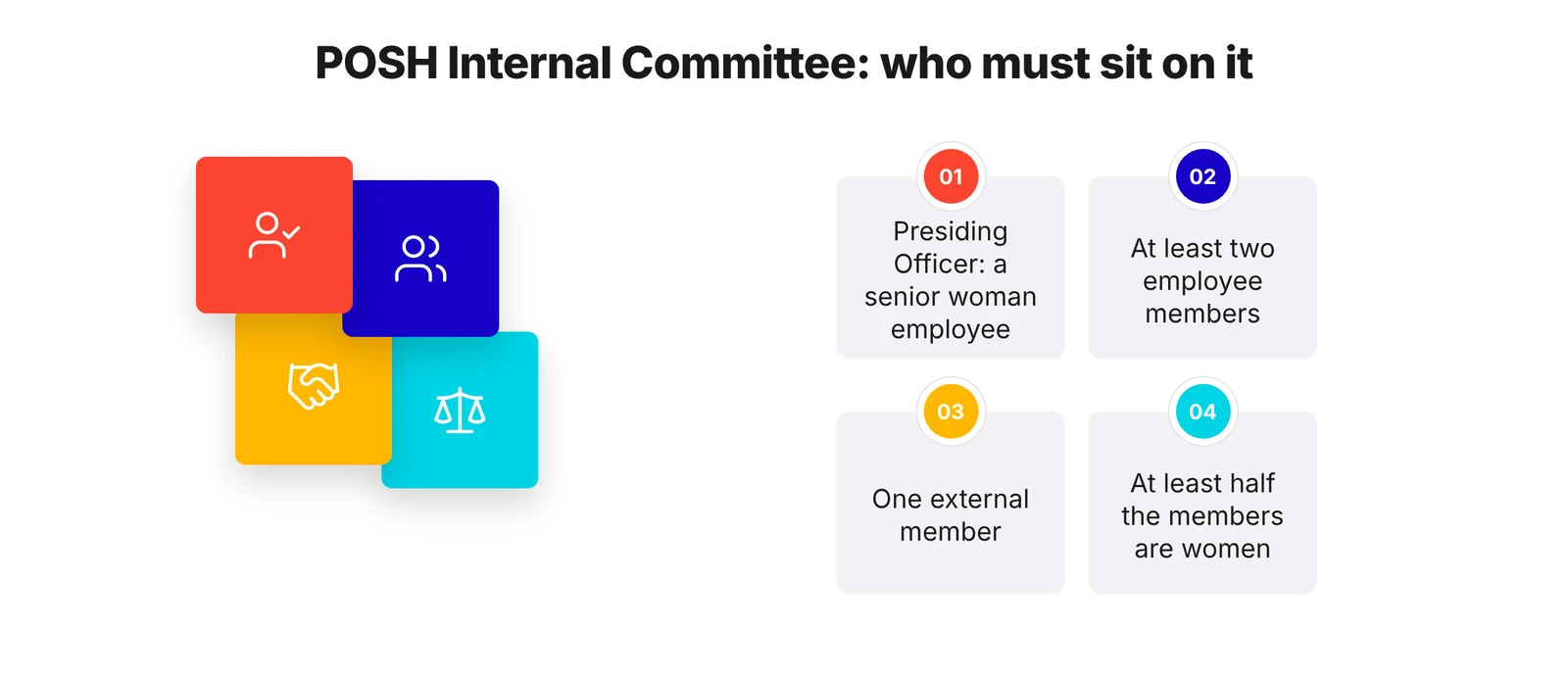
Workplaces with 10 or more employees need an Internal Committee (IC), commonly called the ICC.
| Position | Requirement |
|---|---|
| Presiding Officer | A senior woman employee, with alternatives provided by the Act if one is unavailable at the workplace. |
| Employee members | At least two employees, preferably committed to women’s causes or with social work experience or legal knowledge. |
| External member | One member from an NGO or association committed to women’s causes, or a person familiar with issues relating to sexual harassment. |
| Gender representation | At least half of the total members must be women. |
| Tenure | Each appointment must be for a specified period of no more than three years. |
Pro tip: The minimum composition is four members. An HR manager alone cannot serve as the committee.
2. Publish and Explain the POSH Policy
The POSH Rules require a widely communicated policy or equivalent declaration. Write it so a new joiner can understand the process without asking a manager to interpret it.
3. Conduct Awareness and Committee Training
The Act requires employee awareness programmes at regular intervals and orientation for committee members.
Annual refresher training and induction sessions are useful implementation practices.
Committee members need specific preparation for:
- receiving complaints
- assessing evidence
- conducting fair hearings
- maintaining records
- writing findings
4. Display Required Information and Support Inquiries
Employers must prominently display the penal consequences of sexual harassment and the IC constitution order. You must provide the committee with facilities, relevant information, and assistance securing attendance.
5. Complete Annual Reporting
The IC reports to the employer and District Officer on complaints, disposal, cases pending beyond 90 days, awareness programmes, and action taken. Employers also have reporting duties under Section 22.
Roles and Responsibilities of Employers and Employees
| Role | What responsible handling looks like |
|---|---|
| Employer | Implements recommendations and supports access to available criminal remedies |
| HR | Coordinates administration without directing the committee’s findings |
| IC | Assesses complaints impartially and protects confidential information |
| Manager | Avoids pressuring anyone to withdraw or privately settle |
| Employee | Respects boundaries, gives truthful information, and avoids complaint-related gossip |
How to File a POSH Complaint? Step-by-Step Guide
Step 1: Identify the Appropriate Committee
Submit the complaint to:
- The Internal Committee at a workplace where it is constituted.
- The Local Committee for an establishment with fewer than 10 workers or when the complaint is against the employer.
If your workplace should have an IC but does not, contact the District Officer for guidance and flag the missing committee.
Pro tip: Women can also use the government’s SHe-Box portal to register workplace sexual harassment complaints for handling through the relevant mechanism.
Step 2: Prepare a Written Account
Explain the incident in your own words. Include, as far as you can:
- What happened
- When and where it happened
- The name and role of the person involved
- Whether there were earlier related incidents
- Names of people who may have relevant information
- Any immediate workplace support you need
Step 3: Preserve Available Supporting Material
Keep relevant messages, emails, screenshots, meeting invitations, and other records. Preserve originals where possible and make a note of dates and context. Submit available material and ask about filing formalities. You do not need an eyewitness before approaching the committee.
Step 4: File Within the Time Limit
The usual deadline is three months from the incident. For a series of incidents, it is three months from the last incident.
Step 5: Participate in the Inquiry
The committee considers the complaint, the respondent’s reply, relevant documents, and witness accounts. Both sides must have a fair opportunity to be heard. Conciliation before inquiry is possible only at the aggrieved woman’s request, but note that money cannot be its basis.
Step 6: Receive the Findings and Understand the Next Steps
The report must be available to the concerned parties. Findings determine recommendations, which may include disciplinary action and compensation where appropriate. Section 18 provides appeal rights.
POSH Act 2013: Key Provisions Every Workplace Must Know
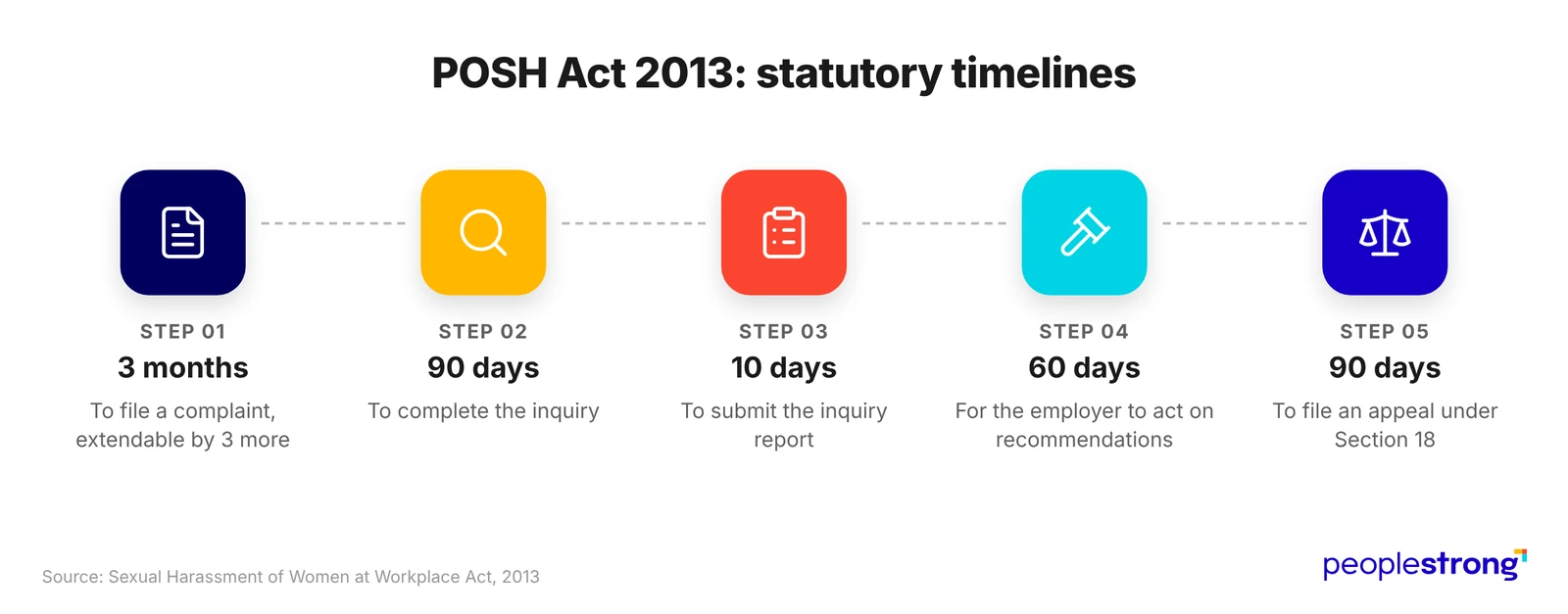
The POSH Act sets separate deadlines for filing, inquiry, reporting, and action. They should not be combined into a single “complaint resolution” deadline.
| Stage | Statutory Timeline |
|---|---|
| Filing a complaint | Within three months of the incident or last incident in a series. |
| Extension for filing | Up to a further three months, for reasons recorded by the committee. |
| Completing the inquiry | Within 90 days. |
| Submitting the inquiry report | Within 10 days of completing the inquiry. |
| Acting on recommendations | Within 60 days of receipt by the employer or District Officer. |
| Filing an appeal under Section 18 | Within 90 days of the recommendations. |
Note: Confidentiality restricts public disclosure. It does not prevent the respondent from receiving information needed to answer the complaint.
Steps to Prevent Sexual Harassment in the Workplace
Use Examples People Recognise
Training should cover situations employees may actually encounter: sexual comments during travel, explicit content in team chats, unwanted advances from clients, or a supervisor linking work opportunities to sexual attention.
Explain how to seek help in each situation. A session that only recites definitions leaves employees to work out the reporting process themselves.
Make Committee Contacts Easy to Find
Publish current IC details in the employee handbook, intranet, onboarding material, and appropriate workplace notices. Include accessible routes for contract workers and employees who do not regularly use company email.
Train Managers to Handle the First Conversation
A manager’s initial response matters. They should listen, explain the reporting options, and avoid promising absolute secrecy.
Address Client and Vendor Conduct
Workplace safety concerns can involve people outside the payroll. Employers should explain expected conduct to clients, vendors, and contractors.
Look for Retaliation and Access Problems
Watch for sudden exclusion from meetings, changed assignments, or pressure to resign post-reporting. Investigate concerns rather than assuming these changes are routine.
Best-Practice POSH Implementation Checklist
| Review area | What to check |
|---|---|
| Policy | The policy is current, understandable, and accessible to the workforce. |
| Committee | The IC has the required composition, valid appointments, and an eligible external member. |
| Locations | Committee arrangements address offices and administrative units across locations. |
| Reporting access | Contact details are current, and complaint channels are monitored. |
| Small-workplace route | Relevant Local Committee and District Officer details are available. |
| Awareness | Employees receive regular awareness sessions, with practical examples and clear reporting instructions. |
| Committee preparation | Members understand inquiry procedures, confidentiality, evidence handling, and report writing. |
| Fair process | Both parties can participate without managerial interference in findings. |
| Interim support | Requests for relief are considered and recommended measures are implemented. |
| Records | Complaint material has restricted access, and deadlines are tracked. |
| Reporting | Annual reports and applicable disclosures are completed. |
| Follow-up | The employer checks implementation of recommendations and responds to retaliation concerns. |
The Bottom Line
An employee should never have to choose between tolerating sexual harassment and keeping a job.
How a workplace responds when someone speaks up tells colleagues what they can expect too.
Make this response worth trusting. For a closer look at how you support people throughout their working day, connect with PeopleStrong and explore our HR solutions.
Frequently asked questions
What Is the POSH Act?
Its formal title is the Sexual Harassment of Women at Workplace (Prevention, Prohibition and Redressal) Act, 2013.
Who Is Protected Under the POSH Act?
Women of any age, whether employed at the workplace or not, including eligible visitors, trainees, and contract workers.
Is POSH Applicable for Men?
Men cannot complain through the Act’s women-specific mechanism. Employers can offer broader protection through an all-gender anti-harassment policy.
Is POSH Mandatory for All Companies?
Covered employers must comply. Small headcount changes the complaint route, but it does not remove workplace duties.
What Is the Time Limit to File a POSH Complaint?
A complaint must be filed within three months of the incident, or of the last incident in a series. The committee can extend this by up to three more months if it records the reasons for the delay.
Why Is POSH Training Important in an Organisation?
It helps employees recognise boundary violations they might otherwise dismiss as banter or part of dealing with senior colleagues.
Can a Complaint Be Filed Anonymously Under the POSH Act?
The formal process requires an identifiable complainant. Anonymous information may prompt preventive review but does not replace that process.
What Happens If Companies Don’t Follow POSH Policy?
Statutory breaches can attract fines up to ₹50,000. Repeat convictions can bring enhanced penalties and licensing consequences.
Do I Need to Prove the Harassment Happened?
The committee assesses evidence. Insufficient proof does not automatically make your complaint malicious; malicious intent requires an inquiry.
What Is the Difference Between POSH and Other Sexual Harassment Laws?
POSH addresses workplace prevention and redressal. Criminal laws involve police and courts. Both processes may apply to the same incident.
What Are the Employer’s Obligations Under POSH?
Employers must constitute an Internal Committee, publish a POSH policy, display the penal consequences and the committee order, run awareness programmes, support inquiries, act on recommendations within 60 days and file annual reports. Handing these tasks to HR or the committee doesn’t shift the employer’s legal responsibility.