











 About Us
 Brand
 Career
 Contact Us



 +91-7314623098


Quick overview:
Organisational development (OD) is the ongoing work of improving how a company is run so people can work well together and meet business goals. It examines management practices, decision-making and working relationships, and makes planned changes guided by employee feedback and data. HR manages the employment relationship; OD looks at how the organisation works as a connected system.
Key takeaways
- Organisational development (OD) is planned, ongoing work to improve how a company runs, guided by employee feedback and data.
- HR manages the employment relationship; OD looks at how culture, structure, behaviour and performance connect.
- OD moves through five stages: contracting, diagnosing, intervening, evaluating, and exiting with a plan to sustain change.
- In Bain’s 2026 research, 88% of senior leaders expected a new structure to work, but only 36% of employees agreed.
- Good OD needs a senior sponsor, time during working hours, and clear feedback on what happened to employee input.
Hiring more people should logically ease the pressure on an overworked team.
But if priorities change halfway through a task and approvals take longer than the work itself, new recruits might soon find themselves struggling (alongside everyone else).
The company ends up spending more, people are working harder, and yet the same problems keep returning.
Organisational development (OD) helps businesses understand why.
It examines how everyday decisions, management practices, and working relationships affect people’s ability to do their jobs.
This guide covers what OD is, how it differs from HR, real examples, the five stages and the skills the work takes.
What is organisational development?
Organisational development (OD) is the ongoing work of improving how a company is run so that its people can work well together and achieve business goals.
It involves making considered changes to how teams are managed, responsibilities are shared, and decisions are made, using research and employee feedback to guide those choices.
Goals of organisational development
The organisational goals should reflect what the business needs to improve and give people a clear idea of what success would look like:
- Remove obstacles to good work: Organisational development can help teams:
- agree who owns each step
- remove unnecessary approvals
- reduce the work that gets sent back
2. Give managers the support to manage well: About 44% of respondents expect their leadership training to place greater emphasis on reducing stress and burnout than in 2025. An OD programme should examine managers’ workloads alongside their skills.
3. Address the reasons people leave: If experienced employees see no route to promotion, recruitment will keep replacing people the business could have retained. OD helps:
- examine career progression
- work out workload and management practices
- address the issues behind avoidable departures
Pro tip: Exit interviews can inform this work, but conversations with current employees can identify concerns earlier.
4. Make adapting to change part of everyday work: Deloitte’s survey found that seven in ten business leaders identified speed and adaptability as their primary competitive strategy for the next three years. For OD, a practical response is to:
- give employees time to learn new skills
- test better methods
- make decisions within agreed limits
What is the difference between organisational development and human resources?
HR manages the employment relationship and people strategy. OD specialises in improving how the organisation functions as a connected system.
Putting it another way, their responsibilities overlap:
| Area | Human resources | Organisational development |
|---|---|---|
| Main focus | Recruitment, reward, employee relations, development and workforce strategy | Relationships between culture, behaviour, structure and performance |
| Typical question | How should we attract and retain the people we need? | What prevents our people from working effectively together? |
| Example | Establishing fair promotion criteria | Examining whether promotion practices discourage collaboration |
Examples of OD interventions
Here are four situations you might find familiar:
1. AI speeds up drafting, but approvals take longer
A marketing team uses AI to produce more content. The same two editors now spend their days checking a growing queue of drafts, and publication dates start slipping.
What OD would do: An OD intervention would examine the entire publishing process with writers and editors. The team could agree which material needs specialist review, train writers to verify claims, and adjust production targets to match review capacity.
2. A restructure leaves managers with too many responsibilities
After a management layer is removed, a team leader inherits additional employees while retaining their own client workload. One-to-one meetings get cancelled, and junior colleagues wait days for guidance.
What OD would do: Here, the intervention would combine leadership support with a review of the manager’s role. Senior leaders could reassign client accounts, remove duplicate reporting, and give experienced employees defined authority over routine decisions. Employee feedback would help establish whether access to support actually improves.
3. Employees complete training but cannot use their new skills
Customer service employees finish a company-funded data analysis course. Another department needs those skills, but their managers refuse transfers because they cannot afford to lose staff.
What OD would do: An OD intervention would connect training with workforce planning. Department heads could agree on temporary project placements, arrange cover, and set release dates for internal moves. The company would track whether trained employees move into relevant work and perform successfully, alongside course completion.
4. Hybrid teams keep working from different instructions
Colleagues in the office discuss a client request and change the project brief. Remote teammates continue working from the approved version, only discovering the change when their work is rejected.
What OD would do: The intervention would establish who can approve changes and require an updated brief before revised work begins. The team would also agree whose input is needed, including colleagues working different hours. Reviewing revisions caused by conflicting instructions would show whether the new arrangement is working.
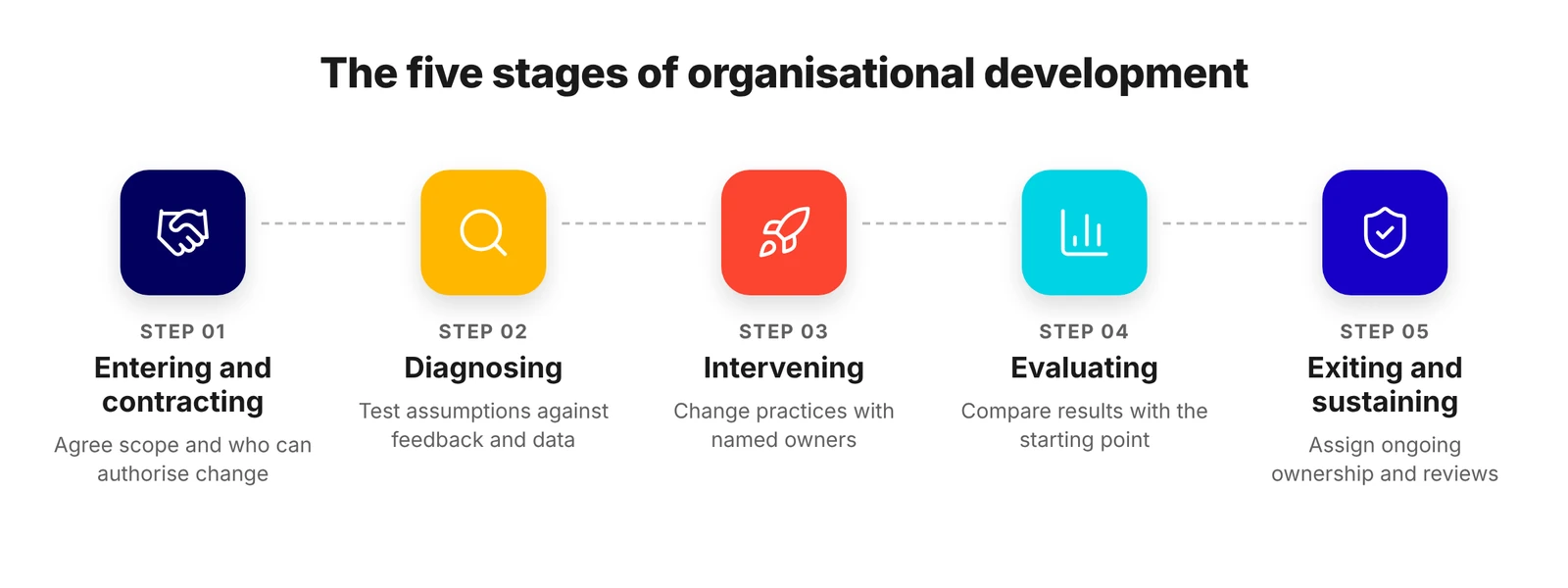
The 5 Stages of Organisational Development
| Stage | What happens | Expected outcome |
|---|---|---|
| 1. Entering and contracting | Agree what needs attention, the scope of the work, and who can authorise changes | A clear brief with responsibilities, resources and boundaries. |
| 2. Diagnosing | Review employee feedback and operational data to investigate causes. Check whether the evidence supports the initial assumptions. | An explanation of the problem that gives the team a basis for action. |
| 3. Intervening and taking action | Choose and implement suitable changes, with named owners, deadlines and support for affected employees. | New working practices that address the issue. |
| 4. Evaluating and gathering feedback | Compare results with the starting position and agreed goals. Ask employees what improved and what became harder. | Evidence to decide whether to continue, adjust or stop the intervention. |
| 5. Exiting and sustaining | Assign ongoing ownership, document the revised practices and schedule reviews after the OD project ends. | Improvements that the organisation can maintain without continued project support. |
Organisational Development Process: What Makes It Work
An organisational development process needs cooperation from people who may have competing priorities. Get started on the right foot with these efforts:
- Give someone authority to resolve disagreements. A project lead can coordinate activities, but a senior sponsor must be able to approve changes that affect budgets, departmental targets or reporting relationships.
- Make participation possible during working hours. Employees need time for interviews, training and trials. Agree which existing tasks will be postponed or reassigned so improvement work does not become another evening commitment.
- Explain what happens to employee feedback. Tell people who will see their responses and how findings will be reported. Share the resulting decisions, including suggestions that cannot be adopted and the reasons why.
- Agree how competing outcomes will be judged. A shorter customer call is not necessarily an improvement if the customer has to call again. Assess speed alongside resolution quality, and check whether gains in one department create extra work elsewhere.
Skills Every Organisational Development Practitioner Needs
Effective OD practitioners combine analytical ability with the judgement to handle uncomfortable conversations:
- Systems thinking: Question whether the requested solution fits the problem. Communication training will achieve little if employees return to managers who keep giving contradictory instructions.
- Research and data interpretation: Ask whose experience the evidence represents. A survey completed mostly by office staff may reveal little about conditions on the factory floor. Check who is missing before drawing conclusions.
- Facilitation: Help people examine a problem without turning the discussion into an argument about competence. When departments blame each other, work through specific incidents and establish where their accounts differ.
- Emotional intelligence: Recognise when a proposed change threatens someone’s confidence, status or sense of security. In Harvard Business Impact’s 2026 Global Leadership Study, 45% of respondents said emotional and social intelligence had become more important for meeting business needs than in 2025.
- Business judgement: Include the full cost of a recommendation. A new process may promise savings while requiring training, temporary cover and time away from customers. Decision-makers need both sides of the calculation.
- Change management: Judge what a team can reasonably take on. Agree what existing work will pause, arrange support and check whether employees can use the new approach during a busy working day.
- Professional discretion: Protect the people who share sensitive information. Removing a name from a comment is insufficient if the details identify the employee. Decide what can be reported without exposing the speaker.
Why should companies care about organisational development?
In Bain’s 2026 research, 88% of senior leaders expected their new organisational structure to achieve its aims. Only 36% of employees working within it agreed.
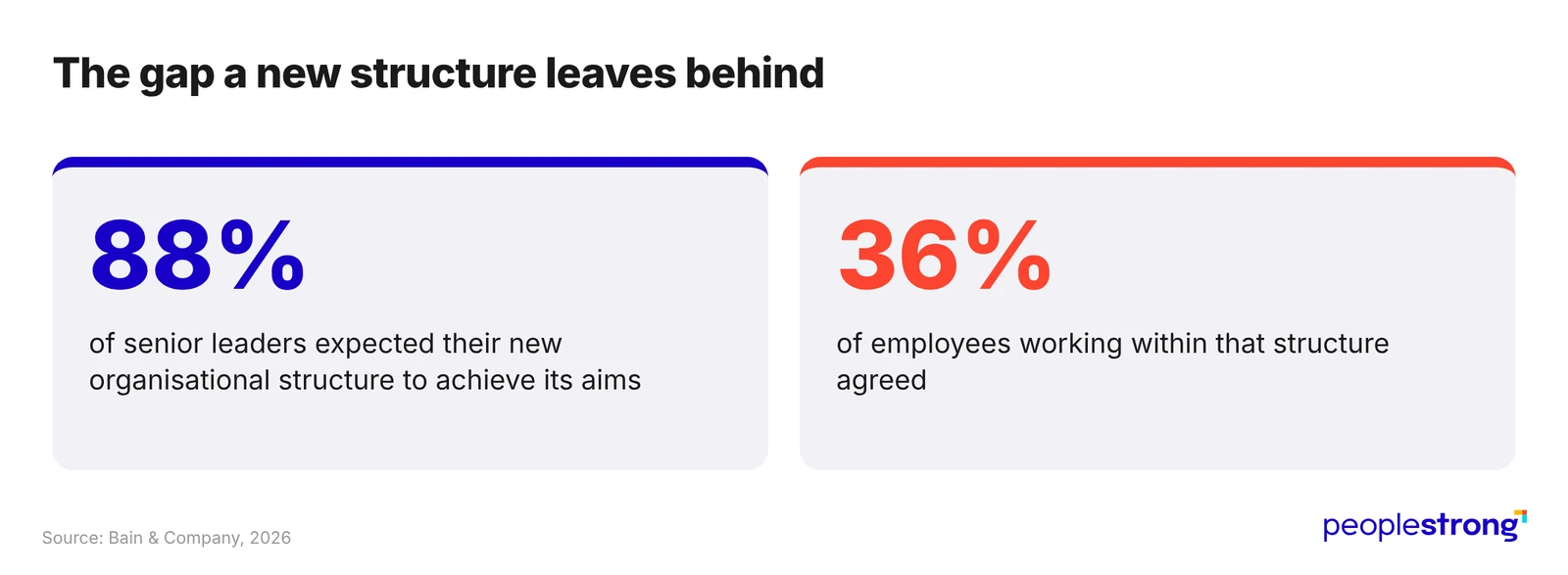
OD helps companies address this gap:
- Find what leadership has missed: Employees can identify responsibilities that overlap, missing skills and targets that create conflict between departments.
- Get value from planned changes: A restructure needs workable arrangements for allocating tasks, making decisions and resolving disagreements.
- Reduce dependence on a few experienced people: Shared knowledge and clear responsibilities help teams maintain service when someone leaves or moves into another role.
- Make growth manageable: As workloads increase, OD helps companies identify which practices need to change before delays and mistakes become routine.
The future of organisational development
- Give employees room to experiment: Microsoft’s 2026 Work Trend Index found that 45% of surveyed knowledge workers using AI felt safer pursuing existing goals than redesigning their work with AI. OD can help managers agree which targets can temporarily change during a trial.
- Define responsibility for AI decisions: Businesses need to establish who approves an AI recommendation, investigates an error and decides when human review is necessary.
- Update jobs as the work changes. When automation removes routine tasks, employees need revised responsibilities and opportunities to develop the judgement their remaining work demands.
- Include OD in planning: Decisions about technology, staffing and performance measures should account for how employees will work together once the changes take effect.
Conclusion
When the same problem follows different people into the same role, the job itself deserves a closer look.
Organisational development helps companies investigate what needs to change, whether that is the workload, the reporting structure or the support employees receive.
The findings should determine the next step.
If employees need new skills or clearer performance goals, PeopleStrong’s performance management, learning and career development tools can help HR teams put those plans into practice.
Book a PeopleStrong demo to explore how we can support your organisation’s development priorities.
Frequently asked questions
Is OD part of HR?
Often, yes. OD may sit within HR, operate independently or involve external specialists. Effective delivery requires participation from business leaders and employees.
What is the role of organisational development?
OD diagnoses organisational problems, helps people design changes and evaluates whether those changes improve performance and working conditions.
What are the benefits of Organisational Development?
Potential benefits include better collaboration, clearer accountability, stronger management, reduced rework and improved retention. Results depend on the diagnosis and implementation.
What are the 5 stages of organisational development?
A common model includes entering and contracting, diagnosing, intervening, evaluating, and exiting with arrangements to sustain improvements.
What is the purpose of organisational development?
Its purpose is to improve organisational effectiveness while building the capability to handle future problems and change.
What is the organisational development framework?
An OD framework structures diagnosis, action, and evaluation. There is no single universal framework; choose an approach suited to the problem and organisational context.