












 About Us
 Brand
Brand
 Career
 Contact Us



 +91-7314623098



One late provident fund remittance triggers interest, damages and a paper trail that resurfaces at the next audit. Finance sees the same process differently: a monthly cost run that has to close on schedule. Compliance sees statutory deadlines. Two teams, two definitions of failure, one payroll cycle. And the choice between running that cycle in-house or handing it to a managed provider usually gets made on cost and headcount, then tested later on what actually breaks.
This comparison is written for HR operations, payroll and compliance leaders at enterprises of roughly 1,000 to 10,000+ employees. You’re deciding whether to keep the payroll cycle in your own team, move it to a managed provider, or split the work. India is the only market covered here, because multi-state operations, state-level levies and central filings are what turn this into a risk decision rather than an administrative preference.
TLDR
– Enterprise payroll compliance breaks at five recurring points: statutory filing calendars, the attendance-to-payroll data chain, month-end reconciliation and audit evidence, employee query and full-and-final handling, and key-person dependency inside a small team.
– An in-house payroll team wins on control over exceptions and speed of internal decisions; managed payroll services win on statutory coverage, filing discipline and continuity when a payroll specialist leaves. – Neither model fixes broken inputs. If attendance, overtime and contract-labour data arrive late or unvalidated, outsourcing the calculation simply relocates the same error.
– A hybrid model, where you keep payroll data and approvals in your own system while a provider runs statutory processing and filings, often suits multi-state enterprises better than a full swing in either direction.
– PeopleStrong’s Payroll Services sit alongside its own Core HR, Leave and Attendance and Payroll engine, so the managed team works on your live data rather than on a monthly file handover. PeopleStrong serves 500+ enterprise customers covering 2M+ employees and has been named a Gartner Peer Insights Customers’ Choice for Cloud HCM Suites for enterprises above 1,000 employees from 2022 through 2025.
In-House Payroll and Managed Payroll Services, Defined in Plain Terms
In-house payroll means your own employees run the monthly cycle. They collect inputs, apply the calculation rules, produce payslips, prepare challans and returns, answer employee questions and hold the relationship with statutory authorities. The software may be licensed from a vendor. The process, the calendar and the liability for getting it right sit with your team.
Managed payroll services means a provider runs that cycle for you. Their team takes agreed inputs, processes the payroll on their platform, generates payslips and registers, prepares and often files statutory returns, and supports employees on payroll questions. You keep approval rights, funding, and ownership of your employee data. The provider carries the operational load and, to the extent your contract says so, the service commitments around accuracy and timeliness.
Two shapes of managed payroll are worth separating, because they behave differently under pressure:
- Platform-led managed payroll, where the same vendor supplies the HR and payroll software you already use and staffs the service team on top of it. Inputs flow inside one system.
- Service-led payroll outsourcing, where a specialist processing firm runs payroll on its own engine and receives inputs from you as files or through an interface. The service depth can be excellent; the data chain has one more join in it.
A third arrangement, often called co-sourcing or hybrid payroll, keeps calculation and approval with your team while handing statutory filing, reconciliation support and query handling to a provider. Enterprises tend to arrive at it gradually rather than evaluate it deliberately.
Where Enterprise Payroll Compliance Usually Breaks, Whoever Runs It
Payroll problems at enterprise scale are rarely caused by someone not knowing the rules. They’re caused by process design: an input that arrives after cut-off, a state entity nobody owns, a reconciliation done in a spreadsheet outside the system of record, a calculation rule that lives in one person’s head.
Five break points show up repeatedly in multi-state, multi-entity operations. The rest of this comparison judges in-house payroll and managed payroll services separately against each one, then scores them together.
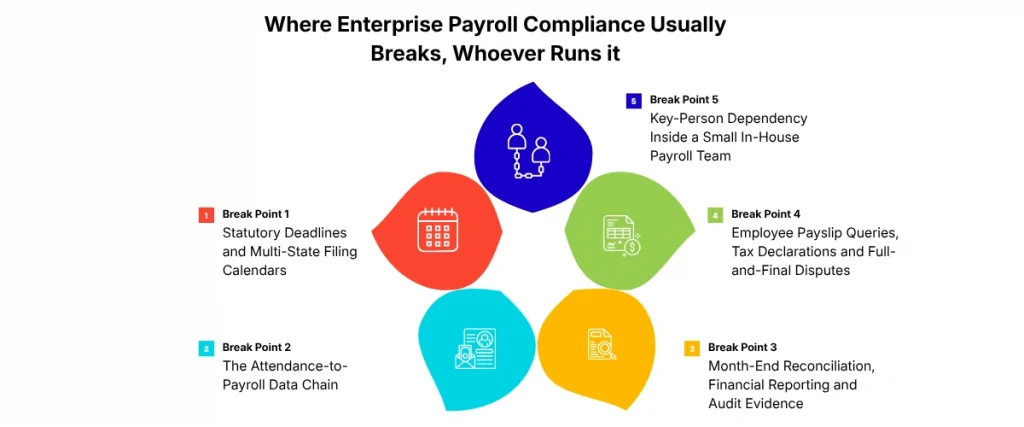
Break Point 1: Statutory Deadlines and Multi-State Filing Calendars
An enterprise operating across several states isn’t running one compliance calendar. It’s running a central calendar plus a separate set of state obligations for every location where it employs people.
The core central items in India:
- Employees’ Provident Fund: the electronic challan-cum-return and the contribution payment are due by the 15th of the following month, per EPFO’s filing requirements.
- Employees’ State Insurance: contributions are payable by the 15th of the following month under ESIC rules.
- Tax deducted at source on salaries: deposit by the 7th of the following month, with the quarterly salary TDS return filed in Form 24Q and Form 16 issued to employees annually.
The state-level items are where multi-location enterprises lose the thread:
- Professional tax: slabs, rates, registration requirements and payment frequency are set by each state that levies it, so a company in six states may be running six different schedules.
- Labour welfare fund: applicability, contribution amounts and periodicity vary by state, with half-yearly or annual cycles in most states that operate one.
- Shops and establishments and factory registers: maintenance and inspection obligations differ by state and by establishment type.
Then there’s the ongoing consolidation of central labour legislation into the four labour codes notified by the Ministry of Labour and Employment, which will change wage definitions and contribution bases when the codes are brought fully into force.
How in-house payroll handles it. Well, if you have a dedicated compliance owner per region and a maintained calendar. Poorly, if a single payroll manager covers 12 states alongside month-end processing. Central filings are visible and rehearsed, so they’re seldom where the problem starts. The gap tends to be the state entity added six months ago that nobody registered.
How managed payroll handles it. This is the strongest case for outsourcing. A provider running payroll for many clients keeps state-level rule tracking as a standing function rather than a side task, and updates rate and slab changes centrally. The risk is scope. If your contract covers processing but stops short of filing, you’ve bought calculation help and kept the deadline risk.
Break Point 2: The Attendance-to-Payroll Data Chain
Payroll accuracy is decided before the payroll run starts. In manufacturing, retail and healthcare especially, the month’s variable pay comes out of shopfloor attendance, shift patterns, overtime approvals, loss-of-pay marking, leave encashment and contract workforce records.
When that chain is manual, the failures cascade. Attendance closes late, so payroll inputs are frozen on incomplete data. Regularisation requests arrive after cut-off and get carried as arrears. Those arrears distort the next month’s tax computation for the affected employees, which produces queries, which pull the payroll team away from the following cycle.
How in-house payroll handles it. Strongly, if attendance and payroll sit in the same system and cut-offs are enforced by workflow rather than by email. An in-house team can also chase a plant HR coordinator directly, which a remote provider cannot.
How managed payroll handles it. It depends entirely on how inputs reach the provider. A service-led arrangement that receives a monthly attendance file inherits whatever quality that file has, and the provider’s service commitment usually starts from the moment clean inputs are received. Platform-led managed payroll, where the provider’s team works inside the same system your attendance is captured in, removes the handover and with it a whole class of reconciliation work.
The decision factor here is integration overhead, not service quality. Before you compare providers, map how many systems your payroll inputs cross today.
Break Point 3: Month-End Reconciliation, Financial Reporting and Audit Evidence
Payroll doesn’t end with payslips. It ends with numbers finance can post, defend and reproduce.
That means general ledger postings mapped to the right cost centres and legal entities, month-on-month variance explanations at component level, provisions for gratuity and leave encashment, reconciliation of statutory contributions to what was actually remitted, and an evidence trail showing who changed which master data and when. Statutory registers and Form 16 issuance sit in the same bundle.
How in-house payroll handles it. Your team knows your chart of accounts and your entity structure, which shortens the finance conversation considerably. The common weakness: reconciliation happens in spreadsheets outside the payroll system, so the audit evidence is a workbook rather than a system record.
How managed payroll handles it. Established providers treat reconciliation packs, variance reports and statutory registers as standard deliverables, produced on a fixed schedule and in a consistent format. That’s genuinely valuable to a finance function preparing for statutory or internal audit. What you should test in evaluation is analytics depth: whether you get a monthly PDF pack, or whether you can query payroll cost by entity, location, grade and component yourself, without raising a request.
Break Point 4: Employee Payslip Queries, Tax Declarations and Full-and-Final Disputes
Volume here is seasonal and heavy. Investment declaration windows, proof submission season, appraisal arrears and the annual Form 16 cycle all land on the same small team. Exits generate some of the most disputed calculations in payroll: notice recovery, unavailed leave, gratuity eligibility, recovery of advances, the timing of the final settlement.
How in-house payroll handles it. Response quality is usually high, because the person answering knows the employee’s history. Response time is the problem. During declaration season, a payroll team of four answering several hundred queries a week is doing helpdesk work instead of controls.
How managed payroll handles it. Providers typically offer a defined support channel with response commitments, which protects the processing calendar from query load. The trade-off is that a first-line agent without access to your policy exceptions escalates more often, and employees notice the extra hop.
This is where the platform layer matters more than the service layer. PeopleStrong’s embedded HR assistant, Jinie, resolves routine employee queries such as payslip access, leave balances and policy questions directly in chat, and customers report a roughly 60% reduction in HR administrative load from it. That doesn’t remove the need for expert handling of a contested full-and-final settlement. It does mean the specialist is dealing with the twenty cases that need judgement rather than the two hundred that need a payslip link.
Break Point 5: Key-Person Dependency Inside a Small In-House Payroll Team
Enterprise payroll functions, even at 5,000 employees, often run on a handful of people. In many teams, one person holds the undocumented logic: how a legacy allowance is treated, why a particular grade has a different gratuity base, which plant has a local settlement affecting overtime rates.
Nothing about that is careless. It’s what happens when a process grows faster than its documentation. The exposure only becomes visible when that person takes leave in March, or resigns during the year-end close.
How in-house payroll handles it. This is the model’s structural weakness. Mitigation exists, through documented calculation rules, cross-training and configuration held in the system rather than in spreadsheets, but it needs deliberate investment that rarely gets prioritised until after an incident.
How managed payroll handles it. Continuity is a contracted obligation. Providers staff backups, document client-specific rules as part of transition, and aren’t dependent on one individual’s availability. You do inherit a different concentration risk, namely dependency on a single vendor, which is managed through documented process libraries, data portability terms and a defined exit assistance clause rather than left to chance.
Scorecard: How In-House Payroll and Managed Payroll Compare on Each Break Point
| Dimension | In-house payroll | Managed payroll services | Hybrid (co-sourced) |
| Central statutory filings | Reliable with a dedicated owner; exposed when the owner is also processing | Standing function with tracked rule changes | Provider files, your team approves |
| Multi-state coverage (professional tax, labour welfare fund, registers) | Weakest point as location count grows | Usually the strongest reason to outsource | Strong, if state registrations are explicitly in scope |
| Attendance-to-payroll integration | Strong when attendance and payroll share one system | Strong only in platform-led models; file-based handovers add risk | Strong, since inputs stay in your system |
| Reconciliation and audit evidence | Depends on whether reconciliation lives in the system or in spreadsheets | Standardised packs and registers on a fixed calendar | Best of both, with more coordination effort |
| Analytics depth | Full access to your own data; limited by reporting tooling | Varies widely; ask whether you can self-serve or must request | Retained in-house |
| Employee query handling | High context, slow at peak season | Defined response commitments, more escalations on exceptions | Tiered, with exceptions kept internal |
| Integration overhead | Low if single-platform, high across stitched tools | Highest in service-led models with monthly file exchanges | Moderate and ongoing |
| Key-person risk | High in small teams | Transferred to the provider, with vendor concentration to manage | Reduced on statutory work, retained on policy logic |
| Control over exceptions and off-cycle runs | Highest | Governed by contract and change requests | High |
| Cost shape | Fixed headcount cost | Variable, typically per employee per month | Mixed |
Read the scorecard by weighting the rows that match your actual exposure. A single-state IT services company with clean attendance data and a stable payroll team gains far less from outsourcing than a manufacturer running eleven plants across six states with contract labour on every site.
The Hybrid Middle Ground: Keeping Payroll Control While Outsourcing Statutory Work
Full outsourcing is rarely necessary to fix the break points that hurt most. A hybrid split usually addresses them at lower disruption.
A workable division of labour looks like this:
- You retain: employee master data, attendance and leave capture, salary structures, approval of the payroll register, funding, and policy decisions on exceptions.
- The provider takes: statutory computation, challan preparation and remittance, return filing, state registrations and renewals, reconciliation packs for finance, and first-line employee query response.
- You jointly govern: the monthly calendar, cut-off enforcement, change control on calculation rules, and the escalation path for disputed settlements.
This arrangement also absorbs an acquisition or a new plant opening with less disruption, because adding an entity is a scope change to an existing service rather than a hiring exercise.
What to Ask a Managed Payroll Provider Before You Sign
Treat the evaluation as an operational audit. Alongside the product demonstration, these are the questions that show how the service will actually run:
- Scope precision: Ask explicitly whether professional tax and labour welfare fund registrations, filings and renewals for every state you operate in are in scope, or only central filings.
- Input dependency: Confirm when the provider’s accuracy commitment starts, and what happens when attendance inputs arrive after cut-off.
- Integration method: Establish whether payroll runs on your existing HR system, on the provider’s platform with an interface, or on file exchange, and who maintains that interface.
- Reconciliation deliverables: Request a sample month-end pack, including general ledger output, component-level variance analysis and statutory reconciliation.
- Audit support: Ask what evidence they produce for statutory and internal audits, and whether change logs on master data are retrievable by user and timestamp.
- Analytics access: Determine whether your team can query payroll cost data directly or must raise a request for every cut of the numbers.
- Employee support model: Check response commitments, escalation tiers, and who handles a contested full-and-final settlement.
- Continuity and exit: Look for documented client-specific rules, named backup resources, data export in usable formats, and a defined transition-out obligation.
- Compliance posture: Ask how the service is built to support compliance, and how rate and slab changes are applied, for each of the following:
– Employees’ provident fund.
– Employees’ state insurance.
– Tax deducted at source on salaries.
– State levies, including professional tax and labour welfare fund.
Treat any guarantee of absolute compliance as a reason to read the contract more carefully.
Managed Payroll Options Enterprises Shortlist Today
The providers below are established options for Indian enterprises above 1,000 employees looking for a managed payroll alternative to an in-house team. Each entry describes what the provider offers and who it typically suits.
| Provider | Delivery model | Key strengths | Ideal company size |
| PeopleStrong Payroll Services | Managed service on PeopleStrong’s own HCM and payroll platform | India statutory processing on the same system as Core HR, attendance and leave; HR Analytics; Jinie for employee queries | 1,000–10,000+ |
| ADP | Managed payroll on ADP’s India and multi-country payroll platforms | Long-established payroll operations, structured compliance processes, standardised reporting | 500–10,000+ |
| Ramco Systems | Payroll software with managed payroll service options | India and multi-country payroll processing, statutory compliance capability, HR suite integration | 1,000–10,000+ |
| Neeyamo | Payroll outsourcing with a technology platform | Broad country coverage including hard-to-serve locations, service-led operating model | 1,000–10,000+ |
| Paysquare | Payroll outsourcing service for Indian enterprises | India payroll processing and statutory compliance support, established mid-to-large enterprise service base | 500–5,000 |
| TMF Group | Payroll and HR administration outsourcing within a wider compliance service | Payroll bundled with entity, accounting and tax compliance services | 500–10,000+ |
| ZingHR | HCM platform with payroll and processing support | India payroll depth, workforce management for distributed and frontline teams | 500–5,000+ |
ADP
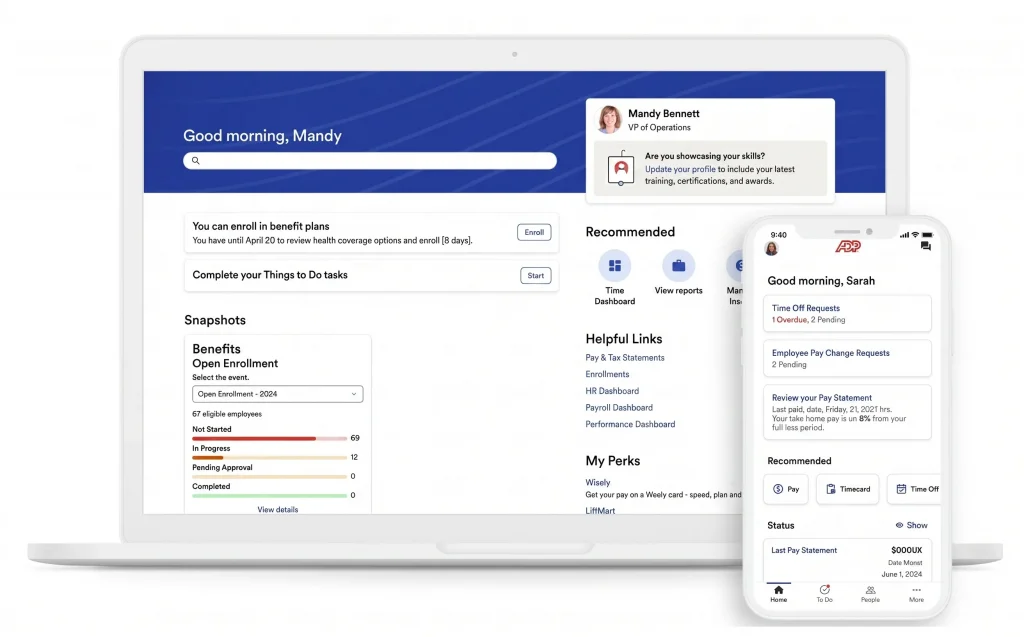
ADP delivers payroll processing and statutory compliance through its own India payroll platforms and its multi-country payroll services, with defined service processes and standardised reporting outputs for finance. The service is structured around process maturity and predictable monthly deliverables. Ideal for enterprises that want a service-led arrangement with formalised controls and are comfortable running payroll on the provider’s platform alongside a separate HR system.
Ramco Systems
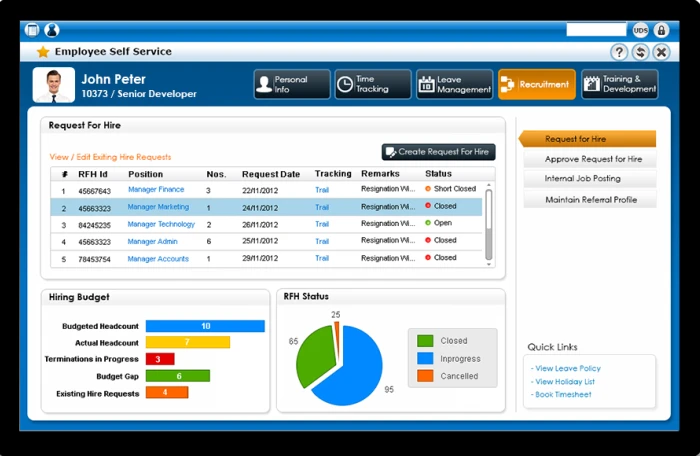
Ramco offers payroll software for India and other markets, with managed payroll delivery available on top of the same product, plus HR suite modules that can be adopted together. It suits situations where payroll complexity is high and there’s value in being able to move between self-run and managed operation. Ideal for large organisations that expect their payroll scope to expand and prefer software and service from one supplier.
Neeyamo
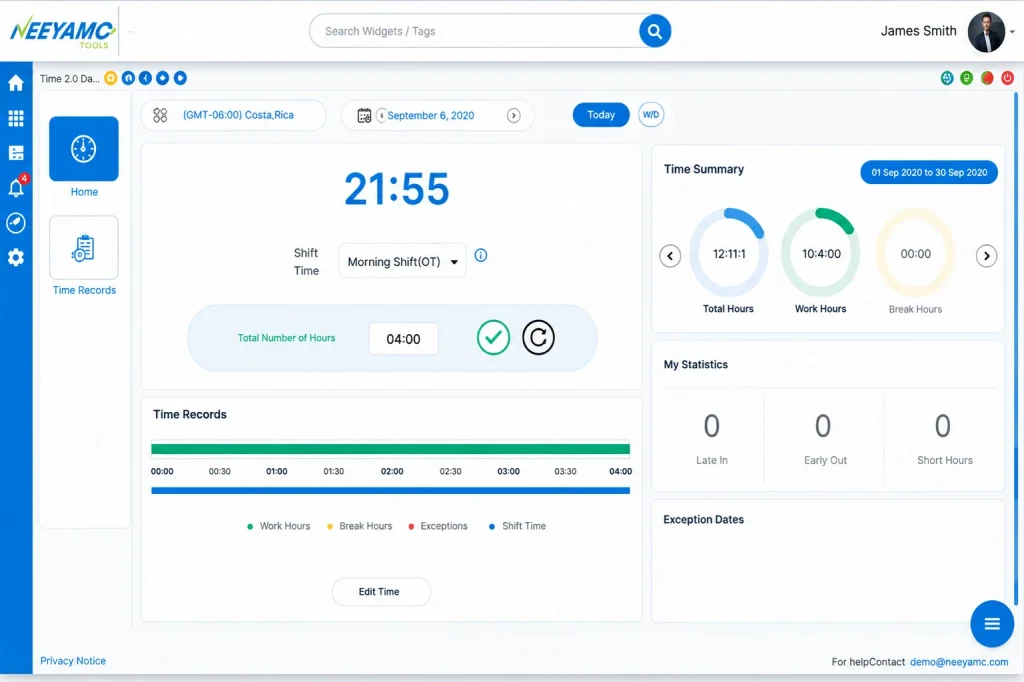
Neeyamo runs payroll as an outsourced service supported by its own technology, with coverage spanning a wide range of countries, including locations that are harder to service. Its model is oriented around a global operations team rather than a locally licensed product. Ideal for enterprises whose primary driver is coverage breadth and a service-managed operating model rather than in-house platform ownership.
Paysquare
Paysquare provides payroll outsourcing for Indian companies, covering monthly processing, statutory computation and compliance support, with reporting for finance and HR. It’s a service-first provider rather than a software vendor. Ideal for mid-to-large Indian enterprises that want to hand over payroll operations without changing their existing HR system of record.
TMF Group
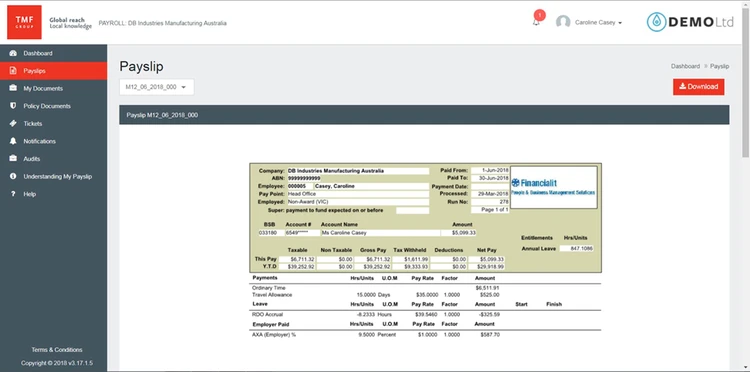
TMF Group offers payroll and HR administration as part of a wider corporate compliance service that also covers entity management, accounting and tax. Payroll arrives packaged with adjacent statutory obligations rather than as a standalone service. Ideal for enterprises with complex legal entity structures that prefer one supplier across payroll and corporate compliance.
ZingHR
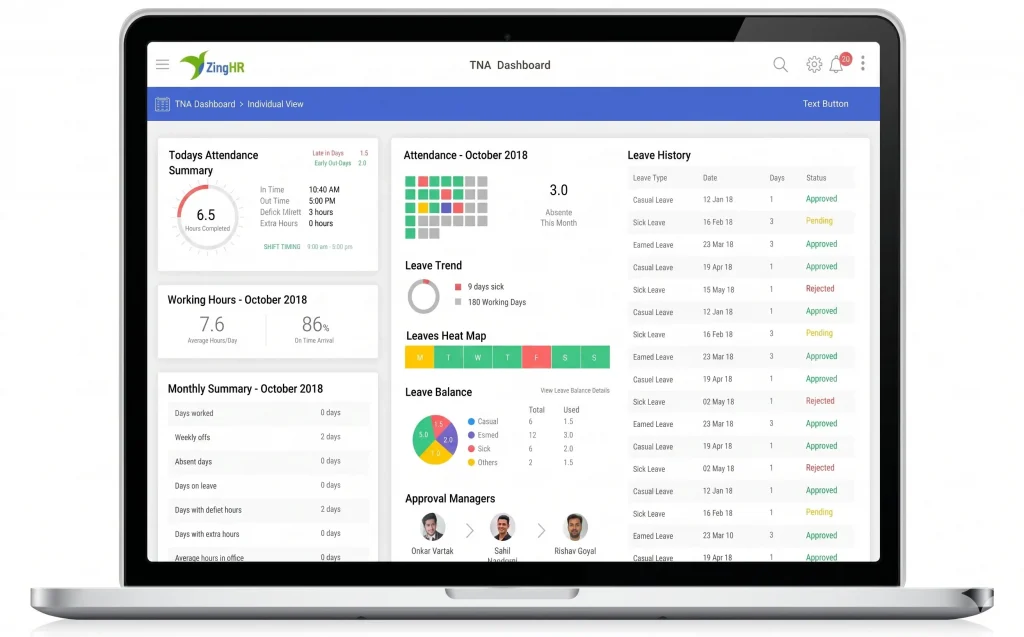
ZingHR provides HR and payroll software for Indian enterprises, with India payroll processing depth and workforce management features aimed at distributed and frontline teams, plus processing support. Ideal for organisations that want an India-focused platform with payroll at the centre and are evaluating software and service together.
A note on options built for smaller teams
greytHR, Keka and Zoho Payroll serve payroll and compliance needs in smaller organisations, and greytHR also offers payroll outsourcing services. They’re listed separately here rather than in the primary table because their design centre sits below the 1,000-employee band this comparison addresses. Requirements such as customisation depth, multi-entity handling and analytics scale differently above that band, so map them against your own scope. Ideal for organisations below the enterprise band covered here that want payroll and compliance software with lighter service requirements.
A note on global HCM suites
Workday, SAP SuccessFactors and Oracle Fusion Cloud HCM are frequently in the same evaluation, though India payroll for these suites is often delivered through partner-run or third-party managed payroll arrangements rather than as a native statutory engine. That’s a workable structure, and one worth mapping carefully during evaluation, because it determines how many parties sit between your attendance data and your provident fund challan. Ideal for enterprises standardising global HR processes on a single suite and sourcing India payroll through a partner arrangement.
Where PeopleStrong’s Managed Payroll Services Sit
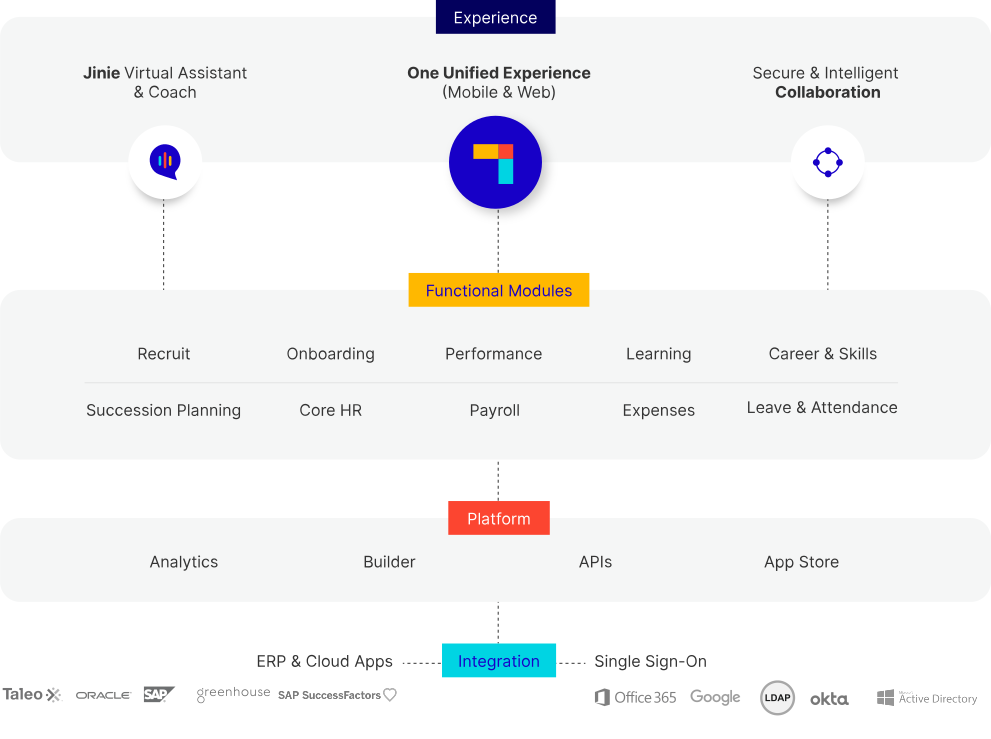
PeopleStrong’s Payroll Services are run by PeopleStrong’s own team on PeopleStrong’s payroll engine, the same platform that holds Core HR, Leave and Attendance, and Workforce Management for its customers. That structure targets the second break point above directly. The managed team works on live attendance and leave data inside the system, rather than on a file exported from one system and imported into another.
What is covered:
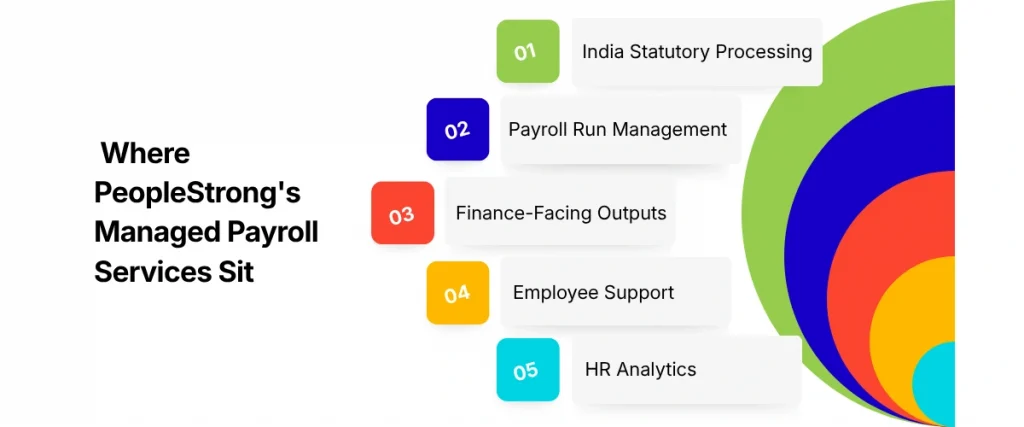
- India statutory processing, built to support compliance with the applicable filing calendars, across:
– Provident fund contributions and returns.
– Employees’ state insurance contributions.
– Tax deducted at source on salaries.
– Professional tax in the states where you operate.
– Gratuity and full-and-final settlement.
- Payroll run management, covering input validation, calculation, payslip generation, statutory registers and Form 16 support.
- Finance-facing outputs, including general ledger postings by entity and cost centre, and month-on-month variance reporting.
- Employee support, with routine payslip, tax declaration and leave balance queries handled through Jinie, People’strong’s embedded HR assistant, which customers report cuts HR administrative load by around 60%, leaving the payroll specialists on exceptions and disputes.
- HR Analytics, so payroll cost can be examined by location, entity, grade and component without raising a report request each time.
The evidence behind it: PeopleStrong serves 500+ enterprise customers covering more than 2 million employees, and has been recognised as a Gartner Peer Insights Customers’ Choice for Cloud HCM Suites in the 1,000+ employee enterprise segment for 2022, 2023, 2024 and 2025. The business is backed by Goldman Sachs Alternatives, which matters practically when you’re signing a multi-year payroll service that has to outlast your current HR team.
Ideal for enterprises of 1,000 to 10,000+ employees running multi-state, multi-entity operations in manufacturing, BFSI, pharmaceuticals and healthcare, IT services or retail, where attendance complexity and statutory spread are the two things making in-house payroll hard to sustain, and where the same organisation wants one system of record across the hire-to-exit lifecycle rather than a payroll service bolted onto unrelated HR tools.
What Managed Payroll Will Not Fix, and How to Cover the Gap
Outsourcing changes who performs the work. Several things it leaves untouched, and evaluations go wrong when buyers assume otherwise.
It will not fix poor inputs. If plant attendance closes three days late, the provider processes late or processes incomplete. Mitigation: enforce cut-offs through system workflow, with regularisation windows that close before payroll input freeze, and agree a documented late-input protocol with the provider.
It will not remove your liability. Statutory obligations rest with the employer. A provider’s service commitment gives you contractual recourse, not a transfer of legal responsibility. Mitigation: keep an internal payroll compliance owner who reviews the filing calendar and challan evidence monthly, even when they perform none of the work.
It will not resolve policy ambiguity. A provider cannot decide whether a particular allowance forms part of the gratuity base at your company. Mitigation: document calculation rules and exceptions during transition, and treat that document as a controlled artefact with a named owner.
It will not eliminate change management. Employees notice when the person who used to fix their payslip becomes a ticket queue. Mitigation: communicate the support model before go-live and keep an internal escalation route for sensitive cases.
On PeopleStrong specifically, two points are worth testing in your own evaluation: loading speed and session behaviour during peak-cycle usage, and how much vendor involvement deep customisation of workflows and report formats requires, rather than being fully self-service. Practical mitigation: run a load test with your own peak-cycle volumes during evaluation, and specify your non-negotiable report formats and workflow variations in the statement of work rather than discovering them after go-live.
Matching the Payroll Model to Your Actual Risk Profile
| Your profile | Model that usually fits | What to watch |
| Single state, stable headcount, payroll and attendance already on one platform | In-house payroll | Key-person dependency; document calculation rules now |
| Four or more states, growing location count, professional tax registrations lagging | Managed payroll services | Confirm state registrations and filings are explicitly in scope |
| Heavy shopfloor or frontline attendance, high overtime and contract labour | Platform-led managed payroll or hybrid | Keep attendance in your system rather than in file-based handovers |
| Frequent statutory audits, listed entity, tight financial close | Hybrid, with provider-produced reconciliation packs | Ask for system-generated audit evidence, not spreadsheets |
| Payroll team of three or fewer covering 3,000+ employees | Managed payroll services | Continuity and exit terms; documented rule library |
| Post-merger, multiple entities and legacy salary structures | Hybrid, moving to managed after harmonisation | Sequence the transition after structure clean-up, not during |
The choice comes down to four things you can measure before signing anything. Count the states and entities you file in, because that number predicts where in-house payroll runs out of road. Trace how many systems your payroll inputs cross between capture and calculation, since every join is a reconciliation cost. Check whether your month-end reconciliation and audit evidence live inside a system or inside a workbook. Then ask how many people in your organisation could run a payroll cycle unaided next month if the person who normally does it were unavailable. Where those four answers point the same way, the operating model chooses itself. Where they conflict, the hybrid split is usually the honest answer.
Schedule a demo with PeopleStrong to walk through your own multi-state statutory calendar, shopfloor attendance inputs and full-and-final scenarios against a managed payroll model.
FAQs
How long does it take to move from an in-house payroll team to a managed payroll service?
Enterprise transitions typically run across two to four payroll cycles, covering data migration, salary structure mapping, documentation of calculation rules and exceptions, and at least one parallel run where both teams process the same month. The variable that changes the timeline is not the provider’s readiness but how much of your calculation logic is currently undocumented. Enterprises with multiple legacy entities and unharmonised salary structures should plan for the longer end and avoid cutting over during the year-end tax cycle.
Who is legally responsible for payroll compliance if a managed provider files late?
The employer remains responsible for statutory obligations to EPFO, ESIC and the income tax authorities. A managed payroll contract gives you contractual recourse against the provider, typically through service commitments and indemnities, but it doesn’t transfer the underlying legal duty. This is why enterprises that outsource payroll should still keep an internal compliance owner who reviews the filing calendar and remittance evidence each month.
Can we outsource payroll processing but keep employee data in our own HR system?
Yes, and it’s a common arrangement in large enterprises. In a platform-led managed payroll model, the provider’s team works inside the HR system that already holds your employee master data, attendance and leave, so no monthly file exchange is needed. In service-led models, the provider processes on their own engine and receives data through an interface, which works well provided you agree who maintains that interface and how master data changes are synchronised.
What should we check about attendance before choosing a payroll model?
Look at three things: how late attendance regularisation requests typically arrive relative to your payroll cut-off, how many separate systems attendance data passes through before it reaches payroll, and what proportion of your workforce has variable pay driven by shift, overtime or contract records. Enterprises with heavy shopfloor or frontline attendance usually get more benefit from keeping attendance and payroll on the same platform than from any change in service provider, because that is where the errors originate.
Does managed payroll make sense for a company with fewer than 1,000 employees?
It can, particularly where the company operates across several states and has only one or two people handling payroll. The economics differ, though. Smaller organisations often find that payroll software with lighter compliance support meets their needs, and providers such as greytHR, Keka and Zoho Payroll are built for that band. The case for a full managed service strengthens as state count, entity count and workforce complexity grow rather than as headcount alone increases.