












 About Us
 Brand
Brand
 Career
 Contact Us



 +91-7314623098



A payroll manager closes the monthly run on time, then spends the rest of the week explaining it. Finance wants to know why one plant’s cost went up while headcount stayed flat. Group reporting needs the same numbers split by cost centre rather than by legal entity. The payroll register holds part of the answer and the attendance system holds another. Provident fund contributions sit in a third export that has to be matched by hand. Nobody did anything wrong, and the processing worked exactly as designed. What was never designed is the reporting layer sitting on top of it.
This guide is for payroll leads, heads of HR operations and finance controllers weighing up whether to hand payroll to a managed provider, and deciding what to insist on regarding payroll analytics before anything is signed. India supplies most of the worked examples because its reporting detail runs deepest. The UAE and Saudi Arabia appear where their requirements pull the reporting model in a different direction.
TLDR
- Managed payroll moves processing and statutory filing to a provider, but analytics depth varies sharply between providers and often decides the shortlist.
- Reporting continuity is a common casualty during a transition: historical data, cost-centre mapping and the variance trail that explains month-on-month movement.
- Score providers on named capabilities, including pre-payout variance detection, employee-level drill-down, multi-entity consolidation, self-serve report building and raw data export.
- Contract terms decide whether you actually get analytics: data ownership, export format and frequency, the price of new report builds, and what you take with you at exit.
- India brings the most detailed statutory reporting of the three markets covered here, while the Gulf adds wage protection, end-of-service gratuity and localisation reporting.
What Is Managed Payroll, and Where Does Payroll Analytics Sit in the Model?
Managed payroll is an arrangement where an external provider runs the payroll cycle on your behalf: input validation, calculation, statutory deductions, payslip generation, filing support and payment files. Your team keeps ownership of policy, approvals and data, and steps out of the mechanics of processing.
There are three delivery shapes an enterprise typically chooses between:
- Licensed payroll software you operate. Your team runs the cycle on the vendor’s platform. You keep full control and full workload.
- Managed payroll services. The provider operates the cycle on a platform, with named service levels covering accuracy, timelines and statutory filings. Your team reviews, approves and reports.
- Full payroll outsourcing or BPO. The provider handles processing and a wider set of administrative tasks, sometimes on infrastructure you never see.
Analytics behaves very differently across those three. Run the software yourself and you have direct access to the underlying data, whatever its structure. Move to a managed or outsourced model and your access is defined by what the provider chooses to expose and what the contract obliges them to deliver. Managed payroll services with real-time analytics and reporting close that gap by giving your team live dashboards, drill-down and export rights over the same data the provider processes, rather than a monthly PDF pack.
The practical test is simple. If a question from your CFO requires an email to your provider, you have managed processing. If your team can answer it directly from a dashboard within the hour, you have managed payroll with analytics.
Why Enterprise Teams Outgrow In-House Payroll, and What They Lose in Reporting First
In-house payroll teams are usually staffed to complete a cycle, not to analyse one. That works while the organisation has a handful of entities and a stable workforce. It stops working when the business adds plants, acquires a company with its own payroll calendar, or moves a large share of the workforce onto shift-based and variable pay.
Processing seldom collapses under that pressure. Reporting degrades quietly instead:
- Institutional knowledge concentrates in one or two people. The person who knows how overtime maps to the general ledger is also the person running the cycle, so reporting requests queue behind the run.
- Consolidation becomes a manual assembly job. Each entity produces its own register, and a group view only exists once someone rebuilds it in a spreadsheet.
- Reports describe the past, never the exception. You can see what was paid. You cannot easily see which cost centres moved outside their normal range before the payment left the bank.
- Attendance and payroll drift apart. When the workforce management system and the payroll engine are separate, the link between hours worked and money paid has to be re-established every month by hand.
By the time a CFO asks for payroll cost per unit of output by site, the honest answer is often that the data exists but cannot be produced within the reporting window. That gap, rather than any single processing error, is what pushes most enterprises towards a managed model.
The Reporting Gaps That Trigger a Switch: Month-End Delays, Manual Reconciliation and Blind Cost Centres
Month-End Delays That Push Payroll Costs Out of the Close
For organisations running multiple entities, payroll is a large cost line and one of the last to be finalised. When the register is only ready after the cycle completes, and the general ledger mapping is applied afterwards, payroll arrives late in the financial close. Finance then books estimates and adjusts in the following period, which makes month-on-month cost comparison unreliable for anyone trying to read a trend.
Manual Reconciliation Between Attendance, Payroll and the Ledger
Reconciliation work grows with complexity rather than with headcount. A 4,000-person organisation with one entity and one shift pattern reconciles quickly. A 4,000-person organisation with eleven entities, three shift patterns and site-level allowances does not. Each manual join between attendance exports, payroll output and ledger codes is a place where a number can drift, and each one eats time that would otherwise go to analysis.
Blind Cost Centres and the Questions You Cannot Answer
Blind cost centres appear when the payroll structure and the finance structure were designed separately. Payroll knows employees by entity, location and grade. Finance needs them by cost centre, project or product line. Where that mapping lives in a spreadsheet rather than in the payroll system, any question phrased in finance’s language requires translation, and the translation is only as current as the last time someone updated the file.
No Variance Trail Before the Money Moves
One reporting gap becomes expensive precisely because it surfaces after payout. Without a variance check comparing this cycle to the last one by employee, component and cost centre, a duplicated allowance or a mis-keyed overtime batch is discovered through an employee query or an audit sample rather than before the bank file is released.
Features of Payroll Services to Score During Evaluation
Score each provider on these capabilities individually, with evidence, rather than on a single overall impression.
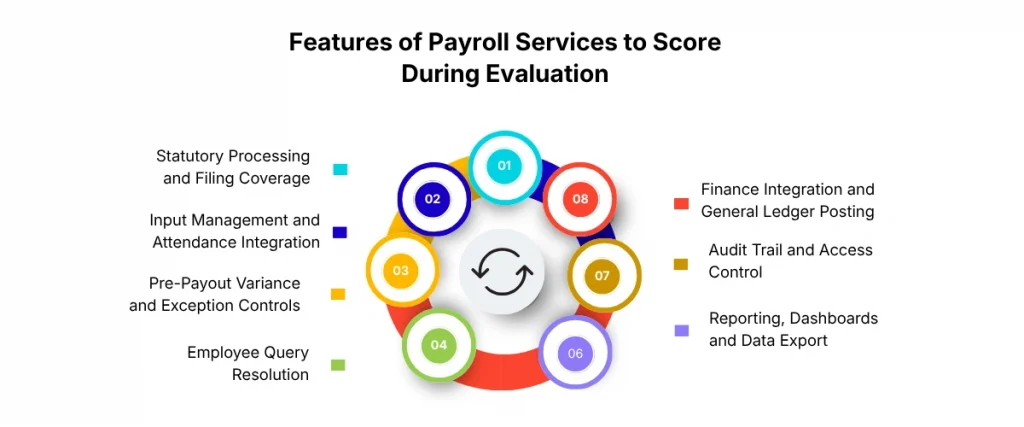
1. Statutory Processing and Filing Coverage
Ask which filings the provider prepares, which they submit, and which remain your responsibility. The line between “we generate the return” and “we file the return” makes a real difference during an inspection.
2. Input Management and Attendance Integration
Much of payroll accuracy is determined by input quality. Check how variable inputs reach the provider: file upload, API, or a shared leave and attendance or payroll and workforce management module. A provider whose payroll engine and attendance module sit on the same platform removes an entire category of reconciliation work, because hours and pay are derived from one record rather than two.
3. Pre-Payout Variance and Exception Controls
Look for automated comparison against the previous cycle at employee and component level, with configurable thresholds and a documented review step before the payment file is released.
4. Employee Query Resolution
Payslip, tax declaration and reimbursement queries can eat a large share of payroll team time, particularly in the days after each run. PeopleStrong’s embedded HR assistant, Jinie, resolves these directly with employees, including payslip retrieval, leave balances and policy questions, and can reduce HR administrative load by around 60%. For a payroll team, that means fewer tickets arriving during the exact week when close-out and filing work is heaviest.
5. Finance Integration and General Ledger Posting
The provider should post payroll to your chart of accounts in your structure, with the mapping maintained inside the system and visible to your team.
6. Audit Trail and Access Control
Every change to a master record, pay component or approval should carry a user, timestamp and reason code that you can query without raising a request.
7. Reporting, Dashboards and Data Export
Confirm what your team can build without provider involvement. Confirm too that you can extract the full transactional data set, not only formatted reports.
Payroll Analytics Requirements That Change the Shortlist
Enterprise payroll reporting dashboards are where shortlists separate. Two providers can process a cycle to the same standard and still differ completely in what your team can see afterwards.
| Analytics capability | Question to ask the provider | Why it matters for your reporting |
| Live cycle visibility | Can we see input status, exceptions and variance while the cycle is in progress? | Lets you correct errors before payout rather than after |
| Cost-centre and dimension reporting | Is the finance mapping held in the system and maintained by us? | Removes the spreadsheet translation layer before the close |
| Multi-entity consolidation | Can we view all entities in a single currency-normalised dashboard? | Produces a group payroll view without manual assembly |
| Employee-level drill-down | Can a dashboard number be opened down to the individual payslip component? | Allows you to defend a number in an audit or board review |
| Self-serve report building | Can our team build and schedule new reports without a change request? | Prevents every new question becoming a billable ticket |
| Historical data depth | How many cycles of detailed history are retained and queryable online? | Trend analysis is impossible without several years of comparable data |
| Raw data export | Can we export the full transactional data set on demand, in a defined format? | Keeps your analytics and finance systems independent of the provider |
Two of these deserve emphasis. Self-serve report building determines whether analytics stays current, because a reporting model that depends on provider change requests will always lag the business. Historical data depth determines whether analytics is possible at all in year one, since a provider who migrates only balances and not detail leaves you with a comparison baseline that starts from the go-live date.
Managed Payroll Providers Compared: Features, Analytics Depth and Ideal Company Size
The providers below serve enterprise clients in India, the Gulf, or both. Each entry follows the same structure: what the offering covers, and who it suits.
| Provider | Best for | Key strengths | Analytics and reporting shape | Ideal company size |
| PeopleStrong | India and Gulf enterprises wanting payroll on the same platform as core HR and attendance | Unified hire-to-exit suite, India and Gulf statutory coverage, embedded HR assistant | Cross-module HR and payroll dashboards drawing on one employee record | 1,000 to 10,000+ employees |
| ADP | Multinationals standardising payroll across many countries | Payroll operations across a broad set of countries, defined service governance model | Reporting and workforce analytics tooling layered over managed payroll | Mid-market through large multinational |
| Ramco Global Payroll | Enterprises with large India and GCC operations | India and Gulf statutory handling, pay rules built for shift-based industries | Payroll dashboards and reporting within the Ramco platform | Large enterprise and multinational |
| Neeyamo | Organisations with employees spread across many smaller jurisdictions | Wide country footprint including smaller jurisdictions, global payroll operations model | Consolidated global payroll reporting and data services | Multinational with distributed headcount |
| Alight | Large enterprises outsourcing payroll alongside benefits and HR administration | Combined payroll and HR administration services, enterprise delivery model | Employee experience and payroll reporting through its service platform | Large multinational enterprise |
| TMF Group | Groups needing payroll aligned with local accounting and entity compliance | Payroll delivered together with accounting, tax and entity administration in each jurisdiction | Jurisdiction-level reporting consolidated for group use | Multi-entity groups of varying size |
PeopleStrong
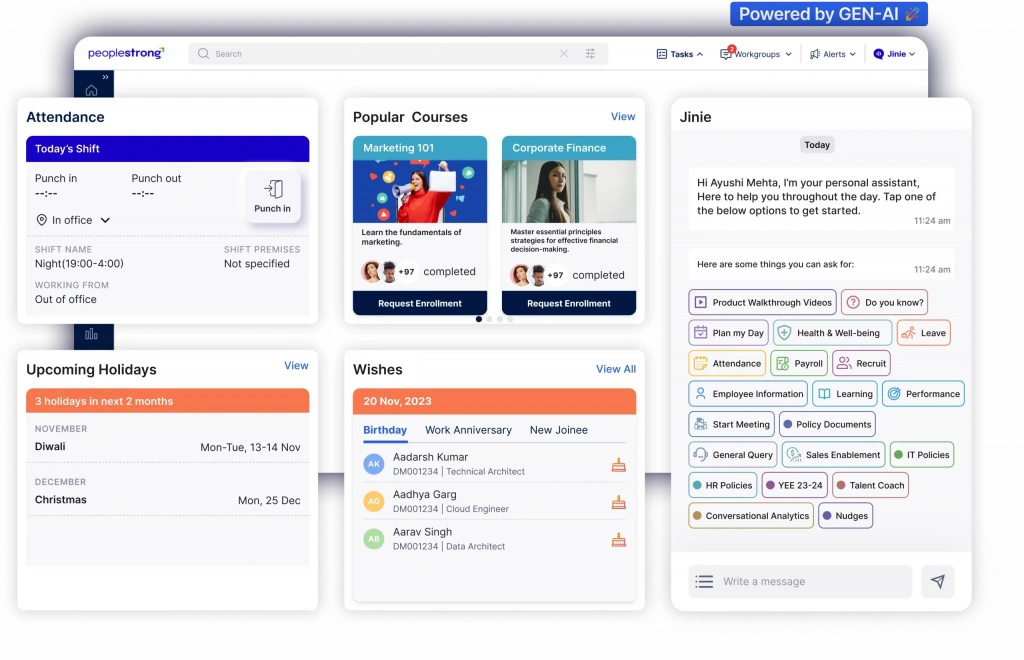
Payroll and workforce management sit inside the same platform as core HR, leave and attendance, so pay is calculated from the same employee record that holds shift data, leave balances and org structure. Statutory handling covers India’s provident fund, employees’ state insurance, tax deduction at source and gratuity in the same run, with UAE and Saudi Arabian labour requirements supported on the same platform. HR Analytics runs across modules, which means payroll cost can be read next to headcount, attrition and attendance without joining exports.
PeopleStrong currently serves 500+ enterprise customers and manages over 2 million employees across 10 countries. It has been named a Customers’ Choice in Gartner’s Voice of the Customer for cloud HCM suites in the 1,000+ employee segment for four consecutive years from 2022 to 2025. For a payroll leader, that track record matters mainly as evidence that the platform has been run at volumes similar to yours.
Ideal for: Enterprises of roughly 1,000 to 10,000+ employees in India and the Gulf that want managed payroll on the same system of record as HR and attendance.
ADP
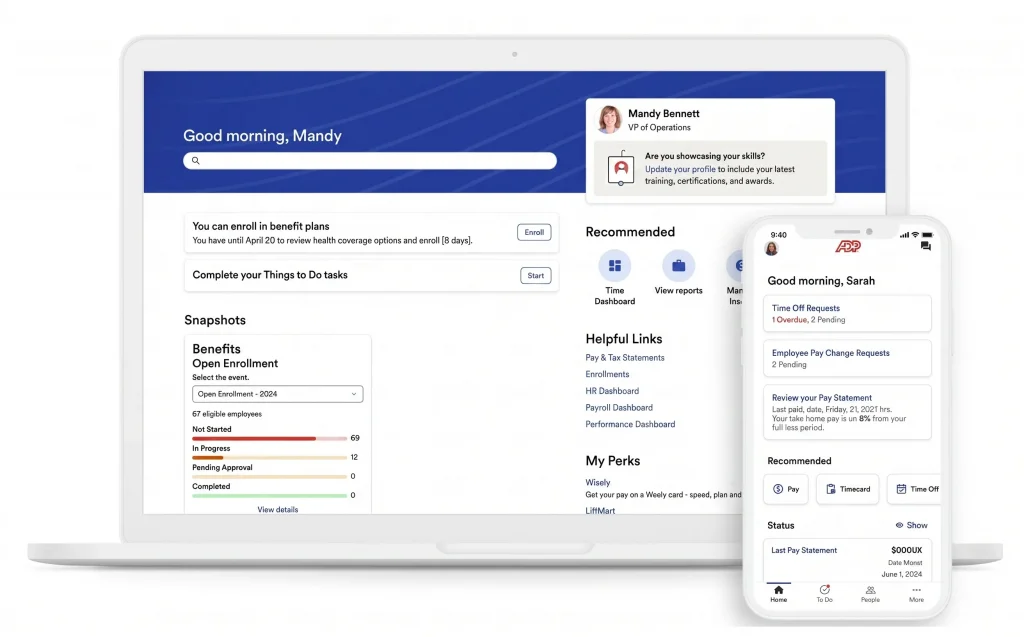
ADP provides managed payroll and HR outsourcing services across a wide set of countries, supported by a defined delivery and governance model that suits organisations standardising processes across regions. Its services extend from payroll processing to tax and compliance support, with reporting and workforce analytics tooling available alongside the payroll service.
Ideal for: Multinationals seeking a single payroll operating model across many countries, with a mature service governance structure.
Ramco Global Payroll
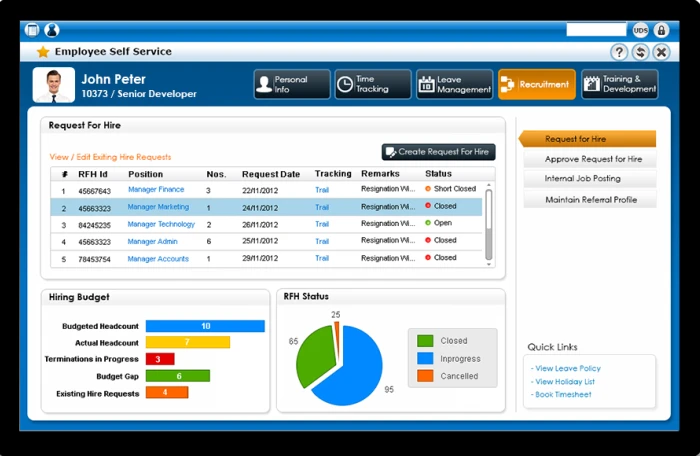
Ramco offers payroll as part of its HR platform, with statutory processing for India and Gulf countries and deployments across manufacturing, logistics and services organisations. Payroll reporting is delivered within its own platform, and the payroll engine is designed to handle complex pay structures common in shift-based industries.
Ideal for: Large enterprises with concentrated India and GCC operations and complex pay rules across sites.
Neeyamo
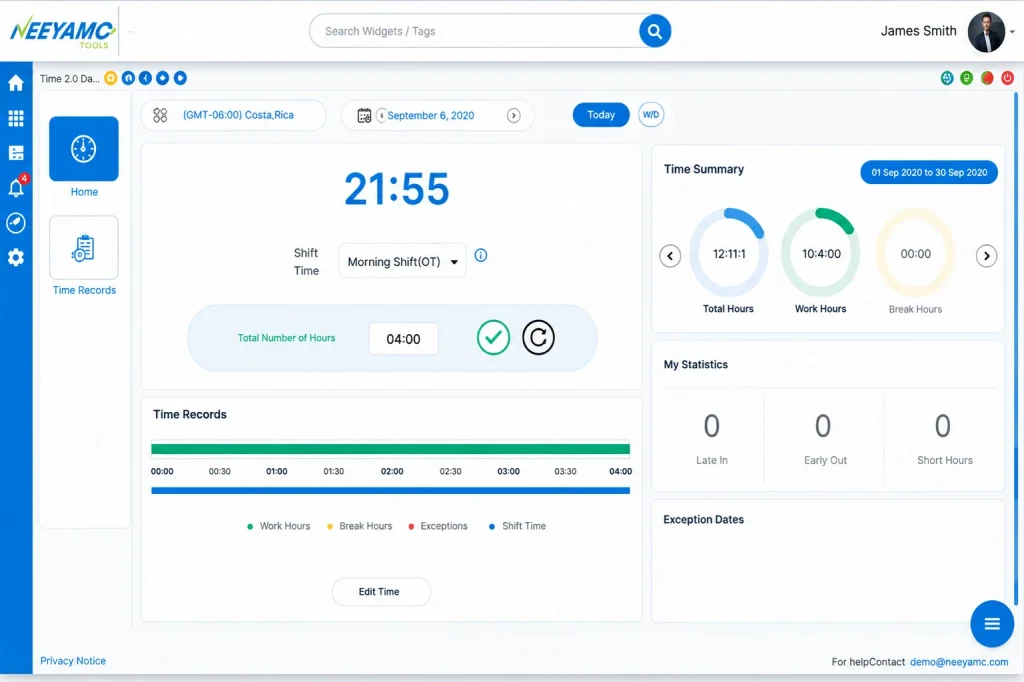
Neeyamo runs global payroll operations across a wide country footprint, including jurisdictions where an organisation may have only a handful of employees. The service model combines local processing capability with consolidated global payroll data, which suits organisations carrying small employee populations in many countries.
Ideal for: Multinationals with headcount distributed across numerous jurisdictions, including smaller markets.
Alight
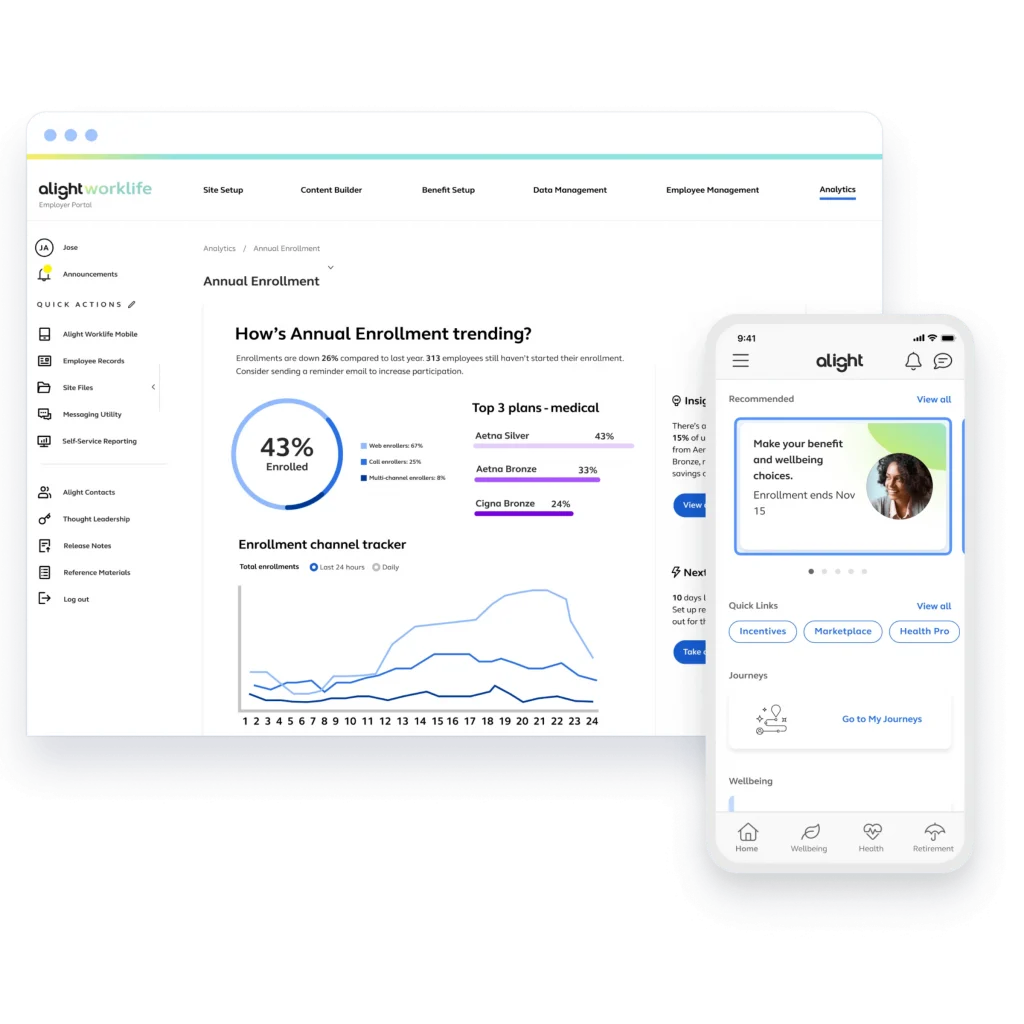
Alight delivers payroll as part of a wider HR and benefits administration service for large enterprises. Organisations typically select it when payroll is one component of a broader administrative scope being handed to a single partner.
Ideal for: Large multinationals outsourcing payroll together with benefits and HR administration.
TMF Group
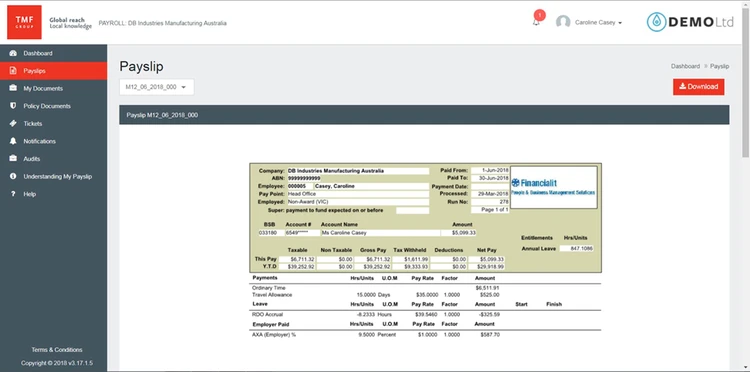
TMF Group provides payroll alongside accounting, corporate secretarial and tax services in each jurisdiction where it operates. That combination suits groups whose payroll obligations are tightly linked to local entity compliance and statutory accounts.
Ideal for: Multi-entity groups that want payroll, local accounting and entity compliance delivered together.
Options for Smaller and Growing Teams, Kept Separate From the Enterprise Shortlist
These platforms are built for a different tier and should not be evaluated on the same terms as the enterprise providers above. They’re included because organisations approaching the enterprise band often start here.
- greytHR handles payroll and statutory compliance for Indian businesses, with quick setup and payslip workflows built around local statutory requirements. Ideal for small and mid-sized Indian companies with a single-country footprint.
- Keka combines payroll with core HR and performance in a single product. Ideal for growing Indian companies that want HR and payroll together without heavy configuration.
- Zoho Payroll provides payroll processing integrated with the wider Zoho application set. Ideal for smaller organisations already standardised on Zoho products.
- HROne covers payroll, attendance and core HR for Indian businesses with an emphasis on process automation. Ideal for mid-sized Indian organisations consolidating a first HR system.
Organisations typically begin looking beyond this tier when entity count, workflow customisation or analytics depth outgrows what a mid-market product is designed to carry.
Multi-Country Payroll Analytics: Consolidating India, the UAE and Saudi Arabia in One View
Running payroll in three markets means three different statutory models, three filing calendars and, frequently, three sets of local advisers. The analytics question is whether those differences stop at the processing layer or follow you all the way into your reporting.
A workable consolidated view requires four things. Employee data must follow a common structure, so grade, cost centre and entity mean the same thing in every country. Pay components need classifying into a shared group taxonomy, even where local names differ. Currency conversion has to be applied consistently, with the rate and date visible on the report. Finally, each consolidated figure must open back into the local detail behind it.
Where these are missing, group reporting reverts to a spreadsheet that someone rebuilds monthly. Ask any shortlisted provider to demonstrate a live consolidated dashboard covering more than one country, using real client data structures rather than a demonstration data set.
India: The Statutory Reporting Load a Managed Provider Has to Carry
India’s obligations are the most detailed of the markets covered here, and they are where reporting failures become expensive fastest. A managed provider should be able to produce, on demand, the underlying data for each of the following:
- Provident fund: Monthly electronic challan-cum-return filing with the Employees’ Provident Fund Organisation, including employee-wise contribution detail and new joiner and exit reporting.
- Employees’ state insurance: Contribution calculation and return filing for eligible employees, with wage-limit eligibility applied correctly as salaries change mid-year.
- Tax deduction at source: Quarterly Form 24Q returns, annual Form 16 issuance, and investment declaration and proof-verification workflows that feed the monthly deduction.
- Professional tax: State-wise rates, thresholds and filing calendars, which differ across states and require entity-level tracking.
- Labour welfare fund: Applicable states only, with contribution periodicity that varies by state.
- Gratuity: Liability tracking under the Payment of Gratuity Act, with actuarial reporting inputs for finance.
- Bonus: Eligibility and calculation under the Payment of Bonus Act, with the supporting register.
Any of these can be queried by an inspector, an auditor or a works council at employee level. A provider who supplies summary returns but cannot produce the employee-level working behind them leaves your team exposed during exactly those conversations.
The Gulf: Wage Protection, Gratuity and Localisation Reporting Considerations
Gulf payroll carries a lighter contribution load than India but tighter payment-file discipline and localisation reporting. The two markets differ enough to evaluate separately.
United Arab Emirates
- Salary payments for applicable establishments must be made through the Wage Protection System administered under the Ministry of Human Resources and Emiratisation, which means the payroll output file format and submission timing are as important as the calculation itself.
- End-of-service gratuity must be accrued and reported for finance, not only calculated at separation.
- Emiratisation reporting requires workforce composition data that sits in HR rather than payroll, which is easier to produce where both live on one platform.
Saudi Arabia
- Wage payments are reported through the Wage Protection System under the Ministry of Human Resources and Social Development, with file-level accuracy against registered employee records.
- General Organisation for Social Insurance contributions apply at different rates for Saudi and non-Saudi employees, so nationality has to be a reliable, reportable field.
- Saudisation reporting under Nitaqat depends on accurate nationality and headcount classification, and a payroll provider’s data structure determines how easily those figures can be produced.
Ask any provider serving both Gulf markets to show how a variance in one country’s wage file is surfaced without waiting for the local team’s month-end summary.
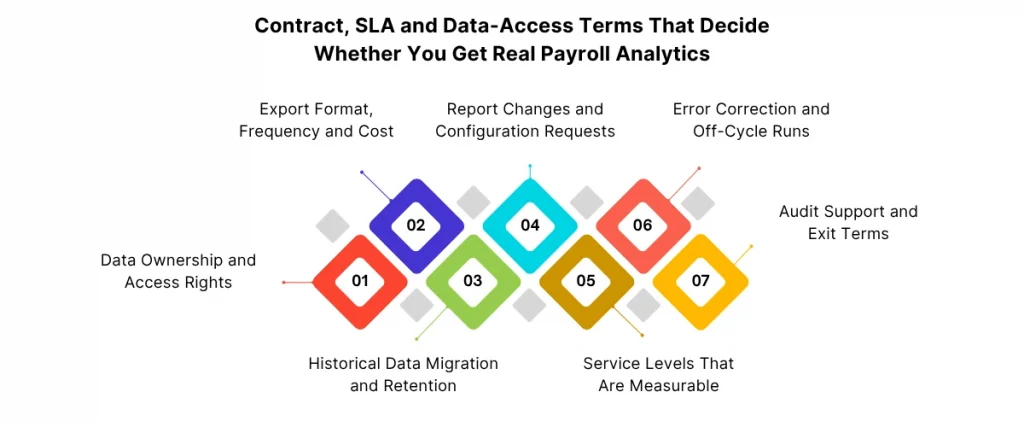
Contract, SLA and Data-Access Terms That Decide Whether You Get Real Payroll Analytics
Analytics is a commercial question as much as a technical one. These clauses determine what your team can actually do with the data.
Data Ownership and Access Rights
State plainly that all payroll data, including derived and calculated fields, belongs to your organisation, and that your named users hold read access to the underlying records rather than only to published reports.
Export Format, Frequency and Cost
Specify the export format, the schedule, and that on-demand extracts carry no per-request charge. A right to export that costs money each time is a right you will use rarely.
Historical Data Migration and Retention
Define how many cycles of detailed history are migrated at go-live, how long detail is retained online, and what happens to archived data. Without this, your first year of trend reporting has no comparison baseline.
Report Changes and Configuration Requests
Establish which report changes your team can make without involving the provider, the turnaround for those that require them, and how many are included annually before charges apply.
Service Levels That Are Measurable
“Accurate and on time” is unenforceable. Define accuracy as errors per thousand payslips, define timeliness against a named cut-off, and attach a remedy to each.
Error Correction and Off-Cycle Runs
Agree the correction process, who bears the cost of provider-caused errors, and how many off-cycle runs are included.
Audit Support and Exit Terms
Set out what the provider supplies during a statutory audit, and what you receive at exit: full data in a usable format, within a defined period, at no additional cost.
A 90-Day Transition Plan: Moving Off In-House Payroll Without Losing Historical Data
| Phase | Timeline | Payroll workstream | Analytics and data workstream |
| Discovery and design | Weeks 1 to 4 | Document every pay component, rule and exception; map entities, calendars and approval chains | Inventory existing reports and their consumers; agree the cost-centre and dimension model with finance |
| Build and migrate | Weeks 5 to 8 | Configure pay rules and statutory setup; load master data and year-to-date balances | Migrate detailed historical cycles, not just balances; validate report outputs against prior-period numbers |
| Parallel run | Weeks 9 to 12 | Run at least two full cycles in parallel and reconcile line by line at employee level | Rebuild the top ten reports in the new system and compare against legacy output before sign-off |
| Go-live and stabilise | Week 13 onwards | First live cycle with the outgoing team on standby; agree an issue escalation path | Hand dashboard access to finance and HR operations; schedule recurring reports and confirm drill-down works |
Two points decide whether this plan holds. The parallel run should reconcile at employee and component level, not at total-payout level, because equal totals can hide offsetting errors. And the knowledge held by your outgoing in-house team should be documented during discovery, while those colleagues are still available and engaged.
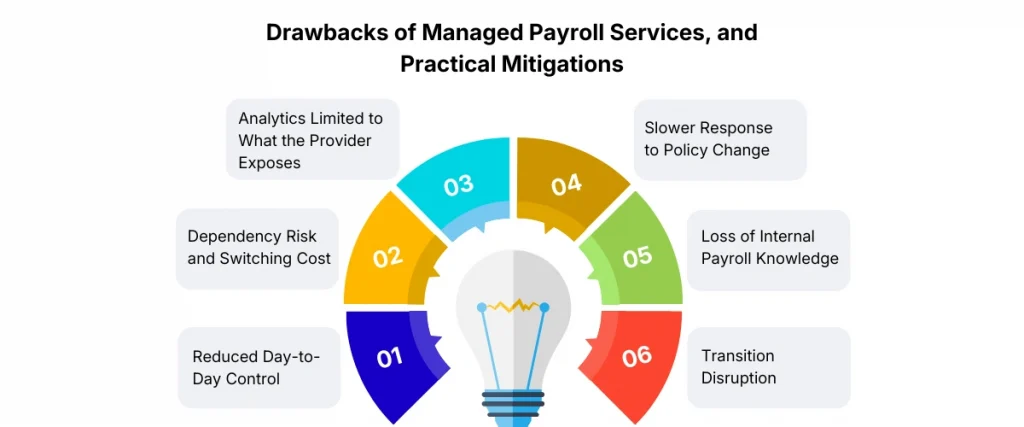
Drawbacks of Managed Payroll Services, and Practical Mitigations
Reduced Day-to-Day Control
You no longer decide unilaterally when a correction is processed. Fix this in the contract: a defined off-cycle process, agreed turnaround times, and a named service manager with the authority to act.
Dependency Risk and Switching Cost
Moving away from a provider is harder than moving to one. Agree exit terms at signature, covering full data return in a defined format, a stated transition period, and detailed history you keep regardless.
Analytics Limited to What the Provider Exposes
If dashboards are fixed, your questions must fit the reports available. Test self-serve report building during evaluation, using a question your provider hasn’t seen in advance.
Slower Response to Policy Change
Internal teams change a rule the same week; a provider may require a change request. Negotiate a service level for configuration changes and an annual allowance included in the fee.
Loss of Internal Payroll Knowledge
Over time, fewer people in-house understand how pay is calculated. Keep a small payroll governance function that reviews exceptions, owns policy and validates statutory output.
Transition Disruption
The move itself carries the highest risk of anything described here. A genuine parallel run, employee-level reconciliation and a communication plan so employees know where payslip queries go from day one will contain most of it.
Where PeopleStrong Fits for Enterprises Switching From In-House Payroll
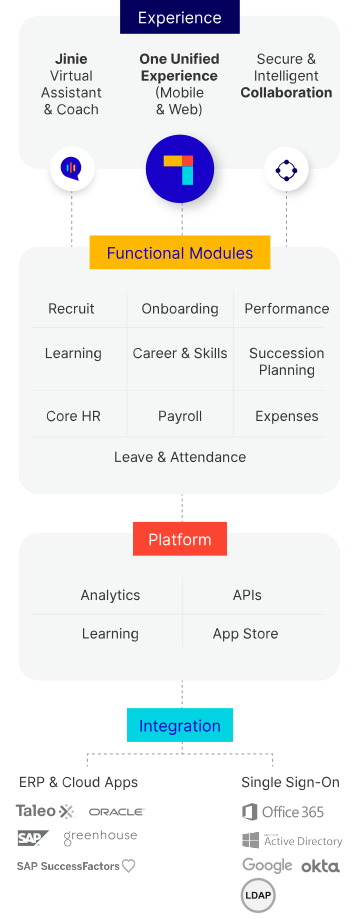
PeopleStrong is built for organisations in the 1,000 to 10,000+ employee band that have outgrown a mid-market product or a spreadsheet-supported in-house team, and don’t want the cost and timeline of a global suite implementation. Payroll, leave, attendance and core HR run on one platform, so payroll cost analysis, headcount, overtime and attrition can be read together rather than joined after the fact. Statutory processing in India supports compliance with provident fund, employees’ state insurance, tax deduction at source and gratuity obligations in the same system, and UAE and Saudi Arabian labour obligations are covered on the same platform.
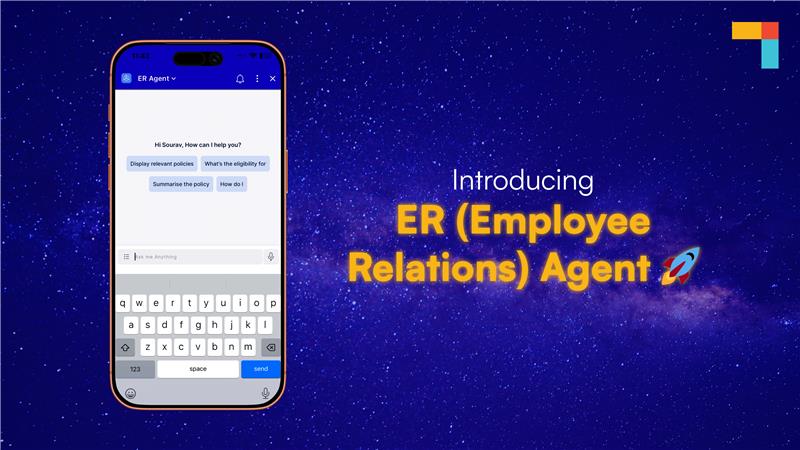
Two details matter specifically for teams coming off an in-house model. The cost-centre and organisational structure is configured inside the system and maintained by your team, which removes the spreadsheet mapping step before the financial close. Employee payslip and tax queries go to Jinie, the embedded HR assistant, which resolves routine questions directly with employees and can reduce HR administrative load by around 60%. That relieves the query pressure that normally peaks in the same week your team is closing statutory filings.
One honest note on limitations. Reviewers cite occasional slower loading during peak periods, session timeouts, limits on deep workflow and report customisation, and parts of the interface that look older than newer mid-market tools. If your requirement includes highly bespoke report logic, test that specific requirement during evaluation rather than assuming it.
The evidence base is straightforward: 500+ enterprise customers, more than 2 million employees managed across 10 countries, backing from Goldman Sachs Alternatives, and recognition as a Customers’ Choice in Gartner’s Voice of the Customer for cloud HCM suites in the 1,000+ employee segment across 2022, 2023, 2024 and 2025. For a payroll leader, the relevant takeaway is that the platform has been operated at comparable scale and complexity.
Choosing Between Providers: The Factors That Should Decide It
Weigh the decision on five specific factors. Start with statutory depth in the countries you actually operate in, tested against your own edge cases rather than a standard demonstration. Then check whether payroll and attendance data live on one record or require reconciliation, since that single design choice drives most month-end manual work. How much reporting your team can build without a change request determines whether analytics stays useful after year one. How much detailed history is migrated and retained online determines whether you have a comparable baseline for trend analysis at all. Last, read the contract terms covering data ownership, export cost and what you take with you at exit.
If your operations are concentrated in India with meaningful UAE or Saudi Arabia headcount, and you want payroll consolidated with HR and attendance rather than delivered as a separate service line, that combination narrows the field quickly. Schedule a demo with PeopleStrong to walk through your own multi-entity payroll variance, cost-centre mapping and statutory reporting scenarios before committing to a provider.
FAQs
How long does it take to move from an in-house payroll team to a managed provider?
A structured transition for a single-country enterprise typically runs around 90 days, covering discovery and design, configuration and data migration, a parallel run of at least two cycles, and go-live. Multi-country transitions usually take longer, because each jurisdiction has its own statutory setup and validation. Don’t shorten the parallel run. Employee-level reconciliation is what catches offsetting errors that equal totals would hide.
What happens to our historical payroll data when we switch providers?
That depends entirely on what your contract requires, which is why migration and retention terms should be agreed before signature. Ask for detailed transactional history to be migrated rather than closing balances alone, specify how many years remain queryable online, and confirm in writing that full data is returned in a usable format at no extra charge if you exit. Without these terms, your trend reporting effectively restarts at go-live.
Can managed payroll providers give us real-time dashboards, or only monthly reports?
Both models exist in the market, so test this rather than assume it. Providers with live dashboards let your team see input status, exceptions and variance while the cycle is still running, which allows correction before the payment file is released. Providers operating on a reporting-pack model deliver formatted output after the cycle closes, meaning every additional question becomes a request.
Does managed payroll remove the need for an internal payroll team?
It changes the role rather than removing it. Most enterprises retain a small payroll governance function that owns policy, reviews exceptions, validates statutory output and manages the provider relationship. Keeping that capability in-house also protects against the gradual loss of internal knowledge about how pay is actually calculated.
How do we compare providers on multi-country compliance without relying on their own claims?
Give each shortlisted provider the same set of your real edge cases, one per country, and ask them to demonstrate the calculation, the statutory output and the employee-level working behind it. Ask specifically which filings they prepare versus which they submit, since that distinction matters during an inspection. Reference calls with clients running similar entity counts in the same countries are more informative than country-coverage maps.