












 About Us
 Brand
Brand
 Career
 Contact Us



 +91-7314623098



There is a point where paying people in more than one country stops feeling like an administrative task and starts feeling like exposure. Somewhere between a provident fund correction filed a quarter late and a Gulf salary file rejected over one mismatched employee record, the question changes. Payroll leaders start asking whether multi-country payroll belongs in-house at all.
The signals are rarely dramatic. A country lead builds a private spreadsheet to fix rounding on arrears. A finance controller asks for the same headcount cost three different ways, and nobody can say with confidence which version is right. The underlying issue is structural: payroll grew country by country, and no one ever designed the layer that was supposed to sit above it.
This guide is written for heads of HR operations, payroll and compliance leads, and the CFO-side stakeholders who sign off with them. It assumes the decision in front of you is switching model, not switching software. Most examples start with India, because its statutory calendar is the densest of the three markets covered. The UAE and Saudi Arabia are the secondary markets throughout. Vendor selection appears here as one gate in a wider programme, not as the programme itself.
TLDR
– Decide your operating model, retained-team design and country scope before you open a vendor shortlist; the model determines which providers are even relevant.
– The real cost of fragmented country-by-country payroll sits in rework, statutory correction filings, audit effort and duplicated reconciliation, not in per-payslip fees.
– Providers covered with the same structure: ADP, Neeyamo, Ramco Global Payroll, SAP SuccessFactors Employee Central Payroll, ZingHR and PeopleStrong.
– Statutory depth across India and the Gulf usually decides enterprise shortlists, because that is where generic global payroll models thin out.
– Budget for two to three parallel runs, a documented cutover with opening balances signed off, and an SLA framework with payroll accuracy metrics before go-live.
What Managed Payroll Covers, and What It Does Not
Managed payroll means an external provider runs the payroll process end to end on your behalf: input validation, gross-to-net calculation, statutory computation and filing support, payslip publication, bank file generation, and the general ledger output that finance consumes. You keep policy ownership, approval authority and the employment relationship. The provider owns the run.
That’s different from payroll software you operate yourself, where your team configures the rules and presses the buttons. It’s also different from an employer of record, where a third party legally employs the worker. Enterprises with 1,000 employees and up in one legal entity per country generally do not need an employer of record. What they need is a managed payroll provider for multi-country compliance who can absorb the statutory workload while leaving control where it is.
The practical test is simple. If your payroll team spends most of its week on processing and correction instead of policy, controls and analysis, the managed model is worth costing out.
Signals Your In-House Payroll Team Has Outgrown the Model
None of these on their own justify a change. Three or four together usually do.
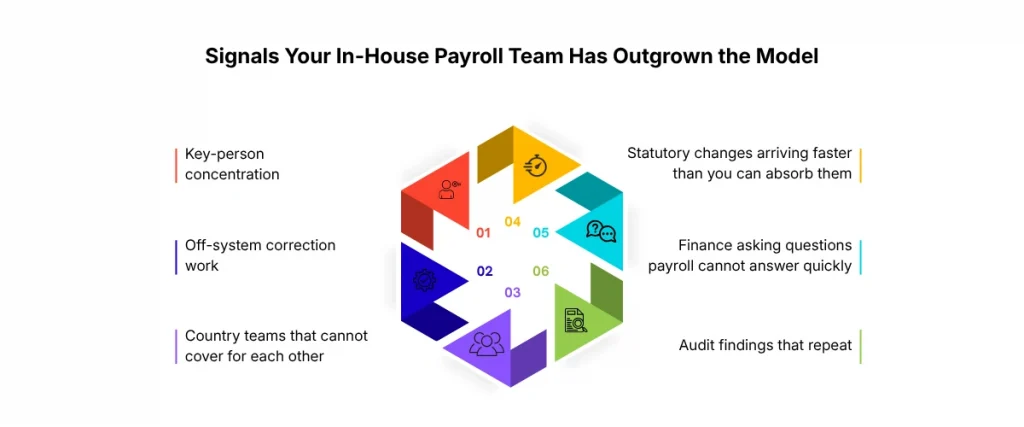
Key-person concentration. One person understands why the India payroll rules were written the way they were. When that person takes leave, the run slows. When they resign, institutional knowledge leaves with them, and the documentation that exists describes what the system does, never why.
Off-system correction work. Arrears, retrospective promotions, mid-cycle transfers and full-and-final settlements are handled in spreadsheets and then pushed back into the system. Every off-system step is a control gap and an audit question waiting to be asked.
Country teams that cannot cover for each other. Your Saudi payroll runs on a different calendar, a different set of rules and often a different tool. The India team cannot step in, and the Gulf team cannot step into India.
Statutory changes arriving faster than you can absorb them. Indian payroll alone carries provident fund, employees’ state insurance, professional tax that varies by state, and income tax rules that shift with each Union Budget. Add end-of-service gratuity and wage protection filing obligations in the Gulf, and monitoring becomes a job rather than a task.
Finance asking questions payroll cannot answer quickly. If a request for cost-per-head by cost centre across three countries takes a week, the reporting layer is the problem. Your people aren’t.
Audit findings that repeat. The same observation appearing in two consecutive internal audits tells you the process is the constraint, not the effort going into it.
Counting the Real Cost of Fragmented Country-by-Country Payroll
Per-payslip pricing is the easiest number to compare, and it captures one part of the picture. What matters is the total cost of running and correcting payroll, and most of that sits outside the payroll budget line.
EY’s widely cited payroll study put the average cost of correcting a single payroll error at around USD 291. For an enterprise processing tens of thousands of payslips a year across several countries, even a low single-digit error rate turns into a material number. And that figure captures only the correction effort. It leaves out the employee trust cost, the manager time spent chasing, and the finance rework when a correction crosses a period close.
Deloitte’s global payroll benchmarking work has repeatedly found that organisations struggle to compare payroll cost and accuracy across countries, because definitions and measurement differ locally. That is the fragmentation problem stated plainly: you cannot manage what three teams count three different ways.
When you build the cost picture, include the following:
- Fully loaded cost of payroll headcount, including the finance and HR time absorbed into each run.
- Licence, hosting and support cost for every payroll tool in every country, including the ones finance pays for.
- Correction and reprocessing effort, measured as hours per cycle, not as a feeling.
- Statutory correction filings, penalties and interest actually incurred over the last 24 months.
- External audit and internal audit hours attributable to payroll.
- Reconciliation effort between payroll, attendance, the general ledger and the bank.
- Cost of the manual controls that exist only because the systems do not talk to each other.
Enterprises that complete this exercise honestly often find the software line is the smallest component in the stack.
Building the Business Case for Managed Payroll: Risk, Reporting and Headcount
A business case built on headcount savings alone tends to fail at the CFO’s desk. The savings are modest, and the risk of a botched transition is not. Build it on three arguments instead.
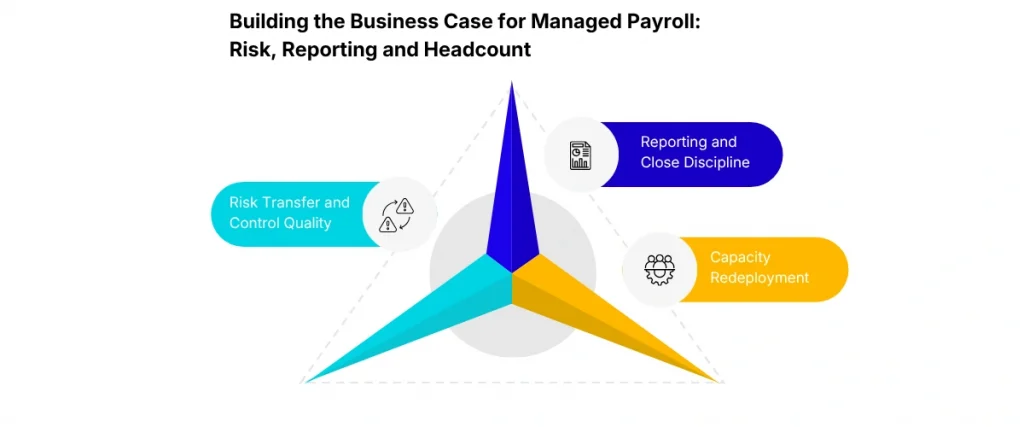
Risk transfer and control quality. You are moving from a process where compliance depends on individual vigilance to one where it depends on a provider’s standing capability and a documented control framework. Frame this as reduced variability backed by contractual accountability, not as a compliance guarantee. No provider can make you immune from a statutory error. A good one makes errors rarer, visible faster, and someone’s contractual responsibility to fix.
Reporting and close discipline. A single payroll output format across countries gives finance one general ledger interface, one cost-centre mapping standard and one accrual method. That’s usually the argument that wins finance over, because it shortens month-end close and removes the reconciliation that currently happens by email.
Capacity redeployment. Your payroll specialists stop processing and start governing: policy design, controls testing, cost analysis, statutory horizon scanning. Present this as a capability upgrade. In most enterprises the retained team shrinks by less than leaders expect and matters more than they expect.
Set a small number of measurable targets before signing: payroll accuracy rate, on-time statutory filing rate, query resolution time, and days to close the payroll journal. You’ll need these later as SLA definitions anyway.
Deciding the Operating Model Before You Decide the Vendor
The most common sequencing error in payroll outsourcing is picking a provider and letting the provider’s standard model define your operating model. Do it the other way round. Four shapes cover most enterprises.
| Operating model | How it works | Best when | Watch-outs |
| Fully in-house, single platform | You run payroll on one system across countries with your own team | Statutory complexity is stable and you have deep bench strength in each market | Key-person risk stays with you; statutory monitoring is a permanent internal cost |
| Managed payroll, single provider | One provider processes all in-scope countries on one platform | You want one contract, one data model and one reporting output | Provider must have genuine depth in every in-scope country, not partner coverage everywhere |
| Managed payroll, aggregator model | A lead provider coordinates local partners country by country | Your footprint spans many countries with small headcount in most | Accountability can blur at the partner boundary; data models often differ underneath |
| Hybrid | Managed in high-complexity or high-headcount markets, in-house elsewhere | You have one dominant market and a long tail of small ones | Two operating rhythms to govern; reporting consolidation needs deliberate design |
Alongside the model, decide three things: which countries are in scope for phase one, what the retained payroll team is accountable for, and where the system of record sits.
That last one matters more than it looks. If employee master data lives in your core HR platform and payroll consumes it, the provider inherits clean input. If master data lives in the payroll provider’s system, you have handed over your system of record along with the process.
Shortlisting Multi-Country Payroll Providers
The market splits into global outsourcing specialists, platform-led vendors and regional enterprise players. Here is a neutral view of six commonly shortlisted options for enterprises operating across India and the Gulf.
| Provider | Model shape | Key strengths | Ideal company profile |
| ADP | Global managed payroll and outsourcing | Very wide country coverage, mature global service delivery, established compliance operations | Multinationals with large distributed footprints and standardised global processes |
| Neeyamo | Global payroll outsourcing with long-tail country coverage | Strong reach into smaller markets, technology-led service delivery, dedicated payroll focus | Enterprises with many countries and low headcount per country |
| Ramco Global Payroll | Platform-led payroll and HR with managed services | Payroll engine depth, strong presence across Asia and the Middle East, unified platform approach | Asia and Gulf-centred enterprises wanting one payroll engine across the region |
| SAP SuccessFactors Employee Central Payroll | Payroll within a global HCM suite, often partner-delivered | Deep integration with the wider SAP landscape, strong finance alignment for existing SAP estates | Large enterprises already standardised on SAP for HR and finance |
| ZingHR | India-origin HCM with payroll and managed services | Payroll processing focus, India statutory coverage, workforce management alignment | Indian enterprises consolidating payroll and attendance |
| PeopleStrong | Unified HCM with managed payroll services across 10 countries | India and Gulf statutory depth, payroll on the same platform as core HR and attendance, Gartner Customers’ Choice recognition 2022 to 2025 | Enterprises of 1,000 to 10,000+ people across India and the Middle East |
1. ADP
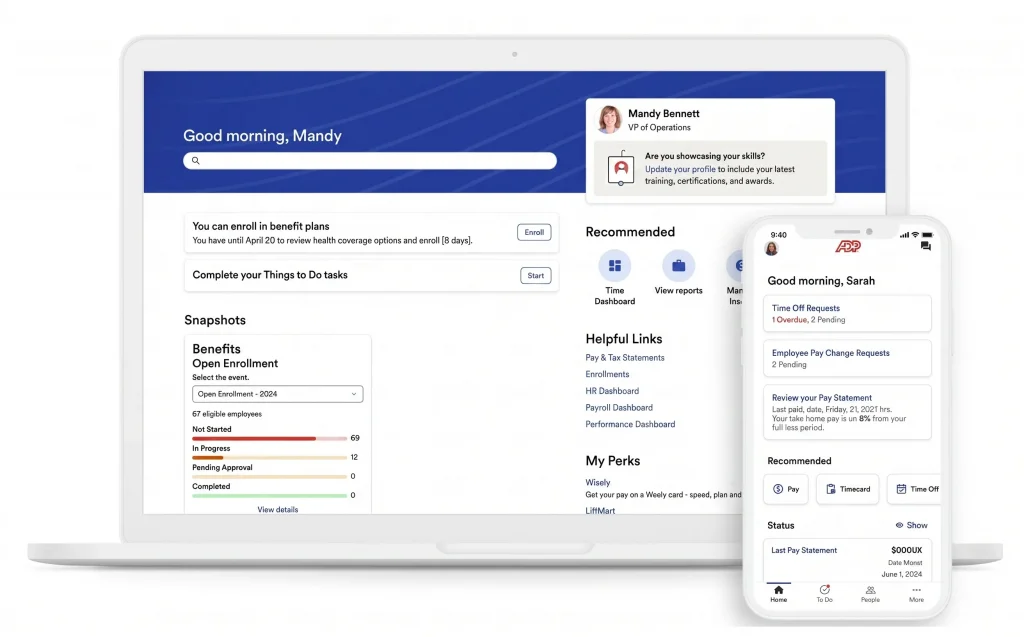
ADP delivers managed payroll through global service centres with country-level compliance teams and its own processing platforms. Coverage breadth is its defining characteristic, along with long-established governance and reporting frameworks familiar to multinational finance functions. Best fit: organisations whose payroll footprint spans many regions and whose process standards are set globally.
2. Neeyamo
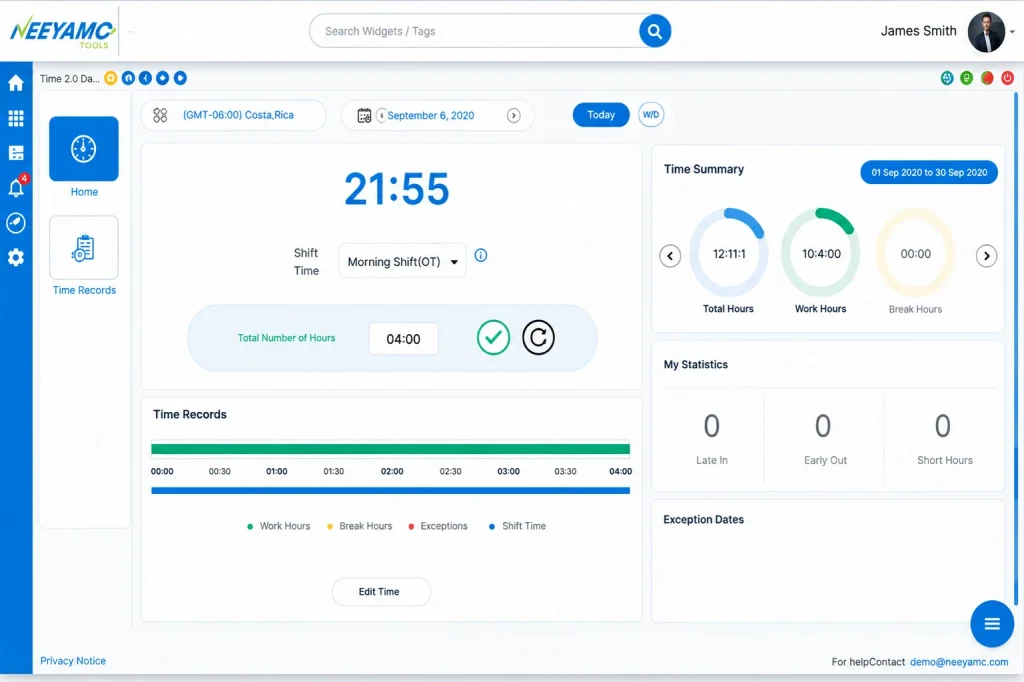
Neeyamo focuses on payroll and adjacent workforce administration, with particular emphasis on reaching markets where larger providers work through partners. Its delivery model combines its own technology stack with managed operations. Best fit: enterprises with a long tail of small-headcount countries that need consistent handling instead of country-by-country improvisation.
3. Ramco Global Payroll
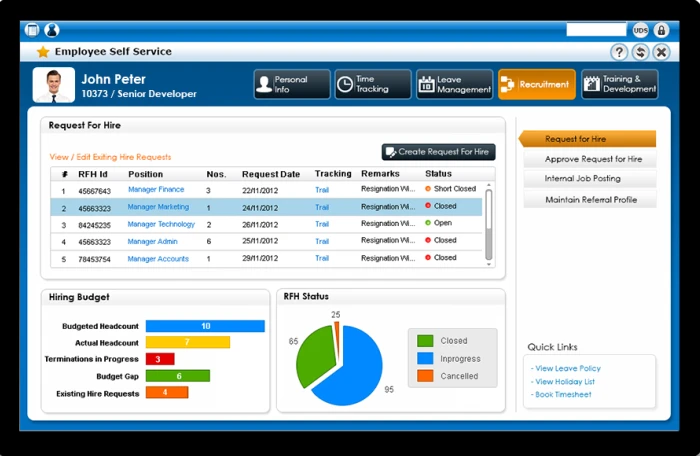
Ramco offers a payroll engine with managed service options, meaningful presence across Asian and Middle Eastern markets, and an emphasis on unified processing across a region. Its heritage in enterprise software shows in configurability for complex pay structures. Best fit: regionally concentrated enterprises that want one engine covering India, Southeast Asia and the Gulf.
4. SAP SuccessFactors Employee Central Payroll
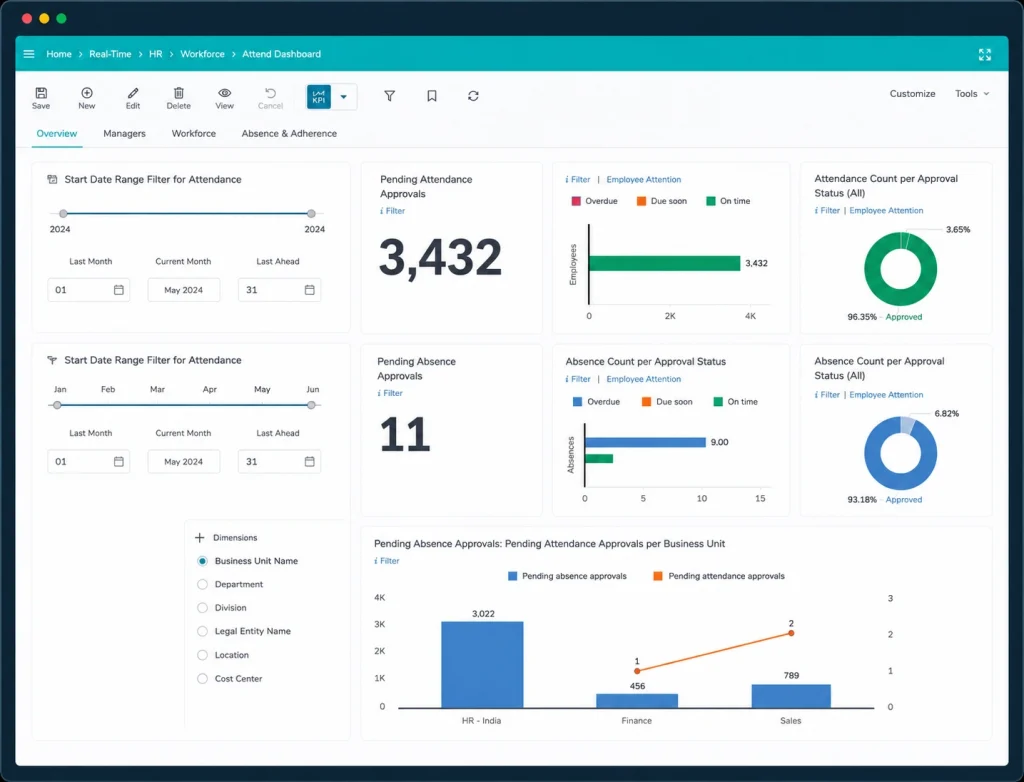
Employee Central Payroll sits inside the wider SuccessFactors suite and is commonly implemented and run with an implementation partner or a business process outsourcing arrangement. Its strength is alignment with an existing SAP finance and HR estate, which simplifies the general ledger and master data story. Best fit: large enterprises already committed to SAP, where payroll consolidation follows the wider platform decision.
5. ZingHR
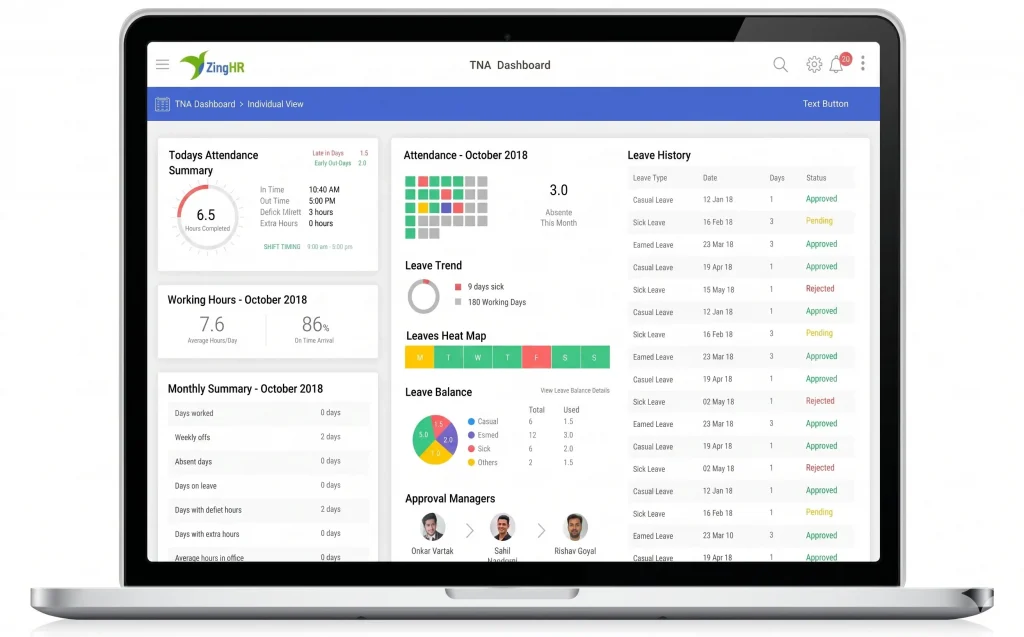
ZingHR provides HCM with a strong payroll orientation and managed processing options, built around Indian statutory requirements and workforce management use cases. Payroll processing and workforce management sit under the same vendor relationship, which suits organisations bringing both together. Best fit: Indian enterprises consolidating payroll, attendance and compliance under one vendor.
6. PeopleStrong
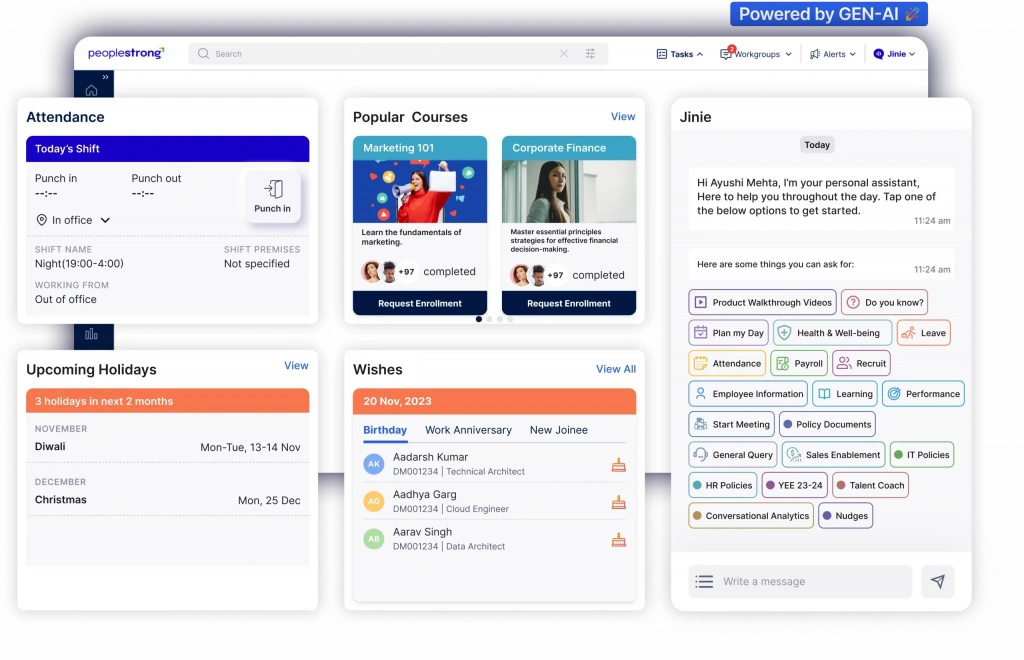
PeopleStrong runs managed payroll as a service on the same platform that carries core HR, leave and attendance, and workforce management, across a 10-country footprint. It currently serves over 500 enterprise customers and manages more than 2 million employees, and has been named a Gartner Voice of the Customer Customers’ Choice for HCM in the 1,000+ employee segment for four consecutive years, from 2022 to 2025. Best fit: enterprises of 1,000 to 10,000+ employees who want one system of record spanning India and the Gulf, with payroll and core HR running on the same platform.
The Regional Question: Why India and Gulf Statutory Depth Decides Most Shortlists
Global payroll buying guides tend to treat country coverage as a binary. Either a provider covers a market or it does not. At enterprise volume, the useful question is different: how deep does the coverage go, and who maintains it?
In India, depth means handling provident fund across exempt and unexempt establishments, employees’ state insurance thresholds, professional tax rules that differ by state and sometimes by slab within a state, labour welfare fund, gratuity accrual, and income tax computation under two regimes with employee-level declarations, proofs and quarterly returns. It also means full-and-final settlements that reconcile notice pay, leave encashment, recoveries and tax in a single statement. Depth is the difference between a provider that computes provident fund and one that can explain your arrears treatment to a regional officer.
In the UAE, salary disbursement flows through the Wage Protection System via files that must match Ministry of Human Resources and Emiratisation records, alongside pension contributions for eligible nationals and end-of-service benefit accrual under the current labour law. Saudi obligations include General Organization for Social Insurance contributions, wage protection filing, Saudisation ratio tracking that interacts with hiring plans, and end-of-service calculations that depend on how the contract ends.
An enterprise payroll partner for India, UAE and KSA operations should be able to show you, in a working system, how each of those is calculated, where the rule sits, who updates it when the law changes, and how the change reaches production. Ask for a statutory change log covering the last 12 months. The answer separates providers with in-country capability from those working through in-country contacts.
Cross-border cases deserve their own conversation: employees on assignment, split payroll, expatriates with tax residency in one market and employment in another, and social security agreements. Generic models fail quietly here, because nothing breaks until a tax authority asks.
Payroll Data Migration: Historical Records, Arrears and Year-to-Date Balances
Migration is where transitions succeed or fail, and it’s almost always underestimated because the data looks tidier in summary than it is in detail.
Work through five layers.
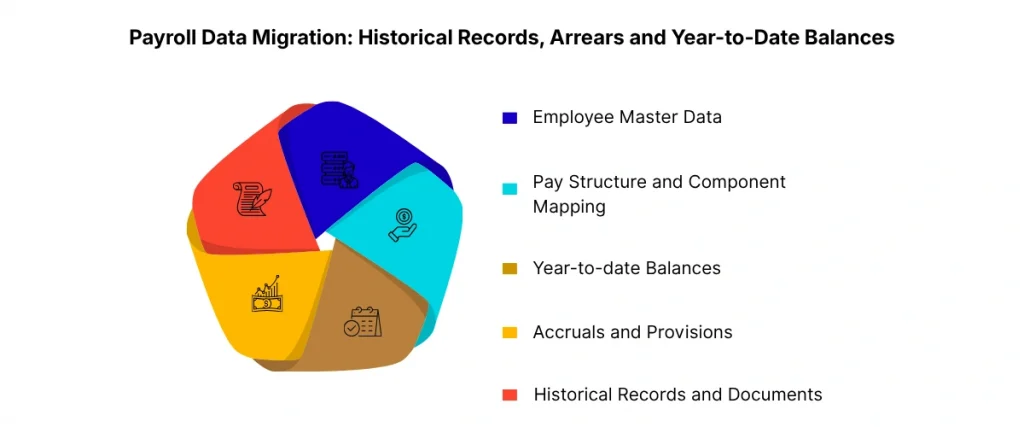
Employee master data. Identifiers, employment history, contract types, statutory registrations, bank details, dependants where they affect benefits or tax. Cleanse before you migrate. A provider cannot fix a duplicate employee record you hand over.
Pay structure and component mapping. Every earning, deduction, reimbursement and recovery needs a target component with the correct tax, statutory and accounting treatment. Legacy structures accumulate components nobody can explain. Retire them deliberately instead of carrying them across.
Year-to-date balances. Taxable income, tax deducted, statutory contributions, exemption utilisation and perquisite values must transfer exactly. A mid-year cutover with wrong opening balances produces tax errors that surface at year-end, when they are most expensive to fix. If your timeline allows, cut over at the start of a financial year in India.
Accruals and provisions. Leave balances and encashment values, gratuity and end-of-service accruals, bonus provisions. Finance must sign off on these, not just HR.
Historical records and documents. Payslips, tax statements, statutory challans and filing acknowledgements. Decide what moves into the new system, what stays in an archive, and how long you must retain each under local rules. Employees will ask for a payslip from three years ago in week two of go-live.
Assign a single accountable owner per layer and require written sign-off. Volume reconciliation alone is not enough. Reconcile values.
Parallel Runs and Cutover: A Realistic Transition Timeline
Plan for two to three parallel cycles per country. One is a test of the build, not of the process. The second catches the exceptions the first cycle did not contain. A third is prudent in India, where a single month rarely exercises every rule.
A workable sequence for a two-country phase one looks like this:
- Weeks 1 to 3, discovery and design. Policy documentation, pay component inventory, statutory register, interface catalogue, retained-team design.
- Weeks 4 to 8, build and configuration. Rules configured, general ledger mapping agreed with finance, integrations specified.
- Weeks 9 to 14, parallel runs. Two to three cycles, with a defined tolerance and a root-cause log for every variance. Do not accept “rounding” as a root cause.
- Weeks 15 to 16, cutover. Opening balances frozen and signed off, access provisioned, employee communication issued, first live run supervised.
- Weeks 17 to 20, hypercare. Daily standups in the first cycle, weekly in the second, then standard governance.
Sequence countries instead of running them simultaneously, unless your programme team can genuinely support both. Start with the market carrying the highest complexity, usually India, because the lessons transfer downward more easily than upward.
Set variance tolerance before the first parallel run, agree who signs off exit criteria, and hold the line. Programmes slip most often when a criterion is waived under calendar pressure.
Integration With Core HR, Attendance and Finance Systems
Payroll accuracy is mostly an input problem. If attendance, leave and employee changes arrive late or in the wrong shape, no provider can produce a clean run.
Three interfaces matter most.
Core HR to payroll. Joiners, leavers, transfers, promotions, pay revisions and statutory data. Effective dating must survive the interface, because retrospective changes drive arrears, and arrears drive corrections. Where payroll sits on the same platform as core HR software, this interface stops being an interface, which removes a whole category of failure.
Attendance and leave to payroll. Shift differentials, overtime, unpaid leave, holiday premiums and, in manufacturing and retail environments, shopfloor and roster data. Distributed frontline workforces generate most of the volume and most of the disputes, so validate this feed hardest. Integrated leave and attendance with clear regularisation workflows cuts the input queries that otherwise land on payroll two days before the run.
Payroll to finance. A general ledger file with cost-centre, entity and account mapping agreed in advance, plus statutory liability postings and accrual entries. Agree the file format and the posting calendar with the controller during design, not during the first close.
Document integration ownership explicitly. When a feed fails at 2am before a payroll cut-off, the escalation path should already exist.
Governing the Partner After Go-Live: SLAs, Escalation and Payroll Accuracy Metrics
Outsourcing the process does not outsource the accountability. Your retained team becomes the control function, and it needs a defined instrument panel.
| Metric | What it measures | How to set the target |
| Payroll accuracy rate | Payslips issued without a subsequent correction, per cycle, per country | Baseline against your last six in-house cycles, then agree an improvement path |
| On-time payment rate | Bank files released and credited by the committed date | Absolute; define the exceptions that do not count and nothing else |
| Statutory filing timeliness | Filings and contributions submitted within the legal window | Absolute, with a named owner per obligation per country |
| Query resolution time | Time to close employee and manager payroll queries by severity | Tiered by severity, measured from first contact rather than from triage |
| Input timeliness | Percentage of inputs received by cut-off from your side | Track it on yourselves; most provider misses trace back here |
| Corrections by root cause | Error volume grouped by cause: input, configuration, statutory, system | Use it as a diagnostic, not a target; review monthly and act on the largest bucket |
Build the governance rhythm to match: an operational review each cycle, a service review monthly, a compliance and risk review each quarter, and a commercial and roadmap review annually. Define severity levels, response times and escalation contacts on both sides in the contract, and name individuals rather than functions.
One clause worth negotiating carefully is the correction and remediation obligation. Specify who bears penalty and interest where the error originates with the provider, and where the boundary sits when the input was wrong.
Financial Reporting and Month-End Close Once Payroll Is Outsourced
Finance leaders usually approve payroll outsourcing for reporting reasons and later judge it on reporting outcomes. Design for that from the start.
Agree the chart of accounts mapping and cost-centre logic across every in-scope country before the first parallel run, and validate the general ledger output during parallel rather than after go-live. Fix the posting calendar so payroll journals land ahead of the close deadline in every entity, allowing for different weekends and public holidays across India and the Gulf.
Multi-currency handling needs an explicit rule: which rate, sourced from where, applied on which date, and how differences are posted. Accruals need the same treatment, particularly gratuity and end-of-service liabilities, which sit on the balance sheet and attract auditor attention.
Ask for three reporting outputs as standard: a payroll cost report by entity, cost centre and component; a statutory liability and payment status report by country; and a variance report comparing cycle to cycle, with explanations for movements above a threshold. Cross-module HR analytics that combine cost with headcount, attrition and workforce mix turn payroll data into something the CFO uses for planning, not only for reconciliation.
Auditors will ask for evidence of controls, not assurances. Confirm in the contract that you receive access to processing logs, approval trails, change records and the provider’s own control attestations.
How PeopleStrong Handles Managed Payroll for Enterprises Across India and the Gulf
PeopleStrong runs managed payroll as a service on top of its own payroll and workforce management platform, across a footprint of 10 countries, for over 500 enterprise customers covering more than 2 million employees. Founded in 2005 and backed by Goldman Sachs Alternatives, it has been recognised as a Gartner Voice of the Customer Customers’ Choice for HCM in the 1,000+ employee category for four consecutive years, 2022 through 2025. For a buyer, that recognition matters mainly as evidence of consistency in the segment being sold to.
Three characteristics shape how the service works in practice.
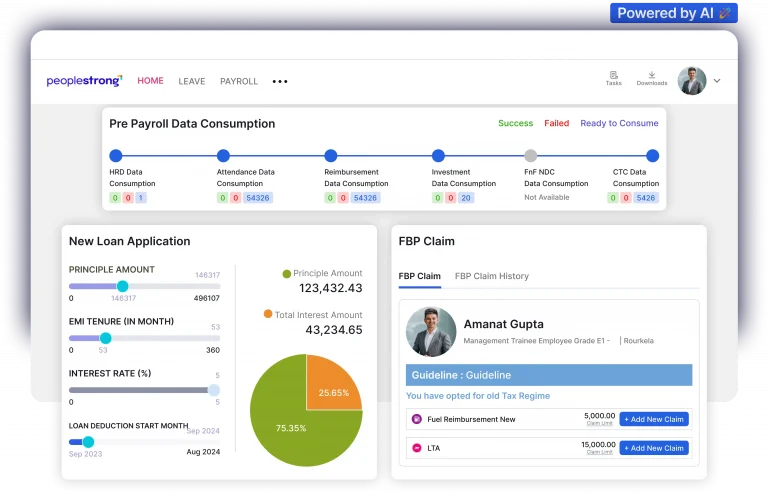
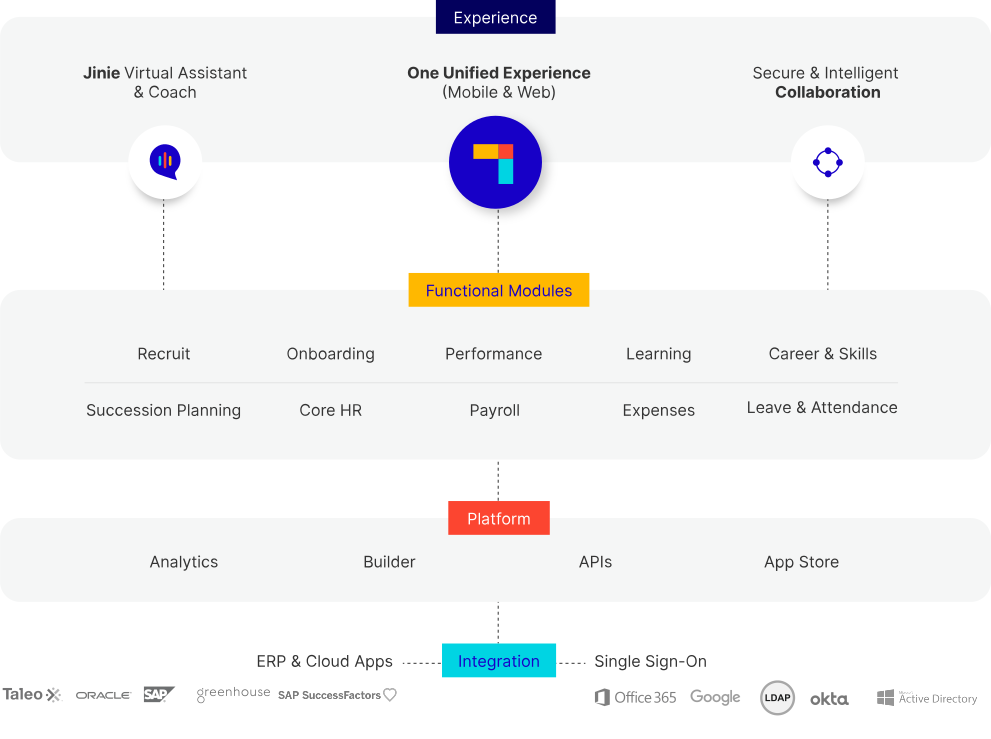
One platform under the service. Payroll, core HR, leave and attendance, compensation management and onboarding run on the same system, so employee changes reach payroll without a file transfer and a reconciliation. The interfaces that usually cause arrears and correction volume simply don’t exist in that configuration. Where you keep an existing system of record, the payroll engine integrates with it, though the single-platform option removes a category of risk that is otherwise permanent.
Statutory rules maintained in-region. Indian provident fund, employees’ state insurance, state-wise professional tax, labour welfare fund, gratuity and income tax under both regimes are configured and maintained as product capability, alongside UAE wage protection filing, end-of-service benefits and Saudi social insurance obligations. The service is built to support compliance with these requirements. When a rule changes, the update path is a defined product process, not a consulting request.
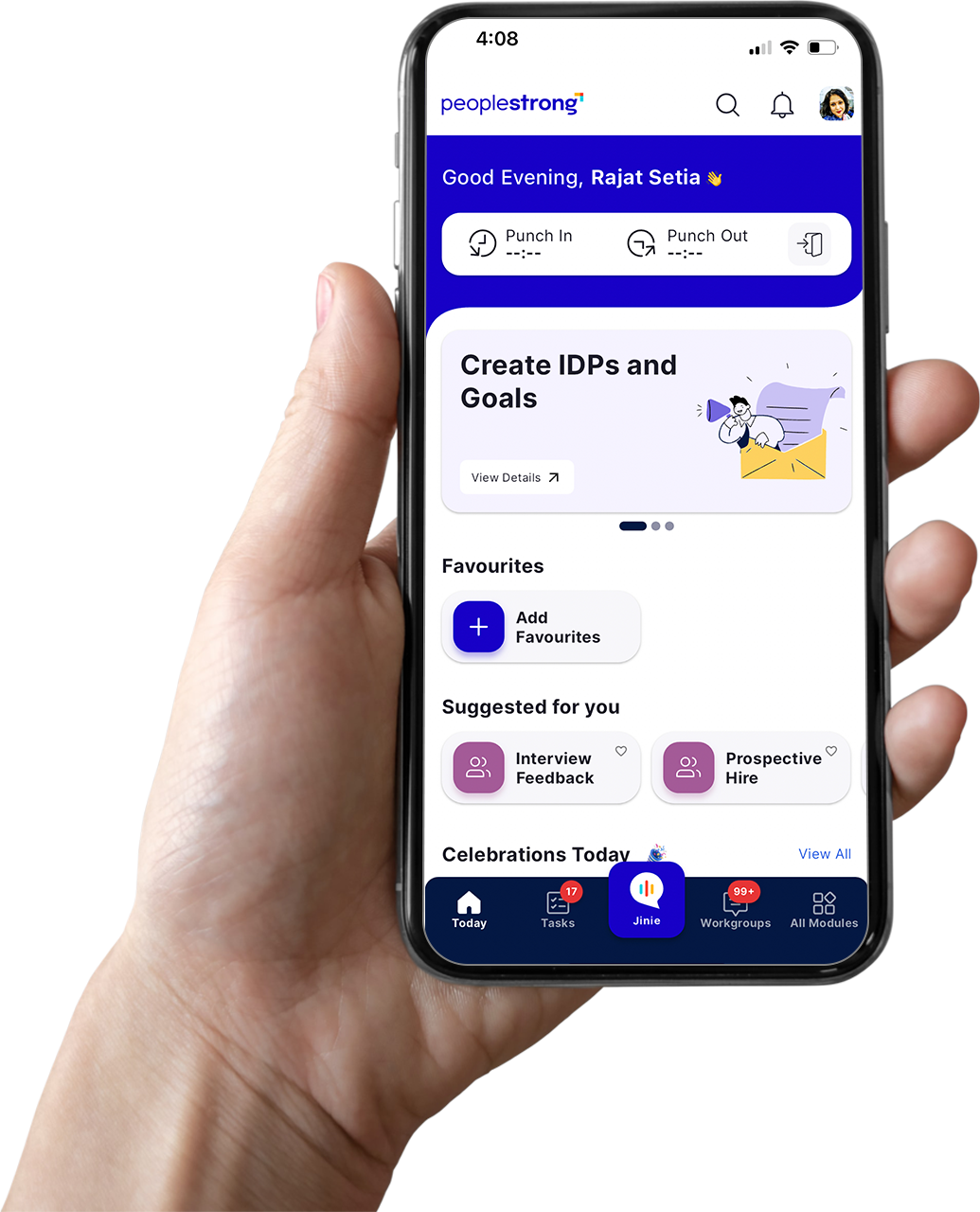
Employee queries handled before they reach payroll. Jinie, PeopleStrong’s embedded HR AI agent, resolves routine employee questions around the clock: payslip explanations, leave balances, tax declaration status and policy questions. Customers cite a reduction of around 60% in HR administrative load as a result. In a payroll context that matters, because query volume in the days after each pay date is what pulls a payroll team away from controls and analysis.
If you’ve outgrown mid-market HR tools and want enterprise depth across India and the Gulf on a defined implementation runway, this model sits in the middle of the market and is worth evaluating alongside the alternatives above.
What Can Go Wrong in a Payroll Transition, and How to Plan Around It
Balance matters here, including on the platform you are evaluating.
Opening balances migrate incorrectly. The most common serious failure. Mitigation: reconcile at value level, not headcount level, and have finance countersign year-to-date tax and statutory balances before cutover.
Undocumented local practice disappears. A rounding convention, an allowance treatment or a settlement rule that lived in one person’s head. Mitigation: run discovery workshops per country with the person who actually processes the run, not only with the country HR lead.
The retained team is too thin. Enterprises cut internal payroll capacity at go-live instead of after stabilisation. Mitigation: hold headcount through at least two full quarters of live running, including one statutory filing cycle and one year-end.
Employee communication lags the change. Payslip format changes, the self-service portal moves, and the helpdesk floods. Mitigation: publish a sample new payslip with a field-by-field explanation two weeks before the first live run.
Scope creeps into the parallel run. New requirements arrive mid-transition and the parallel window absorbs them. Mitigation: freeze scope at design sign-off and route additions to a post-stabilisation backlog.
Platform limitations surface late. On PeopleStrong specifically, reviewers on public software marketplaces note occasional slower page loading and session timeouts at peak, plus limits on deep customisation of certain workflows and report layouts compared with build-your-own tooling. The practical mitigation is to test your three heaviest reports and your busiest concurrent-use scenario during evaluation, and to confirm which report customisations are configurable versus which require a change request. Ask the same question of every provider on your shortlist and compare the answers side by side.
Moving From Evaluation to Transition
The decision in front of you is really a readiness decision. Are your operating model, your retained team and your data ready for someone else to run the process? And which provider has genuine statutory depth in the markets that carry your risk?
Settle the model first, cost the current state honestly, then run a shortlist against evidence: a statutory change log, a working demonstration of your hardest calculation, a named delivery team, and reference customers of your size in your countries.
If your footprint spans India, the UAE and Saudi Arabia, and you want payroll running on the same platform as core HR and attendance rather than beside it, PeopleStrong is worth a structured evaluation. Schedule a demo to walk through your pay structures, statutory scenarios and integration requirements with the team that would run them.
FAQs
How long does a multi-country payroll transition usually take?
For two to three countries at enterprise scale, plan on four to five months from discovery to the end of hypercare, assuming two to three parallel cycles per country. Complex pay structures, poor source data quality or a large number of legacy pay components extend the build phase most. Sequencing countries instead of running them in parallel usually shortens total elapsed time, because the second country reuses design decisions from the first.
Should we use one provider for every country or one per country?
One provider with genuine in-country depth is simpler to govern, gives you a single data model and one general ledger output, and removes the accountability gaps that appear at partner boundaries. Country-by-country vendors can make sense where a market’s requirements are unusual and your headcount there is small. The deciding question: can a single provider demonstrate live statutory capability in each of your material markets, rather than partner coverage described as capability?
What data do we need to prepare before the first parallel run?
Cleansed employee master data, a complete pay component inventory with tax and statutory treatment for each, year-to-date taxable income and tax deducted, statutory contribution balances, leave and gratuity accruals, and your general ledger mapping. Data cleansing should start before vendor selection concludes, because it is your work regardless of which provider you choose. Reconcile at value level rather than record count, and have finance sign off the balances.
Who is accountable if a statutory filing is late once payroll is outsourced?
Legal liability for statutory obligations stays with the employer, which is why no provider can offer a compliance guarantee. What the contract can do is allocate operational accountability and the cost of remediation, including penalties and interest, where the error originates with the provider. Define this clause precisely at negotiation, along with the boundary that applies when the underlying input from your side was incorrect or late.
What happens to payroll data access and confidentiality when payroll is outsourced?
You retain ownership of the data. The provider processes it under contract, with access controls, audit logging and data residency terms specified in the agreement. Confirm where data is stored, who inside the provider can view salary information, how access is reviewed, and what security certifications the provider holds. Confirm your own team’s access rights too, since your retained payroll and finance leads still need to interrogate the data for controls, close and audit.