

Maintaining professionalism and discipline in the workplace ensures a productive and respectful environment. However, when employees engage in misconduct, employers must act appropriately to correct the behavior. A warning letter to an employee for misconduct serves as a formal notice that outlines the issue, provides an opportunity for improvement, and warns of potential consequences if the behavior persists.
In this blog, we will cover everything HR professionals and managers need to know about issuing a disciplinary action warning letter to an employee for misconduct—when it’s necessary, how to structure it, and common mistakes to avoid.
A sample template is also provided to help you draft a precise and professional warning letter when addressing workplace misconduct.
When to Issue a Warning Letter for Misconduct?
A warning letter to an employee for misconduct should be issued when an employee’s behavior violates company policies, disrupts workplace harmony, or impacts productivity. However, not every minor issue requires a formal warning—progressive discipline helps employers address concerns before resorting to written warnings.
Types of Workplace Misconduct
Misconduct can take various forms, including:
- Insubordination: Refusing to follow instructions or showing blatant disrespect toward supervisors.
- Harassment: Bullying, discrimination, or inappropriate behavior towards colleagues.
- Policy Violations: Breaching workplace policies, such as data security, confidentiality, or ethical standards. To prevent accidental breaches and ensure compliance, many organizations now integrate data security posture management (DSPM) as a core component of their internal data handling policies.
- Repeated Absenteeism or Tardiness: Frequent unapproved absences or habitual lateness affecting workflow.
- Unprofessional Behavior: Disruptive conduct, aggression, or using offensive language in the workplace.
The Role of Progressive Discipline
Before issuing a disciplinary action warning letter to an employee for misconduct, companies often follow a progressive discipline process:
- Verbal Warning: An initial discussion addressing the issue informally.
- Written Warning: A formal document stating the misconduct and expected improvements.
- Final Warning: A last opportunity for the employee to correct their behavior before further disciplinary action.
- Termination: If misconduct persists despite repeated warnings, termination may be necessary.
Legal Considerations Before Issuing a Warning Letter
Employers must ensure that disciplinary actions align with labor laws and company policies. Before sending a warning letter:
- Verify that the employee’s misconduct is well-documented.
- Review company policies and employment contracts to confirm violations.
- Ensure the warning letter does not include discriminatory or unfair statements.
- Offer the employee a chance to explain their side before finalizing disciplinary action.
A well-documented and legally compliant warning letter to an employee for misconduct protects the company from potential disputes while promoting fairness in handling disciplinary matters.
Key Components of a Misconduct Warning Letter
A warning letter to an employee for misconduct should be clear, structured, and professional. It must outline the issue in detail while ensuring the employee understands the consequences of further violations. It may also be advisable to convert a PDF warning document to a more interactive format for clarity and sharing. Below are the essential elements of a well-drafted misconduct warning letter:
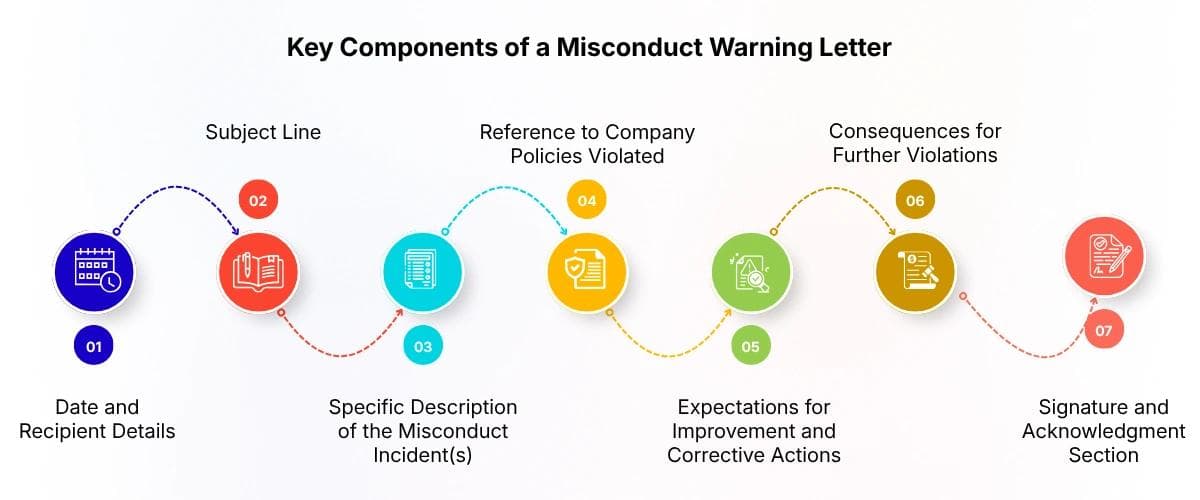
1. Date and Recipient Details
The letter should begin with the date of issuance and the employee’s full name, job title, and department. This ensures clarity on who the letter is directed to and when it was issued.
2. Subject Line
A concise subject line should indicate the purpose of the letter. For example:
Subject: Official Warning Letter for Misconduct
3. Specific Description of the Misconduct Incident(s)
The letter should provide a factual and detailed account of the misconduct. Include:
- The date, time, and location of the incident(s).
- A clear explanation of what happened.
- Witness statements (if applicable).
- Any previous verbal or written warnings related to the issue.
For instance, instead of writing: “Your behavior in the office has been inappropriate.”
Write: “On March 5, 2024, during the morning team meeting, you were observed raising your voice at a colleague and using inappropriate language. This behavior was unprofessional and disruptive to the workplace environment.”
4. Reference to Company Policies Violated
To ensure legal and procedural correctness, reference the specific company policies that the employee has violated. This helps establish a firm basis for the warning.
For example: “Your actions violate Section 4.2 of the Employee Conduct Policy, which strictly prohibits workplace harassment and unprofessional behavior.”
5. Expectations for Improvement and Corrective Actions
The letter should clearly state the expected behavioral or performance improvements. It may include:
- A timeframe for improvement.
- Any required training or corrective measures.
- A reminder of workplace expectations.
For example: “You are expected to maintain professional and respectful communication with colleagues at all times. Failure to adhere to this expectation may lead to further disciplinary action.”
6. Consequences for Further Violations
Clearly outline the potential consequences if the misconduct continues. This could include additional warnings, suspension, or termination.
For example: “If similar misconduct occurs again, further disciplinary action, including possible termination, may be taken.”
7. Signature and Acknowledgment Section
The letter should end with a formal closing, including:
- The employer or HR representative’s name, title, and signature.
- A section for the employee to sign and acknowledge receipt of the letter.
For example: “I, [Employee Name], acknowledge receipt of this warning letter and understand the above concerns.”
A well-structured disciplinary action warning letter to an employee for misconduct ensures clarity, professionalism, and legal compliance. It serves as both a corrective measure and a formal incident record.
How to Write a Disciplinary Action Warning Letter to an Employee for Misconduct?
Drafting a warning letter to an employee for misconduct requires a professional, objective, and legally sound approach. The letter should provide clear details about the incident while maintaining a neutral and constructive tone. Follow these steps to ensure fairness and compliance with company policies.
1. Use a Clear and Professional Format
- Include the company’s letterhead (if applicable).
- Use a formal font and structure to maintain professionalism.
- Ensure the letter is addressed to the employee correctly with full name, job title, and department.
2. Start with a Clear Subject Line
The subject should make it clear that this is an official disciplinary action. For example: “Formal Warning Letter for Misconduct”
3. State the Purpose of the Letter
Begin with a direct statement explaining that the letter serves as an official warning regarding the employee’s misconduct.
For example: “This letter serves as a formal warning regarding your recent actions that violated company policies.”
4. Describe the Misconduct with Specific Details
Provide a factual account of the incident, including:
- The date, time, and location of the misconduct.
- A clear explanation of what occurred.
- Any prior warnings or discussions related to the behavior.
Avoid vague or emotional language—stick to objective facts.
5. Reference the Company Policies Violated
Cite the specific company policy, employee handbook rule, or workplace code of conduct that was breached. This ensures that the disciplinary action is backed by documented regulations.
6. Outline Expected Improvements and Corrective Actions
- Specify what the employee needs to do to correct their behavior.
- Provide a timeline for improvement if necessary.
- Mention any support, such as training or counseling, that the company will offer.
7. Warn About Consequences for Further Violations
Clearly state what will happen if the employee does not improve or commits further misconduct.
For example: “Any future incidents of similar misconduct may result in further disciplinary action, up to and including termination.”
8. Include an Acknowledgment Section
The employee should sign and acknowledge that they have received and understood the letter.
For example: “I, [Employee Name], acknowledge receipt of this warning letter and understand the concerns outlined above.”
9. Sign the Letter
The letter should be signed by the HR manager or relevant authority. If necessary, include space for a witness or a union representative’s signature.
10. Ensuring Fairness and Compliance with Company Policies
- Review the letter carefully before issuing it.
- Ensure that the employee had prior verbal warnings (if applicable) before the written warning.
- Confirm that the disciplinary action aligns with company policies and labor laws.
Common Mistakes to Avoid When Drafting a Warning Letter
- Being Too Vague: Failing to specify the exact misconduct or company policy violated.
- Using Emotional or Subjective Language: The letter should remain professional and fact-based.
- Skipping Legal and Policy References: Always mention relevant workplace policies to justify the warning.
- Not Providing a Clear Path for Improvement: Employees should understand what they need to do to correct their behavior.
- Lack of Documentation: Every warning letter should be properly recorded for future reference.
A well-drafted disciplinary action warning letter to an employee for misconduct ensures that expectations are clear while protecting the company’s legal interests.
Sample Warning Letter to Employee for Misconduct
A well-structured warning letter to an employee for misconduct should clearly communicate the issue, reference company policies, and outline expectations for improvement. Below is a sample template covering all key elements.
Subject: Formal Warning Letter for Misconduct |
Below are a few concise warning letter templates for different types of misconduct. Each letter keeps the message clear and professional while addressing specific workplace violations.
1. Warning Letter for Insubordination
Subject: Formal Warning for Insubordination |
2. Warning Letter for Workplace Harassment
Subject: Disciplinary Warning for Workplace Harassment |
3. Warning Letter for Violation of Company Policy
Subject: Official Warning for Policy Violation |
4. Final Warning Letter for Repeated Misconduct
Subject: Final Warning Notice for Repeated Misconduct |
5. Warning Letter for Unprofessional Behavior
Subject: Official Warning for Unprofessional Conduct |
Each disciplinary action warning letter to an employee for misconduct should be tailored to the specific situation while maintaining professionalism. The goal is to document the issue clearly and provide the employee with an opportunity to improve before further action is taken.
Customization Tips Based on the Severity of Misconduct
The template above provides a structured framework, but modifications may be needed based on the severity of the misconduct.
- For minor offenses (e.g., occasional tardiness or unprofessional behavior), the tone can be softer, emphasizing guidance and correction rather than immediate disciplinary measures.
- For serious misconduct (e.g., harassment, repeated violations, or policy breaches), the language should be firm, clearly stating the consequences if the behavior continues.
- For final warnings, the letter should include a direct statement that any further violations will result in immediate termination.
A disciplinary action warning letter to an employee for misconduct should always be clear, fair, and legally sound. It serves as a formal record of the issue and gives the employee a chance to correct their behavior before harsher actions are taken.
Conclusion
A well-structured warning letter to an employee for misconduct helps maintain workplace discipline while giving employees a chance to correct their behavior. It serves as a formal record, ensuring clarity, fairness, and legal compliance.
The goal isn’t immediate termination but to reinforce company policies and encourage professionalism. HR professionals should ensure consistency in handling misconduct, document each step, and provide clear expectations. A fair and transparent approach fosters accountability while maintaining a positive work environment.
Frequently Asked Questions
Can an employee refuse to sign a warning letter?
Yes, an employee can refuse to sign a warning letter since signing normally implies receipt rather than agreement with what is written in it. However, HR must note down the refusal, together with the witness who will confirm in writing that the letter was received. Enterprise solutions like PeopleStrong simplify this process, managing all deliveries and noting down the time stamps of each communication from employees.
What is the purpose of a warning letter to an employee?
Warning letters are an official means to notify an employee about any issue that might have arisen in terms of their behaviour or performance within the organisation. These letters set the standards of professionalism within the organisation, create boundaries, and ensure that the organisation has a formal record.
Can a warning letter lead to termination?
Yes, the warning letter may result in termination of employment in case an employee fails to meet the expectations of the company. Most companies follow a progressive disciplinary procedure which includes verbal warnings, written warnings and termination of employment, if needed. But by handling the process through an integrated HR system like PeopleStrong, the termination of employment can be ensured on the basis of the documented facts.
What should be included in a warning letter format for an employee?
The employee’s name, designation, department, ID, and the date. Then the specific issue, with facts and the policy clause it relates to, followed by an improvement plan with a review date, the consequences if nothing changes, and space for both signatures.
How do you write a disciplinary action letter for misconduct?
To write a disciplinary action letter for misconduct, state the employee’s details, the purpose of the document, and specific allegations. Outline the evidence gathered, prior warnings, and the exact penalty imposed. Clearly explain required behavioural changes, improvement timelines, and the formal appeal procedure. Ensure the tone remains professional, objective, and fully compliant with internal company policies and local labour laws.
What are 5 examples of serious misconduct?
Serious misconduct includes severe actions that undermine trust or workplace safety. Five common examples are theft or fraud involving company assets, physical violence or harassment towards colleagues, intentional breach of confidentiality, deliberate safety breaches that jeopardise health, and gross insubordination or refusal to follow lawful management directives. These infractions fundamentally destroy the employment relationship and often justify immediate formal disciplinary action or summary dismissal.
What is the difference between minor misconduct and gross misconduct?
Minor misconduct involves smaller policy breaches, such as occasional tardiness, minor dress code infractions, or casual absenteeism, that are typically handled through informal coaching or written warnings. Gross misconduct refers to severe actions, such as theft, violence, or extreme harassment, that instantly destroy the employment relationship. Whilst minor misconduct gives employees an opportunity for improvement, gross misconduct warrants immediate formal investigation and potential summary dismissal without notice.
Related Templates
- 7 Sample Warning Letter to Employee for Unprofessional Behavior
- 5 Sample Employee Warning Letter for Absenteeism Templates
- 6 Sample Warning Letter to Employee for Late Coming
- 6 Sample Employee Termination Letter Templates for Different Scenarios