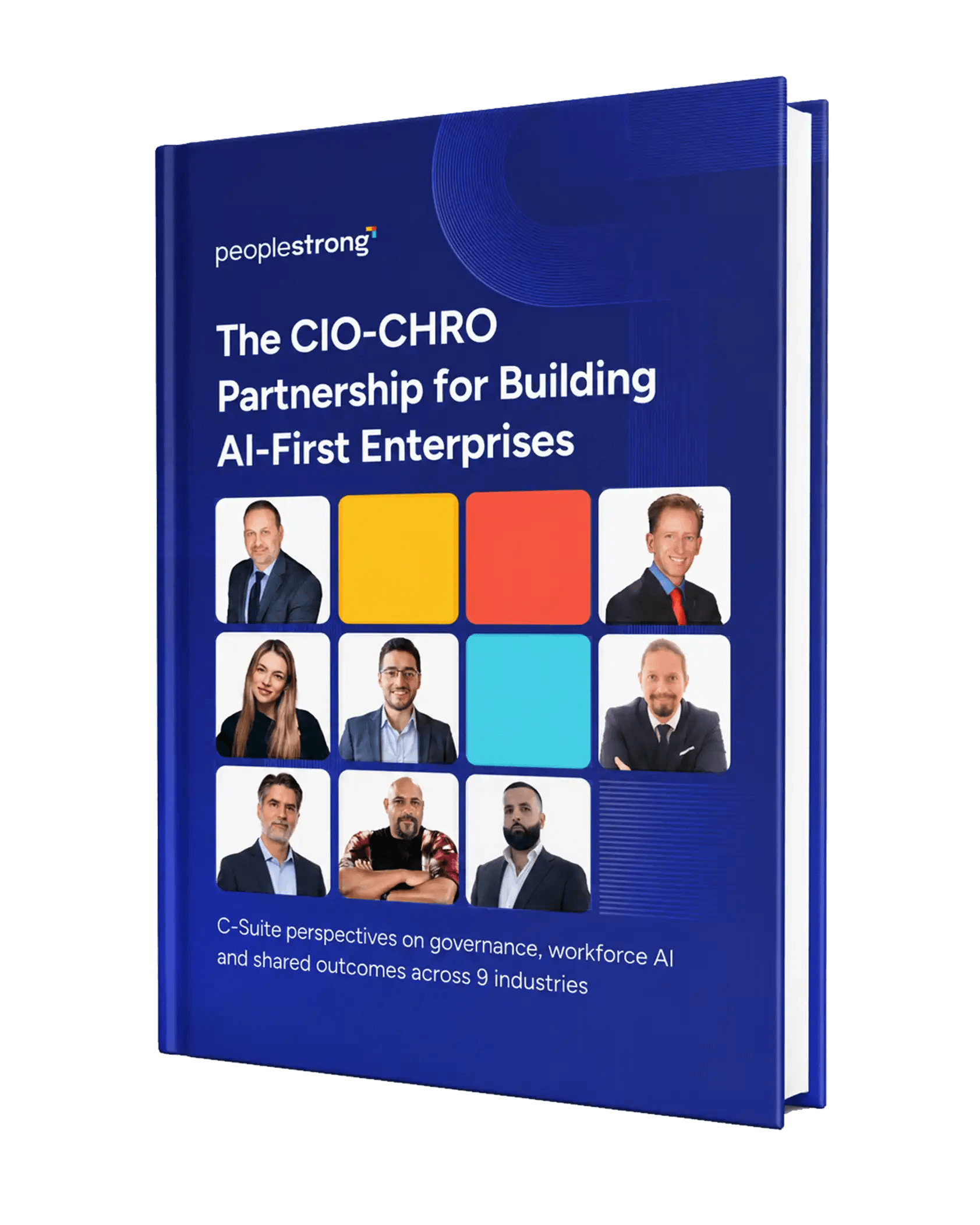
Where CIO and CHRO responsibilities overlap
The enterprises furthest along on AI have stopped treating adoption as an IT rollout with an HR footnote. This whitepaper maps where CIO and CHRO decisions, budgets, and outcomes now comes together.
Shared governance
In markets where a single enterprise sits across a mainland entity, a free zone, and one or two subsidiaries, vendor and data-access decisions can't wait for two separate sign-offs. A joint CIO-CHRO committee owns them as one decision.
Joint metrics
A CIO tracking uptime and a CHRO tracking retention can both hit target while the actual rollout stalls. Anchoring both functions to adoption rate and time-to-competence closes that gap before it shows up in a board deck.
Unified data strategy
Employee data that needs to satisfy the UAE's PDPL in one entity and Saudi Arabia's PDPL in another is not a systems problem or a policy problem in isolation. It's a joint standard CIO and CHRO now have to write together.
What happens when CIO and CHRO actually align
From conversational AI to insurance to F&B nine leaders describe where the partnership holds, and where it quietly comes apart.
A bad hire was a real financial loss at Insurance Navy. So, we went so far as to stop thinking of recruiting technology as a CIO issue and retention as a CHRO issue. We made a collective outcome, a collective number.

CIO and CHRO should jointly manage results like retention and digital literacy. When both are responsible for engagement and training metrics, the CIO can ensure the tech stack reduces daily friction, and the CHRO can ensure adoption stays human-centered.


I depend on our CIO to vet AI tools and vendors. But where I need more from that partnership is the translation layer, turning what a tool can do into what it does for our people on the ground.

It was not the technology that was the issue; it was the sequencing. I would want to pull HR into vendor selection six months early. CIOs treat people issues as system issues. They look for the bug, install the fix, and move on. But people do not update like software.


The CIO can help connect the systems, but the CHRO helps define what the data is supposed to represent in the first place… Most successful workforce AI initiatives are the ones where both functions agree on the language, metrics, and outcomes before the AI enters the conversation.


Governance and bias discussions cannot be owned exclusively by IT. As AI increasingly influences workforce decisions, governance requires shared accountability between technology, HR, legal, compliance, and business leadership.


The common misconception is that deploying an AI agent is a one-and-done setup… We treat our AI assistants exactly like human employees. They are built into our formal workforce governance structure.


Our biggest challenge is data fragmentation. Information often lives in separate systems and was never designed to work together. We need a unified view that requires consistent definitions, data quality standards, and governance across multiple platforms.


Coordinating an AI rollout across more than one GCC entity?
See how nine industry leaders are getting CIO and CHRO to own the same scorecard.
Before you download
Our AI rollout spans entities registered in different GCC jurisdictions. Does the CIO-CHRO model still apply?
Yes, the model becomes more necessary, not less. Different entities may answer to different data protection regimes, but the governance committee, the shared metrics, and the co-owned data standard sit above that structure, not inside it.
Our CHRO isn't from a technical background. Can they still co-own AI governance?
The CHRO's role in this partnership is not to evaluate model architecture. It's to own the adoption side: whether teams use the tool, whether training closes the skills gap, and whether the metrics reflect real behaviour change, not just deployment.
We already have a CIO-led AI strategy across our GCC operations. Why change the structure now?
A CIO-led strategy can hit every technical milestone, on-time deployment, uptime targets met, and still miss the business outcome boards actually ask about, because adoption, retention, and productivity sit downstream of decisions only the CHRO can influence.